
(You must register and have a linked account first)
View Privacy Policy


OR

Show


Forgot your password?

Error message here!

Error message here!

Error message here!

Error message here!

Show Error message here!

Show Error message here!


Lost your password? Please enter your email address. You will receive a link to create a new password.

Error message here!

Back to log-in

Close

For Sale

The following items are listed by for sale by users of the site and dealers. They are in no way endorsed or guaranteed by www.oldswords.com

Add a Classified Item
to

Clicking on the sword will take you through to the relevant classified item or dealer site.
Don't miss out! - Do you want to be kept informed weekly of new aditions? Just join our weekly update list.

You can also receive regular email notifcations when items match your keywords. To recieve them just register or logon at the top right of this page.
Page 20 of 41
  • Nation : Russian
  • Local Price : £645
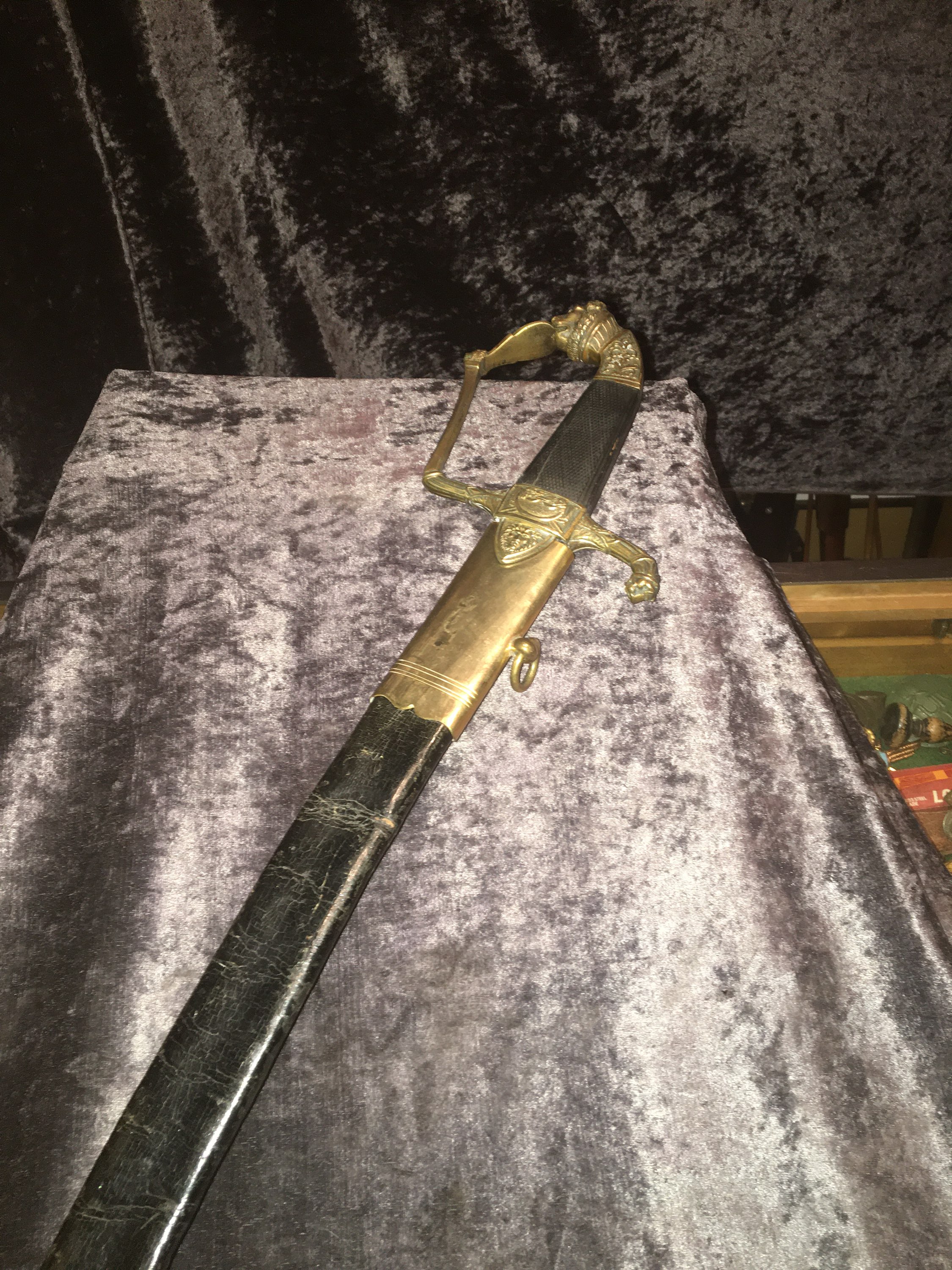
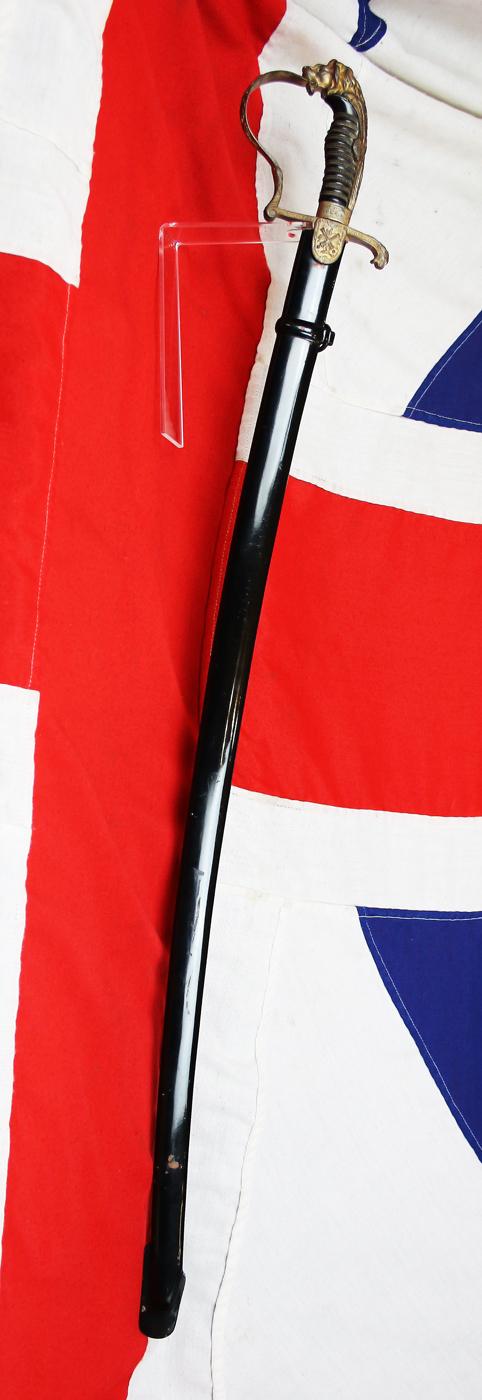
Click and use the code >26179 to search for this item on the dealer website Good Imperial German Artillery Officer´s Sabre With Deluxe Lion Head Pommel Hilt, Lioness Quillon End and Embossed Oak Leaf & Acorn Pattern Design Throughout With Crossed Cannon Quillon.
  • Nation : British
  • Local Price : £645.00
WW1 Era British WD 1897 Pattern Henry Wilkinson London Infantry Officer’s Sword With King George V Guard, Blade Number 45075, Leather Officer’s Cord & Acorn Knot Leather Covered Field Service Scabbard & Sam Browne Leather Frog. Sn 23174:28 -. This is an original British 1897 pattern Infantry Officer’s sword with Cord Acorn Knot scabbard and frog. These swords were a great improvement on previous patterns with better protection to the hand through its ¾ basket hilt (see page 179 of World Swords by Withers & pages 165-167 of Swords of the British Army by Robson). The sword has a 32 ½” long blade with partial fullers and measures 39” overall. The blade has small areas of staining consistent with age and use. The ricasso has the makers name in etched and blued panel ‘Henry Wilkinson Pall Mall London’ with heraldic Arms and Warranted banner. The reverse has the correct ordnance acceptance proof star and inlaid brass proof roundel & original leather hilt washer. The spine of the blade is numbered 45075. It has the full 1897 Pattern knuckle guard with Crown GR V device. It has a curved stepped pommel with ball top and knurled back strap for grip, fish skin covered grip with wire binding in excellent condition. The hilt is fitted with Leather Officer’s Cord & Acorn Knot. It is complete with leather covered wood field service scabbard. The scabbard has a German silver throat mount & is fitted with Sam Browne Pattern leather frog that has 2 belt loops and buckles. All leather & stitching are clean and intact. The price for this nice complete WW1 era sword set includes UK delivery. Sn 23174:28
  • Nation : British
  • Local Price : £645.00
**ATTRIBUTED**WW1 British George V Royal Engineers Officer’s 1897 Pattern with Etched Blade Inscribed ‘HCW N Coy CLPR Aug 1914 To June 1917’ Blade No. 02551 Field Service Scabbard & Frog. Sn 19845. -. This is an excellent WW1 dated 1897 pattern Infantry Officer’s sword with etched blade. It has a clean 32 ½” long blade with partial fullers. The blade is etched on both sides. Both sides have decorative foliate panels. One side has Kings crown Royal Cypher ‘GR V’ (George V Rex), Kings crown & heraldic arms. The reverse has blued and etched panel ‘HCW N Coy CLPR Aug 1914 To June 1917’ and has the ordnance acceptance star with roundel. The spine of the blade is numbered ’02551’. It has a full 1897 Pattern knuckle guard with King George V Crown & Royal Cypher. It has a curved stepped pommel with ball end and knurled back strap for grip, fish skin grip with wire binding in superb condition. There are no visible maker marks on the sword. It is complete with leather covered wood field service scabbard with German silver throat mount. The scabbard is fitted with leather frog that has 2 belt loops and brass buckles. All leather and stitching are clean and intact. The price for this sword worthy of further research includes UK delivery. Sn 19845.
  • Nation : British
  • Local Price : £645.00
Victorian, British Ordnance C. Smith & Son London Pattern 1827 Officer’s Presentation Sword With Etched Blade ‘F.S.F.S From G. Cadets Of B. Co R.M.C.S (Royal Military College Sandhurst) Christmas 1869’ & Scabbard. ED 2552 -. Originally raised as the King’s Royal Rifle Corps in 1755, the Rifle Brigade was officially formed in 1800. The Regiment was always renowned for its individuality both in uniform & tactics and its no wonder that they eventually gained their own distinctive pattern of sword. The 1827 pattern is defined by an all steel hilt coupled with the usual Royal Cypher with strung bugle in the hilt cartouche (see page 174 of World Swords by Withers). This is an original British 1827 Pattern Sword with etched presentation inscription & Scabbard. The sword has a has a 32 ½” blade (38 ½” overall) with partial fuller. The blade has staining consistent with age & etched on both sides with decorative foliate panels and banners. Both sides have ’Crown VR’ Royal Cypher (Victoria Regina). The ricasso has the ordnance acceptance star. The blade is also signed by the manufacturer C. Smith & Son 5 New Burlington St London’ & Royal Appointment. One side is inscribed with presentation detail ‘F.S.F.S From G. Cadets Of B. Co R.M.C.S Xmas 1869’ (The Royal Military College (RMC) was a British military academy for training infantry and cavalry officers of the British and Indian Armies. It was founded in 1801 at Great Marlow and High Wycombe in Buckinghamshire, but moved in October 1812 to Sandhurst, Berkshire). It has a voided full knuckle guard with the Rifle Brigade / Militia ’Queen’s Crown Above Slung Horn’ badge. It has a curved stepped pommel with ball end, fish skin grip with wire binding in excellent condition. It is complete with steel scabbard with 2 hanging rings and shoe. The scabbard has even patina consistent with age and service wear. The price for this sword worthy of further research regarding the presentation inscription includes UK delivery. ED 2552
  • Nation : British
  • Local Price : $1200.00 CAD
ENGLISH FLINTLOCK HOLSTER PISTO. ENGLISH FLINTLOCK HOLSTER PISTOL: Approximately .62 Cal. Circa 1770. The 9 inch barrel is engraved “N… SON LONDON”. It seems quite crudely done, however, it does have clear British Proof marks with the initials “_ W”. The lock has quite a unique waterproof pan. Again, the cartouche on the lock, which would have had the maker’s name, is not visible. The brass furniture is very nice and quite unique in its style. The walnut stock is also unique in that it was never made to carry a ramrod. It is quite likely it was made for the Eastern market. The stock has a very nicely chequered panel on the back of the grip. This is a very unique and unusual flintlock. $1200.00
  • Nation : American
  • Local Price : $1200.00 CAD
P. 1859 NAVAL CUTLASS 2ND TYPE. P. 1859 NAVAL CUTLASS 2ND TYPE: Maker: A & E HOLLER of Solingen. Holler made 13,000 cutlass bayonets many of which were exported to the U.S. for the Civil War. The grips are EXC+, the blade is bright and also EXC+. The scabbard is VG (BCB-B165 & 167) Also European Bayonets of the American Civil War Pg. 73-75. EXC. $1200.00
  • Nation : -
  • Local Price : 8,000 kr
Engelsk interimsvärja för tunga kavalleriet m/1796.
  • Nation : -
  • Local Price : 8,000 kr
Empire saber ca:1800-1810.
  • Nation : ?
  • Local Price : 875.00 USD
FINE EUROPEAN PLUG BAYONET, 19TH CENTURY. German for the Spanish market, first half of the 19th century. 7” d.e. blade with grooved edge ricasso, etched in foliage throughout. The forte with an inscription perhaps RATHBONE.  See Armas Blancas en Espana, color plate 16 for an identical example identified as German monteria knife made in Solingen by A & E Holler. That maker is recorded 1839-69 and almost certainly made this knife during that period. Plug bayonets were popular in Spain for hunting, where a musket could be quickly be converted into a spear for self defense, particularly against boar and bear
  • Nation : American
  • Local Price : 875.00 USD
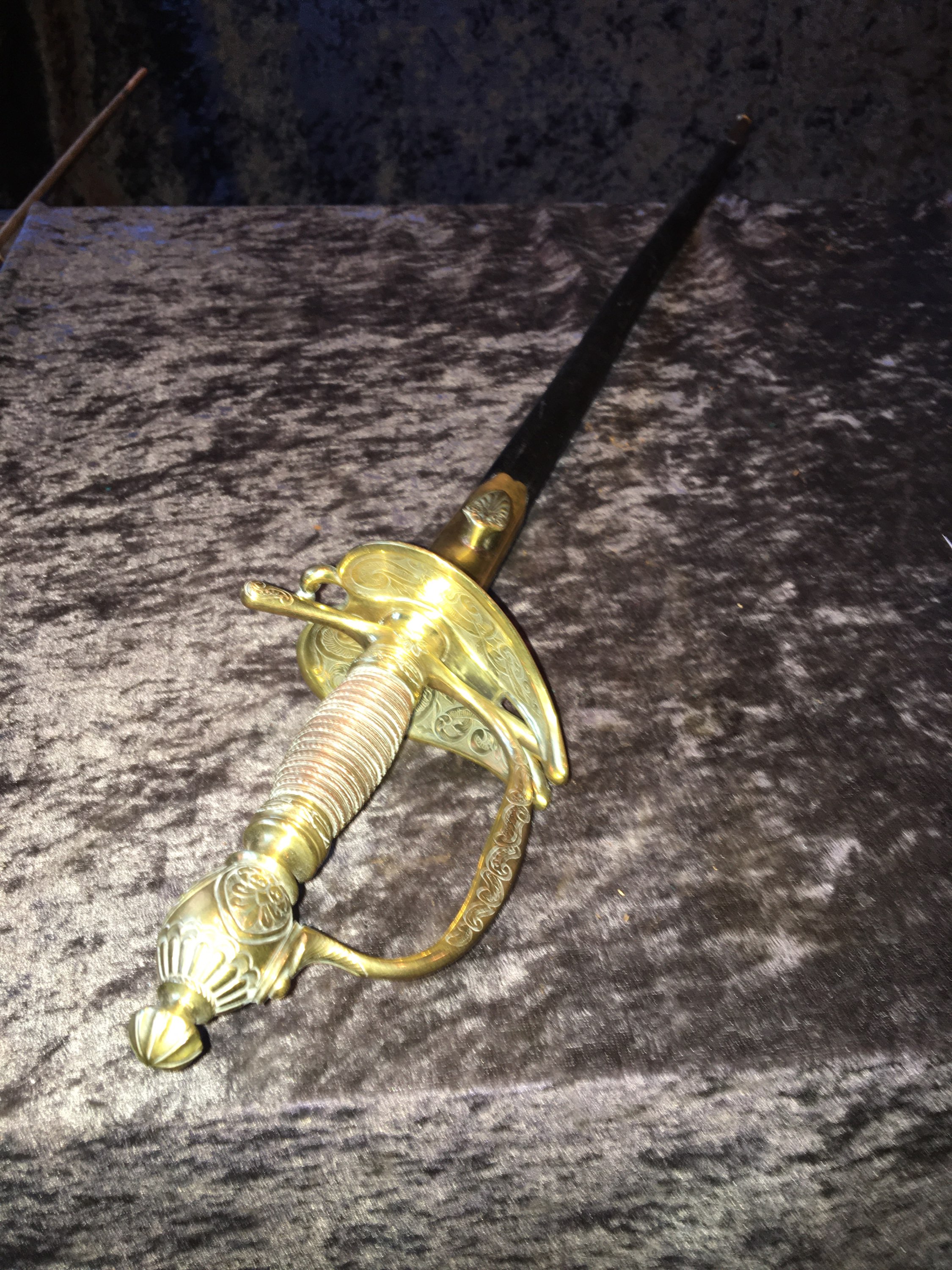
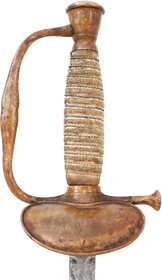
CONFEDERATE NCO SWORD, FROM THE FAMOUS FRANK BARNYAK COLLECTION. Possibly a German import but almost certainly Southern made. Styled as the US M.1840 musicians sword (Peterson #44) which is specified with a 28” blade, this example has a 28 3/8” straight broad fullered blade which is unmarked. The brass or bronze hilt is made in three pieces as opposed to two for the regulation pattern. The pommel base has a flamboyant baluster form compared to the ferrule and neck of the regulation swords. Additionally, the pommel and grip are of a significantly different alloy from the guard, which is substantially similar to the US regulation. The pommel and grip are of copper-rich reddish bronze, not seen on US contract swords. Their very noticeable dissimilarity from the guard virtually precludes manufacture in Germany, leaving Confederate production as the logical conclusion. Frank Barnyak was a professional gun show promoter which gave him unparalleled access to the market. He was known for his ability to ferret out rarities such as this.
  • Nation : Italian
  • Local Price : 875.00 USD
ITALIAN PLUG BAYONET C.1700. Good quality example which was most likely was carried as a sidearm in the form of a bayonet to circumvent local restrictions. 13 3/8” overall. The blade finely formed in the Italian taste with a central fuller and back fuller which transitions to a false edge past the midpoint. Delicate scallops flanking the bolster. Brass base ferrule and one-piece horn grip with silver or white metal cap. The ferrule below worn and incomplete.
  • Nation : American
  • Local Price : 875.00 USD
SECONDARY CONFEDERATE OFFICER’S SWORD. Rare example produced in Germany and supplied to Confederate forces through the blockades. Based on the US 1850 pattern staff and field officer's sword, made without the patriotic iconography. The brass hilt with raised edge shell guard and truncated conical pommel. Wire wrapped ray skin grip. 29 ½” double edged blade, unmarked, as the makers, who were also supplying the North, concealed their identities against retaliation.  The scabbard has a plain tip mount but the ring mounts are as used on the US production. Excellent for the period and use.
  • Nation : -
  • Local Price : 7,950 kr
Sv artilleriofficers sabel ca:1850-60.
  • Nation : British
  • Local Price : £625.00
Unusual 1796 Heavy Cavalry Dress Sword. This unusual sword combines a Scottish broad sword blade with a British 1796 Heavy Cavalry dress sword handle. The brass handle and copper wire are solid with no movement and the blade is in good condition with an overall patinaThe dress sword for the Heavy Calvary was introduced following army reforms in 1786 with full regulations brought in 1796. Normally the sword consists of a boat-shell guard and long double sided blade. These regulations were not strictly enforced, and it is not uncommon to find early swords with non regulation blades as long as the guard and scabbard conformedPossibly this was a family sword, or for a Scottish officer who preferred the shorter, heavier blade over the longer and more delicate regulation
  • Nation : Russian
  • Local Price : £620
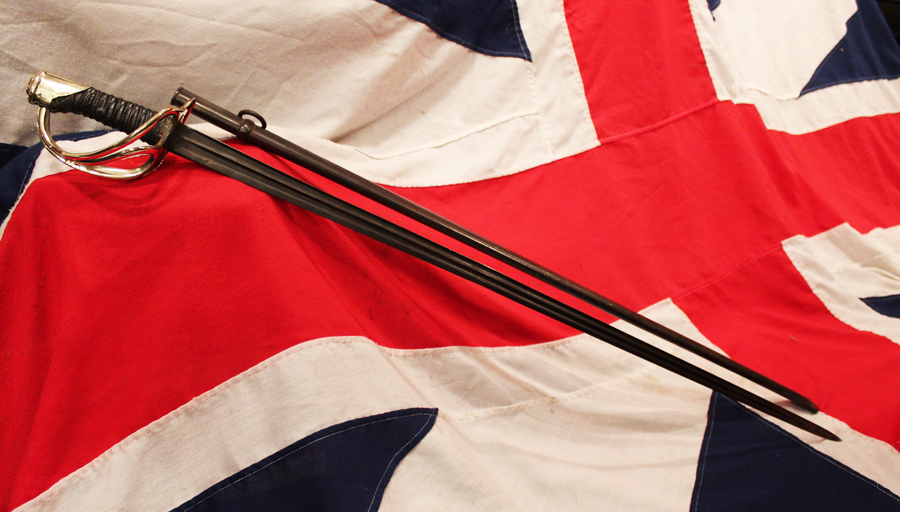
Click and use the code >20222 to search for this item on the dealer website Simply Superb & Most Impressive Antique, Original French, Mid to Late 19th Century, Elite Cuirassiers, Heavy Cavalry Combat Sword
  • Nation : British
  • Local Price : £620.00
Canadian 1890 Pattern Cavalry Trooper&#acute;s Sword, Princess Louise Dragoon Guards. Description Curved, single fullered blade, ambidextrous basket hilt with pierced Maltese Cross symbol and turned-over edges, black pressed leather grips secured by five steel rivets, brown leather washer. Steel scabbard with fixed opposed hanging rings. Overall length 39 inches (99.2cm) blade length 33½ inches (85.1cm). Traces of orange-brown paint to the lip of the guard on one side. The spine of the blade is stamped with &#acute;/90&#acute;, indicating that it is an 1890 Pattern, and a crown inspection mark for Enfield. The flat of the blade is stamped at the forte on one side with a broad arrow and &#acute;EFD&#acute;, indicating War Department property made at Enfield, with another Enfield inspection mark. On the other side it is stamped with an issue mark for 1899, and two broad arrows point-to-point, a mark that was put on War Department equipment that was declared obsolete or to be sold off. The inside of the guard is stamped with &#acute;PLDG&#acute;, indicating the Princess Louise Dragoon Guards, and the sword number &#acute;51&#acute;. The scabbard is stamped at the face side of the throat with two broad arrows point-to-point, below what appears to be &#acute;PLDG&#acute; again “ the &#acute;L&#acute; and &#acute;D&#acute; are most clearly visible with the other letters less visible due to shallower stamping and surface wear. The trailing side of the throat piece is stamped with the date &#acute;96, a further crown inspection mark for Enfield and what look like the Roman numerals &#acute;II.&#acute;. The flat spine of the scabbard body is similarly stamped with a broad arrow and &#acute;WD&#acute;, indicating War Department property, another crown inspection mark for Enfield, the same &#acute;II.&#acute; mark and the date &#acute;96. The PLDG originated in 1872 as the independent cavalry troop of the Canadian capital city of Ottawa. It gained the patronage of Princess Louise Caroline Alberta, the fourth daughter of Queen Victoria, during her time residing in the city. Louise&#acute;s husband John Campbell, the Marquess of Lorne, was appointed Governor General of Canada from 1878 to 1883, and she accompanied him as the viceregal consort. Her stay in Canada caused both excitement and uncertainty, Canadians not being accustomed to having royalty reside there, but left an enduring legacy: Lake Louise, Mount Alberta and the province of Alberta as a whole are named after her. The Ottawa Troop of Cavalry therefore took on the much grander name of the Princess Louise Dragoon Guards from 1879, and was expanded to a full squadron. Being a militia regiment, it could not directly serve overseas, but volunteers from the PLDG served within the Imperial Yeomanry during the Boer War, earning the battle honour &#acute;South Africa, 1900&#acute;. The 1899 issue date on the blade of this sword raises the possibility that it may have issued for this deployment. While the brand new 1899 Pattern was in service by the time of the Boer War the PLDG, like many Canadian regiments, never received it and would have continued to carry the 1890 Pattern throughout. The squadron was expanded again in 1903 to a full regiment and renamed the 5th &156;Princess Louise Dragoon Guards&157;. This regiment was once again not mobilised in its own right for the First World War, but contributed men to the 8th Regiment, Canadian Mounted Rifles. The PLDG was still using their 1890 Pattern swords and carried them across the Atlantic, but on arrival in England they were exchanged for the up-to-date 1908 Pattern. The 8th Regiment was broken up after its arrival, the majority of its cavalrymen sent to France to reinforce the 4th Battalion, Canadian Mounted Rifles. Fighting as infantry, enough of the former members of the 8th participated in the Battle of Mount Sorrel in 1916 to qualify for a battle honour, which ultimately passed to the PLDG after the formal disbandment of the 8th Regiment post-war. In 1936 the 5th PLDG was merged with the 4th Hussars of Canada to form the 4th Princess Louise Dragoon Guards, which served as armoured car reconnaissance units within the Royal Canadian Armoured Corps during the Second World War, earning sixteen battle honours. The regiment became infantry in 1944 but retained some cavalry traditions, including having &#acute;squadrons&#acute; and &#acute;troops&#acute; of men rather than &#acute;companies&#acute; and &#acute;platoons&#acute;. It was disbanded in 1965, and moved to the Supplementary Order of Battle as an inactive unit. The blade has some scattered light pitting. It has been shortened by roughly 1 inch and repointed “ this was probably done during service to repair a damaged tip. Some damage to the leather grips, including chipping at the edges and an abrasion on one side. Light handling wear to the chequering. The hilt and scabbard have some patination and pitting, some small dents to the scabbard towards the chape end. The leather washer fits a little loosely and may be a replacement.
  • Nation : French
  • Local Price : 7,800 kr
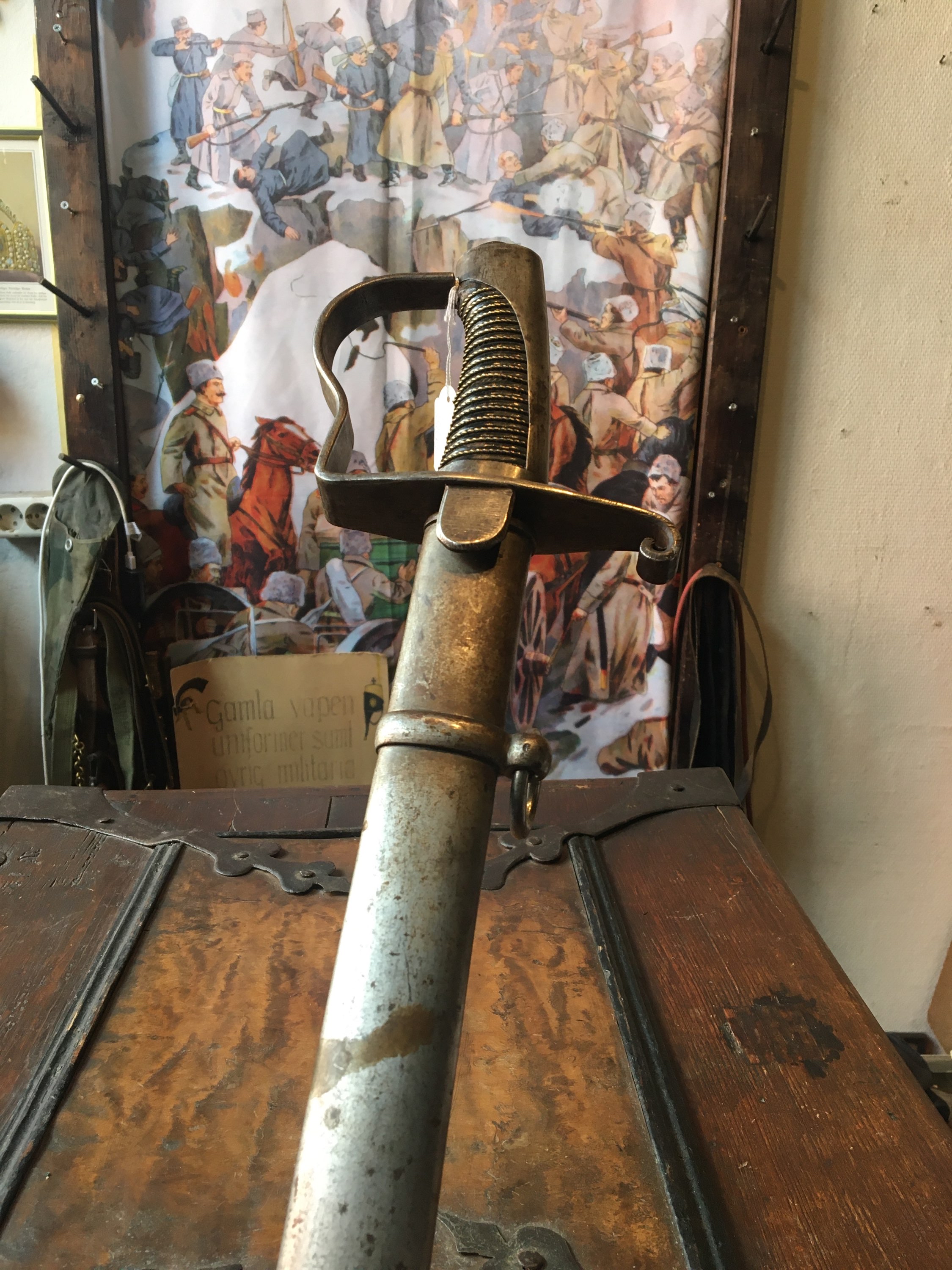
Large cavalry saber dated 1820 possibly French.
  • Nation : American
  • Local Price : 850.00 USD
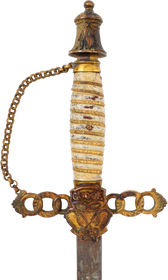
RARE AFRO-AMERICAN SECRET SOCIETY SWORD. Post Civil War, dating about mid 1880's. Gilt brass hilt finely detailed with pierced cross guard and quillon block with GUOOF inscription. Crusades tent form pommel with a crusader to the front. Gilt tape wrapped white ray skin grip.  31 ¾” heavy double edged blade as indicative of early examples. The ricasso marked M C LILLEY & CO COLUMBUS OHIO.  That form used 1882-1925. The blade finely etched on gilt ground with the owner's name, foliage and crusaders scene. The gold faded with remnants of original blue as well. Gilt scabbard with finely modeled crusades and biblical motif mounts. The body hand engraved with the all-seeing eye (the Eye of Providence), serpent and cross and a halberd. The surface is fire gilt, clearly evidenced by remnant brush work. That technique was made obsolete about 1840 with the advent of electroplating and is seldom seen after that date. The GUOOF was the Grand United Order of Odd Fellows, a branch founded in 1843 through a lodge in England, for blacks, which were excluded from membership in the Odd Fellows. The early membership drew from two established black groups who lacked mutual benefit components: the Philomathean Literary Society and the Philadelphia Company and Debating Society. It is considered one of the most significant black mutual aid societies from its beginnings and its membership grew through the 1880's, the period of this sword. The sword itself shows wear from use but was produced to the highest standard: to proportions and using techniques specific to the Civil War and immediate post war, clearly dating it to the early-mid 1880's.  Very Rare. 
  • Nation : -
  • Local Price : 7,700 kr
Engelsk sabel för lätta kavalleriet m/1796.
  • Nation : -
  • Local Price : 7,700 kr
Saber ca: 1790-1820.
  • Nation : British
  • Local Price : £600.00
1796 Pattern Named Infantry Officers Sword. A rare named 1796 Pattern Infantry Officers Sword for Lieutenant Peter Atkinson, Ouse and Derwent Infantry (Volunteers) East Riding Yorkshire. Peter Atkinson was commissioned Lieutenant 5th September 1803, Ouze & Derwent Infantry. The company is numbered 801 in the 1804 army list, and 1296 in the 1806 list. Commanding officer Lt. Col. Richard Thompson.The regulation blade retains some gilt etching, including the crowned GR cipher, 1801-1816 Royal Arms, trophy of arms, floral tributes and &#acute;Warranted&#acute; within banner. The spine is marked with the maker&#acute;s name &#acute;Woolley & Deakin&#acute;. The regulation gilt brass hilt retains most of its original gilding, and the folding side guard is engraved &#acute;PA O.D.V&#acute;. In good untouched condition with age patina, the blade does have a few small patches of pitting. Blade 80cms, overall 97cms
  • Nation : British
  • Local Price : £600.00
English Circa 1800 Fighting Dirk. Description Double-edged, spear-pointed blade 15½ inches in length, overall length ~20¼ inches, with full length tapering central fuller. Reeded wood grip, flat square gilt brass &#acute;pillow&#acute; pommel with ball finial, simple chamfered square gilt brass ferrule, brass cross hilt with forward and reverse quillons. Black leather scabbard with gilt brass throat and chape, with teardrop frog stud. This is an example of the early non-regulation type of English officer&#acute;s dirk, carried by officers in both the Army and Navy from around 1770 until the mid 1800s. The lack of any uniform regulations during this period allowed officers the freedom to buy and carry weapons of their choice, leading to great variety in weaponry. Dirks were a form of dagger or long knife typically carried in addition to an officer&#acute;s full-size hanger or smallsword, used either as a backup weapon or held in the off-hand in the manner of a parrying dagger. This example is gilded for a more pleasing appearance than many fighting dirks, which could be quite simply constructed. Without specific ornamentation or markings one cannot tell if it was carried by an Army or a Navy officer. The blade has been previously cleaned back from a slightly corroded state and has minor pitting to its surface. There is slight movement to the pommel cap. The grip is in excellent condition with only some very minor chipping near the pommel cap. The gilding has worn on raised edges of the ferrule and pommel cap. The scabbard may be a later replacement, in the correct style. An example with a very similar blade and grip (this time of ivory) is illustrated in Peter Tuite&#acute;s &#acute;British Naval Edged Weapons - An Overview&#acute;, in the American Society of Arms Collectors Bulletin, 86:37-57, made by Francis Thurkle. The scabbard is not shown but is described as &#acute;brass-mounted leather&#acute;.
  • Nation : Spanish
  • Local Price : £600.00
Spanish 18th Century Smallsword, with Motto-Inscribed Blade. Description Double-edged blade with short central fuller, thereafter with hexagonal profile, and spear point. Steel late-style hilt with asymmetrical boatshell counterguard, long opposed quillons, slender knucklebow joined by a single sidebar from the guard. Steel ferrule, silver wire-wrapped grip with turk&#acute;s heads. Globular pommel with tang nut. Blade 27¾ inches in length, ¾ of an inch wide at the shoulder, its fuller extending 7½ inches. Sword 34½ inches overall. The blade is stamped at the in the fuller on one side with &#acute;X NO X ME X SAQUES X SIN RASON X&#acute; and on the other side with &#acute;X NO X ME X ENBAINES X SIN X HONOR&#acute;. At the end of the fuller on each side is stamped an anchor-like symbol, perhaps a maker&#acute;s mark. The stamped lettering is rough in places, the &#acute;R&#acute; of &#acute;RASON&#acute; for instance appears to have been lightly stamped once then more firmly stamped slightly off-centre of the first, creating a double image. &#acute;No me saques sin rason, No me enbaines sin honor&#acute; translates to &#acute;Draw me not without reason, sheath me not without honour&#acute;. This phrase, suggesting that the weapon should not be recklessly drawn, but once drawn should be used bravely until honour was satisfied, is sometimes termed the &#acute;Spanish motto&#acute; as it appears so commonly on sword blades of various types made in Spain or intended for the Spanish market. This includes a number produced in Solingen (Germany) for trade in the late 18th and early 19th centuries, many of which ended up in Spanish colonies. This example is of basic construction, and the six-sided nut used to secure the tang suggests that it has been previously taken apart, so it may be a composite piece. The blade has some areas of light patination, no edge damage apart from the very tip, which has rolled (
  • Nation : -
  • Local Price : 835.00 USD
US M.1832 GENERAL AND STAFF OFFICER’S SWORD. The American Sword, Peterson #113. Bronze hilt with straight cross guard, thickened edge boat form shell guard and two piece globular pommel. Interesting fine copper wire on cored wrapped grip. Original to it and rarely seen type. Scattered tiny wire breaks as expected.  27 3/4” straight broad fullered double edged blade. Blade quite crisp with isolated islands pitting. Hilt very good with expected wear from use and good patina. Virtually all of these were made in Germany and as with all officer's swords, variants were produced, some to order and others by caprice, as the specifications were general and officers purchased their own swords. Peterson notes variations to this pattern in The American Sword. All examples are very rarely encountered.
  • Nation : British
  • Local Price : £595.00
English Officers Spadroon c 1796. English Officers Spadroon c 1796 with steel hilt with side bar, knucklebow and decorative pommel with raised tank button plus fluted ebony grip. The blade straight with fuller each side engraved with G R Crown, trophies of arms and Britania with shield, the spine stamped Solingen overall length 38 inch the blade 32.5 inch
  • Nation : British
  • Local Price : £595.00
British Military Georgian Spadroon c1800. British Military Georgian Spadroon c1800 curved blade with two fullers, the hilt with knuckle guard and side loop plus fluted ebony grip. Overall length 36 inch the blade 30 inch the blade very similar to a 1788 cavalry sword.
  • Nation : British
  • Local Price : £595.00
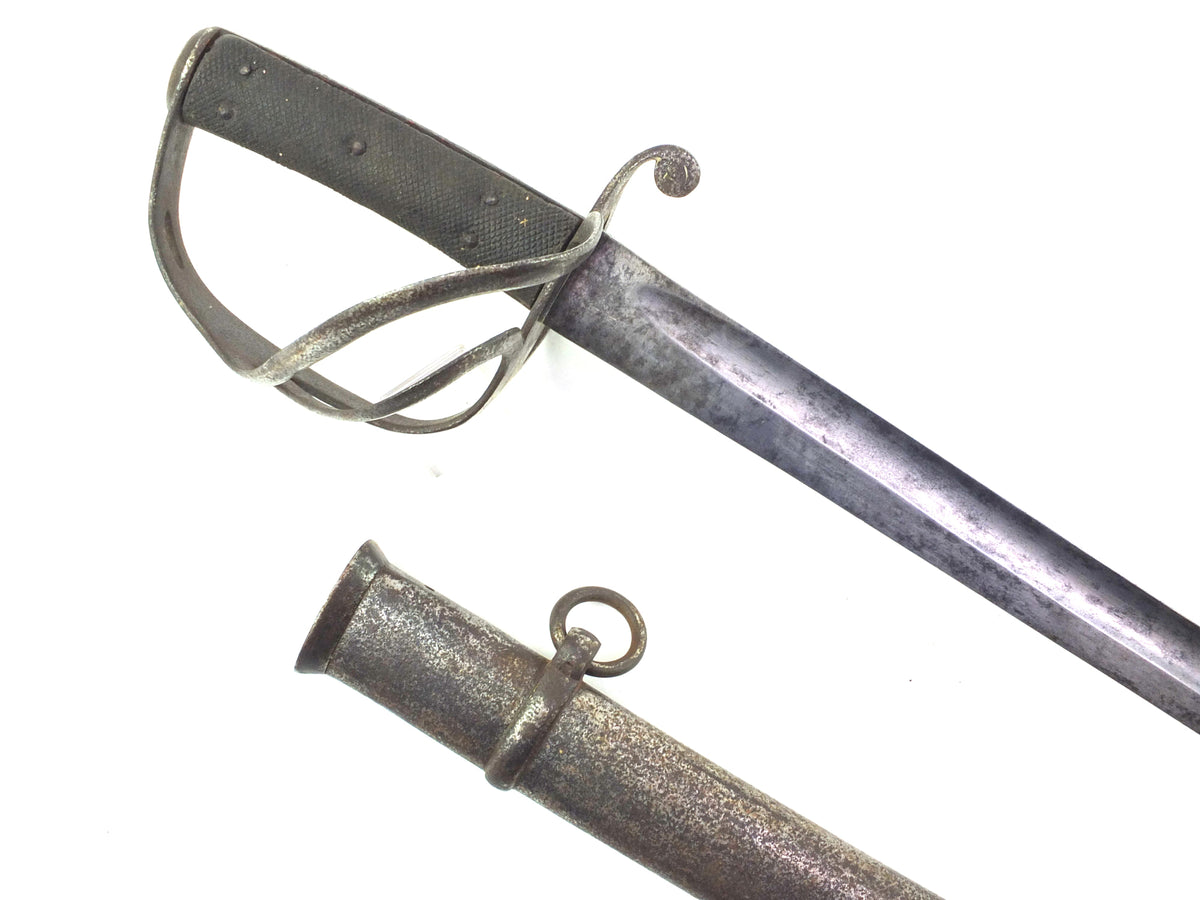
1853 Universal Pattern Cavalry Sword. SN X1945. An 1853 Universal Pattern Cavalry Sword. 40 1/2&157; overall. 35&157; slightly curved spear pointed blade with broad fuller, with inspector´s marks on the blade. Three bar iron guard, chequered leather grip. In its original iron scabbard with 2 suspension rings. Circa1855. Sword in used condition.&194;&160; &194;&160; &194;&160; &194;&160; &194;&160; &194;&160; &194;&160; &194;&160; &194;&160; &194;&160; &194;&160;&194;&160; Images courtesy of West Street Antiques (https://antiquearmsandarmour.com/)
  • Nation : German
  • Local Price : £595.00
**UNUSUAL**UNATTRIBUTED PUMA SOLINGEN PATTERN**WW2 Era Nazi German Army Officer’s Dress Sword, Leopard’s Head Pommel With Red Jewelled Eyes, Scabbard & Officer’s Bullion Cord With Portepee. Sn 23174:34 -. This is a very good original WW2 period Nazi German Army Officer’s Dress Sword. The sword has no visible makers marks but the hilt design is very similar in appearance to an unattributed pattern Puma Solingen example (see page 154 of the book ‘Swords Of Germany’ By Angolia where an example similar to ours is illustrated. The author states ‘Unattributed Leopard head sabre with a langet pattern very similar to a Puma pattern, Note: that the head of the Eagle looks to its left rather than the normal right’. Our example has the same left facing Nazi National Emblem ‘Eagle with outstretched wings & Swastika’ on the langet and a plain shield on the reverse langet. It has a flat knuckle bow and undamaged wire bound grip. The knuckle bow, grip strap and ferrule are adorned with oak leaf decoration. It’s Leopard’s head pommel has original red jewelled eyes. The sword measures 37 ½” overall and it has a 32 ¼” single edged, curved, fullered blade. The blade has its original leather hilt washer. The hilt is fitted with Officer’s bullion stitched cord With bullion portepee. The sword is complete with its original black painted steel scabbard with single steel hanging ring and fixed strap bar. The scabbard has no dents and even aged patina. The price includes UK delivery. Sn 23174:34
  • Nation : British
  • Local Price : £595.00
**AS FOUND**WW1 1915 British Officer’s WD Enfield 1908 Pattern Heavy Cavalry Troopers Sword With Leather Cord & Acorn Portepee & Scabbard. ED 3043 -. This is an original British 1908 Pattern Heavy Cavalry Troopers sword & scabbard. It is as found & has an undamaged 35 ½” single edged blade with fullers (43" overall). The ricasso is date marked ’11/15’ (November 1915) and fitted with original leather hilt washer. It also has WD arrow & EFD (Enfield) manufacturer mark. The spine has ‘08’ (pattern). The bowl guard has no discernible Regiment, maker or date marks. It has a clean undamaged chequered hilt with correct thumb recess to strengthen grip. The guard is fitted with original leather cord with acorn portepee. It is complete with its original steel scabbard with fixed hanging rings. The scabbard has no discernible date, maker or Regiment marks. The price includes UK delivery. ED 3043
  • Nation : British
  • Local Price : £595.00
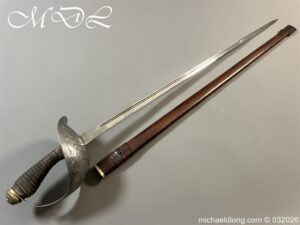
British 1912 Officers Sword. British 1912 Officers Sword WW1 period straight single fullered blade with flat back and spear point 89cm in length. The blade is decorated on one side with the crowned royal cypher for George V, and on the other with the crowned royal coat of arms, both sides there scrolling foliate designs. Complete with field scabbard age wear
  • Nation : British
  • Local Price : £595.00
British Infantry Officers Spadroon c 1796. British Infantry Officers Spadroon c 1796 The straight single edged blade maker marked Bland to each side plus G R and crown. All steel hilt comprising of pommel cap and raised tang button, knuckle bow and straight cross bar with ribbed ebony grip. Note “ John Bland London Sword maker and Cutler 1768 to 1800 over all length 34.75 inch the blade 29 inch
  • Nation : Burmese
  • Local Price : £595.00
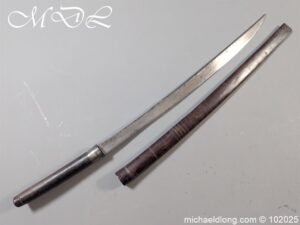
Burmese Dha 19th Century. Burmese Dha 19th Century solid fighting blade single edged for the first 7 inches and then double for the remaining length 15.25 inches. The grip is cord wrap and complete with silver fitting. The scabbard polished wood which shows shadows of where decoration has been removed, over all length 29.75 inches
Page 20 of 41

The following items match your search but are currently listed on Ebay. We take no responsibility for any aspect of the listings or their accuracy.


Sorry, there is not any matching items.