
(You must register and have a linked account first)
View Privacy Policy


OR

Show


Forgot your password?

Error message here!

Error message here!

Error message here!

Error message here!

Show Error message here!

Show Error message here!


Lost your password? Please enter your email address. You will receive a link to create a new password.

Error message here!

Back to log-in

Close

For Sale

The following items are listed by for sale by users of the site and dealers. They are in no way endorsed or guaranteed by www.oldswords.com

Add a Classified Item
to

Clicking on the sword will take you through to the relevant classified item or dealer site.
Don't miss out! - Do you want to be kept informed weekly of new aditions? Just join our weekly update list.

You can also receive regular email notifcations when items match your keywords. To recieve them just register or logon at the top right of this page.

Page 22 of 41
  • Nation : British
  • Local Price : £545.00
*MOVIE INDUSTRY CONNECTIONS*Original George V Joseph Ridge & Co Sheffield 1897 Pattern Infantry Officer’s Sword with Etched Blade Used as A Film Prop in The Film Innocent & Presented to Andrew Hawley on His 1st Film from The Director John Mackenzie 1. This is an original 1897 British Infantry officer’s sword. These swords were a great improvement on previous patterns with better protection to the hand through its ¾ basket hilt (see page 179 of World Swords by Withers & pages 165-167 of Swords of the British Army by Robson). The sword has a 32 ½” single edged blade with partial fullers. The ricasso is signed by the British manufacturer ‘Joseph Ridge & Co Sheffield’. The reverse has the ordnance acceptance ‘proof’ star and inlaid roundel. Both sides of the blade have etched panels featuring foliate devices, the King’s Crown & Royal Cypher ‘GRV’ (George Fifth Rex). It has the correct ¾ bowl guard voided with foliate design and ‘King’s Crown GRV’. The guard has much of its original nickel plating & has an etched plaque ‘To Andrew a memento of his first film from John Mackenzie September 1984’ (Provenance: Purchased in 1984 by Tempest films from Alan Beadle Antique Arms to be used as a film prop by Andrew Hawley in the film ‘The Innocent’ (Andrew Hawley is a producer and actor, known for Devil’s Gold 2018 and The Innocent 1985). It was then presented by the Director John Mackenzie (He assisted Ken Loach on his classic early TV plays such as The Wednesday Play: Cathy Come Home (1966) and made many other films including The Long Good Friday starring Bob Hoskins in 1980). The sword has the correct fish skin covered grip with wire binding which is tight and intact. The hilt is fitted with original leather cord which has stapled repairs in places and acorn knot. The sword is complete with its leather field covered steel scabbard which has fixed hanging bar & shoe. The price includes UK delivery. Sn 19416.
  • Nation : ?
  • Local Price : 745.00 USD
EUROPEAN HUNTING SWORD C.1750-70. Iron mounted hilt with thick recurved scalloped guard and shaped ebony grip with iron base ferrule and pommel cap. 13 7/8” double edged blade, made in this size. The forte with rococo panels of scrolling foliage.  Iconic hound and boar/hound and stag motifs beyond. Rarely found in this size (see Swords and Blades of the American Revolution, #97.S) this sword would have served as a side arm for protection in the streets. May well have served in the American or French Revolutions.
  • Nation : -
  • Local Price : 6,800 kr
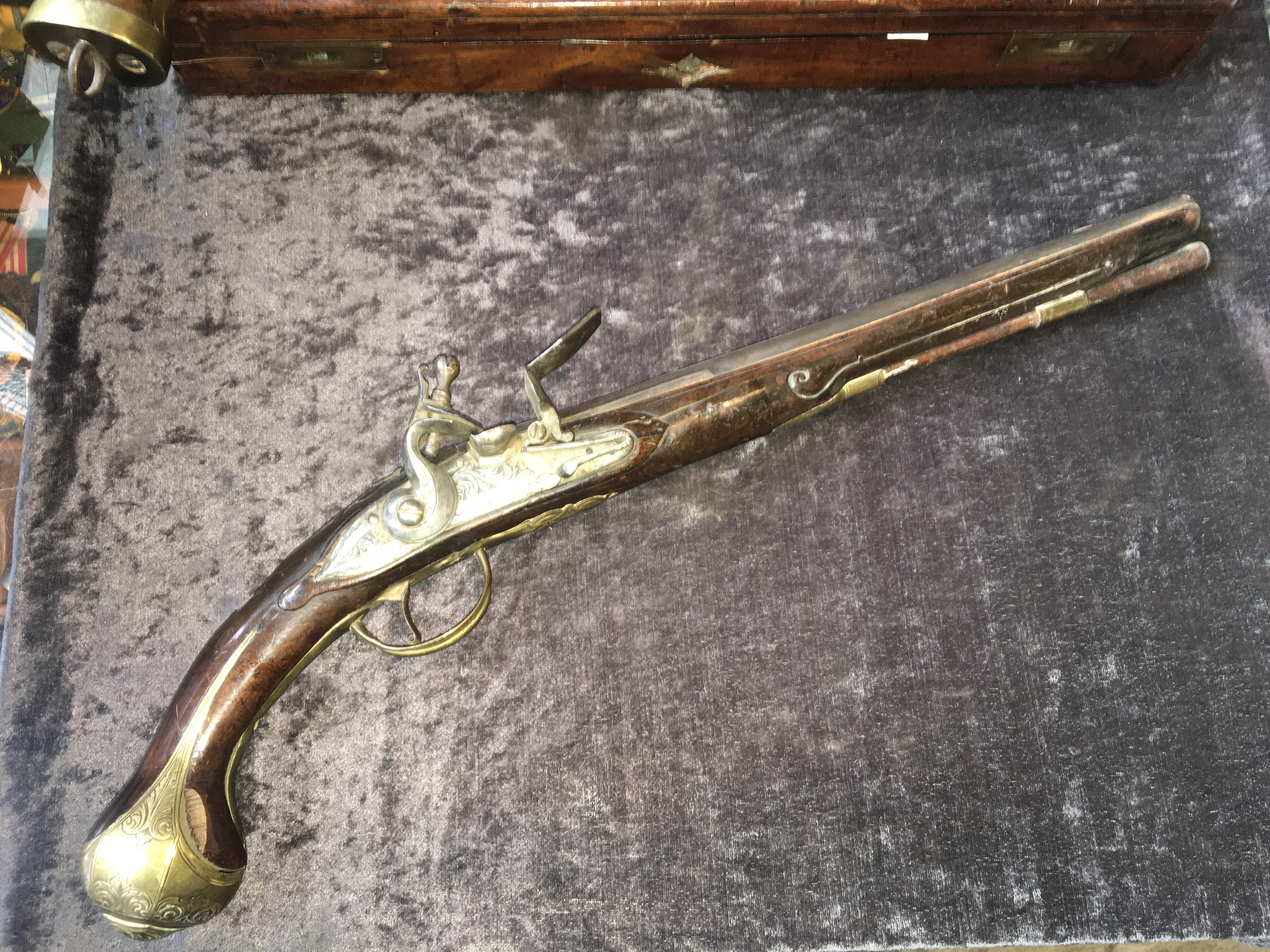
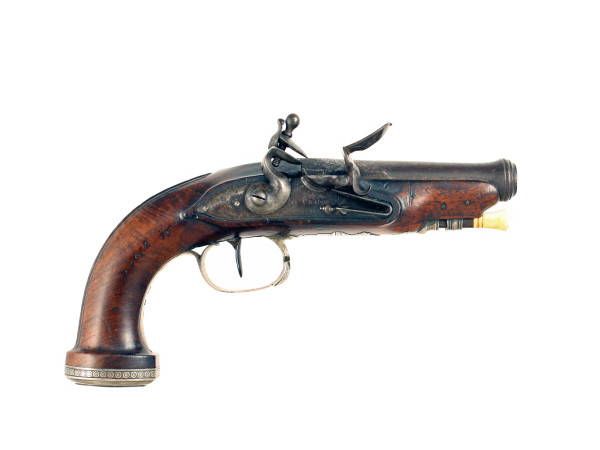
Större flintlåspistol förmodligen Italien/Frankrike 1700talets andra hälft..
  • Nation : -
  • Local Price : 735.00 USD
CIVIL WAR INFANTRY OFFICERS SWORD 1850 PATTERN. See The American Sword, Peterson #73. Brass hilt with good high relief, well chased foliage decoration. The guard in pierced floral motif with U S centered. Wire wrapped leather covered grip, a little dry but complete. Wire complete. 30 1/4” broad and narrow fullered curved single edged blade of fine fighting form decorated 2/3 its length with foliage, military trophies, US, and E PLURIBUS UNUM, motto. Maker's mark to the ricasso. Blade condition excellent plus, bright with crisp decoration. Blade shows gray patina, with the decoration excellent, mottled toward the point. Great age character.
  • Nation : ?
  • Local Price : 735.00 USD
EUROPEAN OFFICER’S SWORD C.1800. Napoleonic Wars period, probably from one of the PR confederation German states. Brass hilt with lion head pommel and wire wrapped leather covered grip. 27 ¾” curved broad fullered blade shows smooth glossy patina but for the point area which has a patch of pitting (as shown) each side. Many of the southern German states including Bavaria fought with Napoleon. Others including Mecklenburg-Schwerin, Brunswick and Oldenburg, opposed France early or defected later. A well used veteran of the Napoleonic Wars.
  • Nation : British
  • Local Price : £525.00
1845 Pattern British Infantry Officer Sword. A good, clean example of the 1845 pattern Infantry Officers sword with a Wilkinson style blade. The sword is etched both sides with Royal Crown, VR all surrounded by floral decoration plus brass proof plug. Regulation gilt hilt with VR and crown to centre. Fish skin grip bound with gilt wire, and it unusually retains the leather insert for the guard. The leather scabbard has some wear towards the tip but is otherwise in good order. Originally Retailed by Murray of Exeter.Replacing the old 1822 pattern, the new style of blade was promoted for British officers’ swords by Henry Wilkinson from 1844-45 and it was made official regulation for Army officers in 1845 and for Naval officers in 1846
  • Nation : British
  • Local Price : £525.00
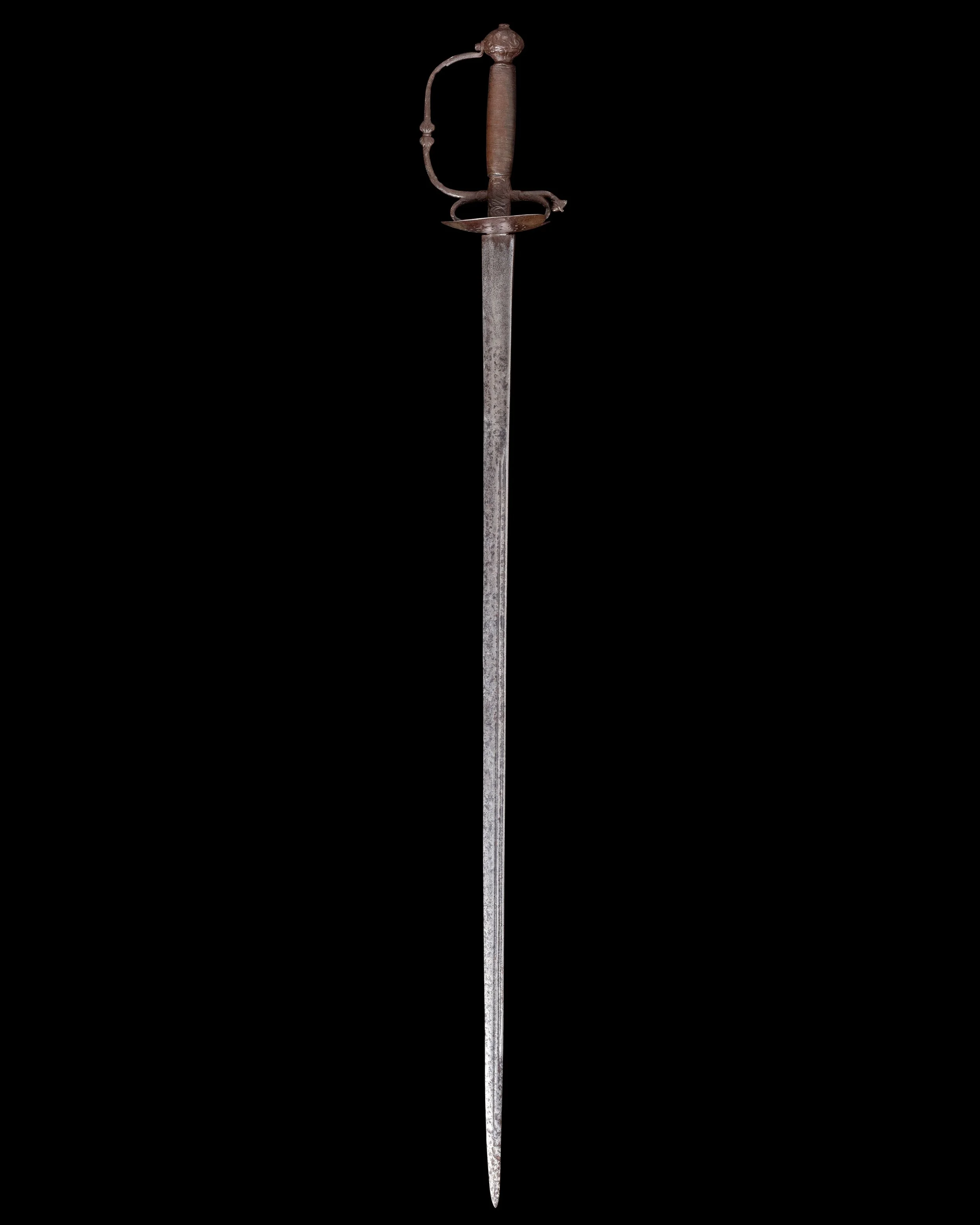
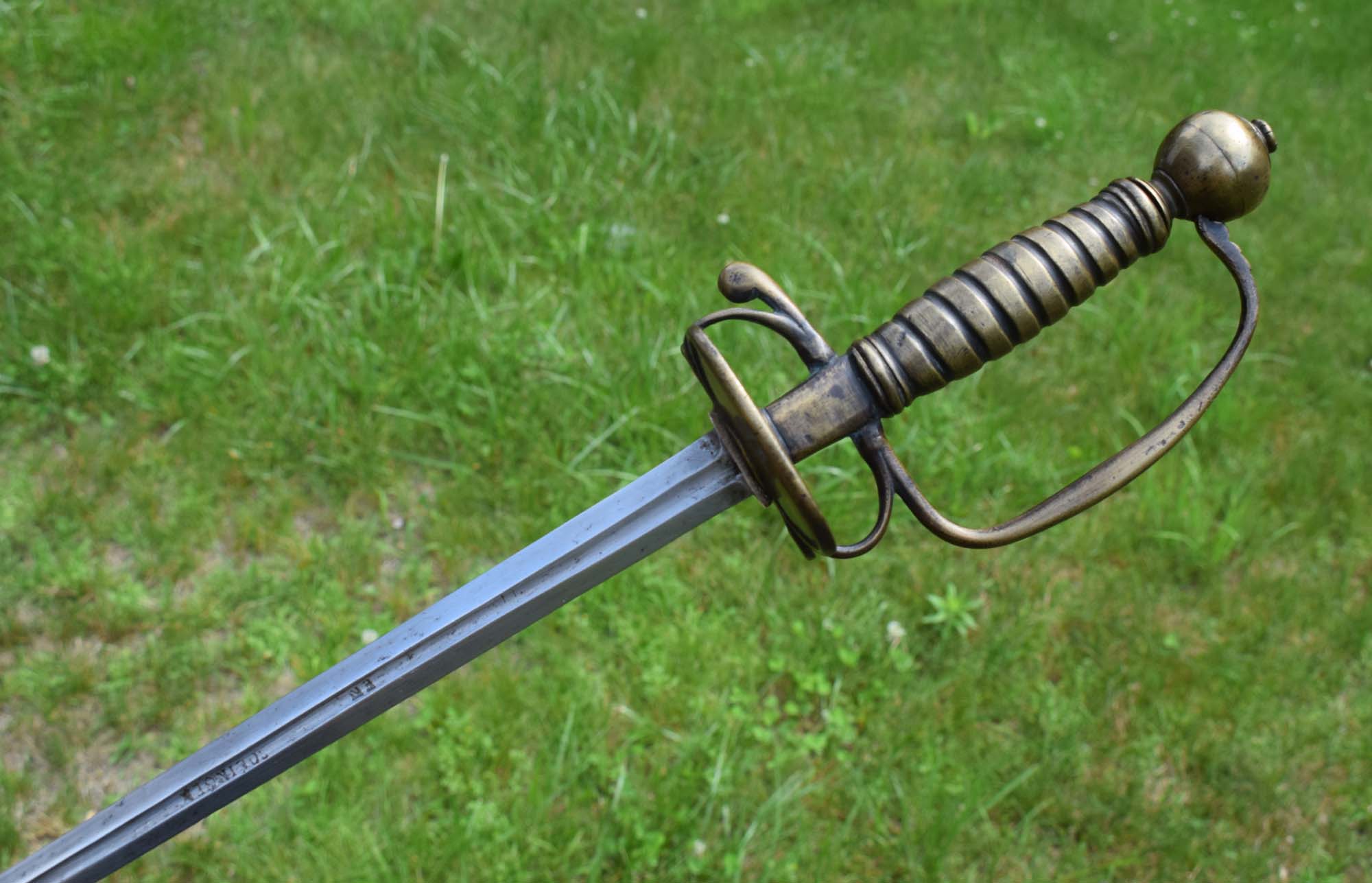
C1760 Steel Hilt Spadroon. Unusual spadroon with a pierced steel shell guard, wire wrapped handle with carved decorations to the pommel and knuckle bow. The 73 cm blade is double fullered, making it quite a light and nimble sword. Spadroons grew in popularity in Britain during the late 17th and 18th century as a light cut and thrust sword for military officers. Eventually being adopted into the official British Army patterns in 1796The handle and guard are solid with no movement, with an even patina over all. The blade has some pitting but is otherwise in good condition.
  • Nation : British
  • Local Price : £525.00
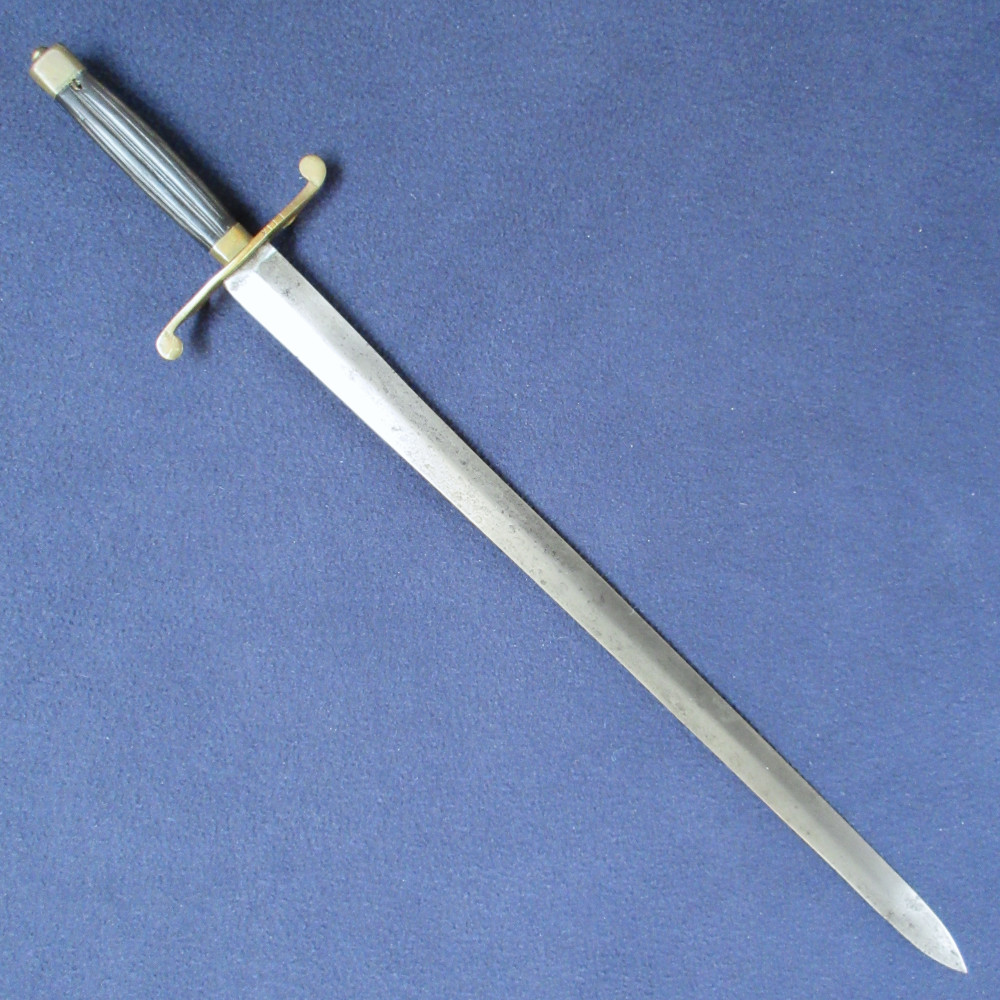
English Circa 1800 Fighting Dirk. Description Double-edged, spear-pointed blade 18 inches in length, overall length 22¾ inches, diamond cross-section. Reeded ebony grip, flat square brass &#acute;pillow&#acute; pommel, simple chamfered square brass ferrule and brass cross hilt with forward and reverse quillons and remnants of a side-ring. The hilt and ferrule are both marked &#acute;XIII&#acute;, quite crudely struck. This is an example of an early type of English officer&#acute;s dirk, carried by officers in both the Army and Navy from around 1770 until the 1820s. The lack of any uniform regulations during this period allowed officers the freedom to buy and carry weapons of their choice, leading to great variety in weaponry. Dirks were a form of dagger or long knife typically carried in addition to an officer&#acute;s full-size hanger or smallsword, used either as a backup weapon or held in the off-hand in the manner of a parrying dagger. Fighting examples such as this one tend to be simply constructed, probably quite inexpensive at the time, with little ornamentation but a relatively substantial blade. This example could be Army or Navy, one cannot tell from its plain features. The blade has light patination and minor pitting in places. There is slight movement to the hilt, which appears to have at one time had a simple side-ring like those often found on contemporary swords “ this has broken or been removed, leaving two spurs. The brass parts have a dark, even patina consistent with their age. A very small hole has been bored on each side of the grip near the pommel. The grip has minor handling wear and surface-level cracking, but remains sound and solidly mounted to the blade. A very similar example is illustrated in Peter Tuite&#acute;s &#acute;British Naval Edged Weapons - An Overview&#acute;, in the American Society of Arms Collectors Bulletin, 86:37-57, with a shorter blade and steel mounts instead of brass, made by Mayfield of Dublin circa 1800.
  • Nation : American
  • Local Price : 725.00 USD
AMERICAN MILITIA CAVALRY OFFICERS SWORD, 1870’S-80’S. Made to the 1872 pattern for US cavalry officers, (Peterson, The American Sword, #86) this example is made without the Eagle and stars and bars shield as normally encountered. These are infrequently encountered, but other examples are known. It is believed that they were made for reunited Southern (Confederate) states which chose to omit the Union decoration. Texas rearmed their militias, including nine cavalry companies, in1870. This example is unmarked with 31 1/4” curved broad fullered blade and brass hilt with wire wrapped leather covered grip. The hilt is excellent for the period. The blade is crisp with bright finish but for a little smooth superficial staining toward the hilt. Iron scabbard undented with raised brown surface oxidation.
  • Nation : British
  • Local Price : £520.00
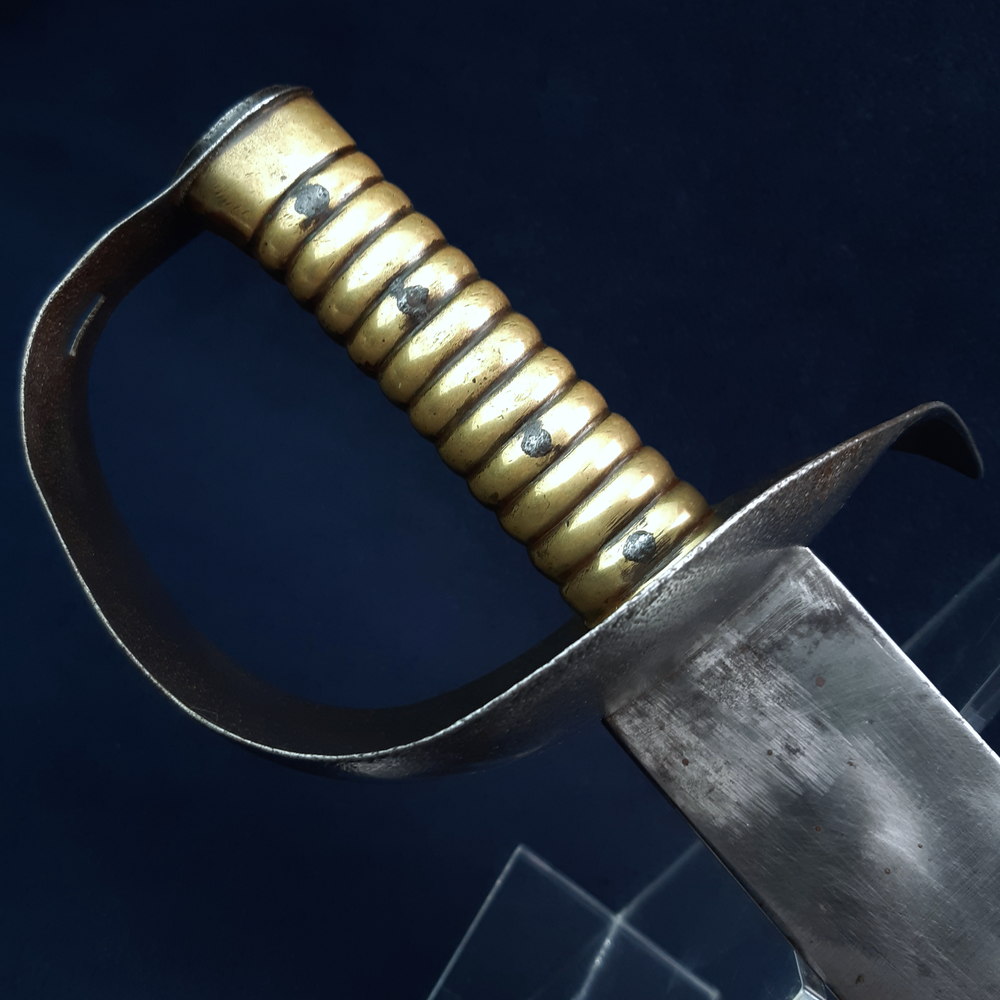
British c1889 &#acute;Lead Cutter&#acute; Cutlass for Sword Exercise, with Brass Grip. Description Unfullered, slightly curved blade with spear point. Plain steel basket hilt similar to the 1845 Pattern naval cutlass, with sword knot slit. Oval steel strengthening piece at the top of the grip, riveted to the inside of the guard. Ribbed slab grips of brass secured to a full-width tang by four flush steel rivets, the tang also incised to continue the ribs around the full grip circumference. Blade 31 inches in length, 1.77 inches wide at the midpoint, 1.85 inches wide at the shoulder, the false edge 10 inches long, the sword 36 inches in length overall and 1.92kg in weight (4.23lb). Lead cutters were specialised swords developed for &#acute;sword feats&#acute;, specific cutting exercises developed in Britain in the late 19th century. Sword feats developed out of military training and conditioning, each being intended to help develop specific aspects of swordsmanship, but over time also became their own form of quasi-sport and demonstrations were held for public entertainment at events known as &#acute;assaults at arms&#acute;. The feat of &#acute;lead cutting&#acute; entailed cutting cleanly with a single stroke through a triangular bar of solid lead, 1.5 inches on each side (thinner bars may have been used for beginners), either suspended or stood on a stool/table to raise it to near shoulder height. This was intended to demonstrate and improve the shoulder strength of a swordsman, who would have to maintain speed and edge alignment through the cut to ensure his sword sheared through the metal rather than pushing the bar to the side. It was sometimes called the &#acute;Coeur de Lion&#acute;, in reference to an apocryphal feat of Richard the Lionheart in which he cut through an iron mace handle with his broadsword. A standard naval cutlass of the 1845 Pattern would most likely have been used in the earliest lead cutting, and lead cutters resembled this cutlass but with broader and longer blades. Despite their name they were actually multi-purpose, also being used for other heavy cutting feats such as cutting sheep carcasses, legs of mutton and broomsticks. They may also have been used simply to increase the difficulty of non-contact sword drills. The maker Wilkinson produced a line of lead cutters in multiple sizes, these being numbered 1 to 4. This example is not obviously by Wilkinson but is almost exactly a number 2 in sizing (the standard No. 2 blade would be 31 inches long, 1.75 inches wide). The brass grips on this example are unusual but a known variation. They are near-identical in form to the ribbed steel grips first used on the 1889 Pattern naval cutlass (which are likewise very occasionally seen in brass) so I would be quite confident in dating it to the same period. It may have been an attempt to update or improve the lead cutter in line with the new generation of cutlass. Both edges are sharp, with a number of nicks to the true edge, some small spots of cleaned pitting towards the tip which slightly impact the true and false edges in places. The tip itself is slightly chipped. The blade looks to be distally straight with no obvious bend or twist. The blade has previously been given a mirror polish with old polishing marks, on top of this are scattered spots of patination and a few small areas of frosting and cleaned pitting. The hilt, exposed tang, rivet heads and pommel cap have peppered cleaned pitting overall, heavier on the inside of the guard than elsewhere. One very small dent to the outside of the guard and a few spots of light staining. The brass grips have an even light patina, heavier in the grooves of the ribs. I am aware some enthusiasts like to put antique lead cutters to use in their training or practice cutting “ while I am not a fencing or HEMA expert this example would seem quite viable for that, perhaps with some resharpening to clean up the nicks from the edge. The deepest nick is 1mm and if the blade lost a little breadth it would still be very near the standard No. 2 cutter. The sword is rock solid in the hand with no movement to any parts. Its full-width riveted tang is probably even more durable than the standard one-piece iron grip with peened tang.
  • Nation : -
  • Local Price : 6,500 kr
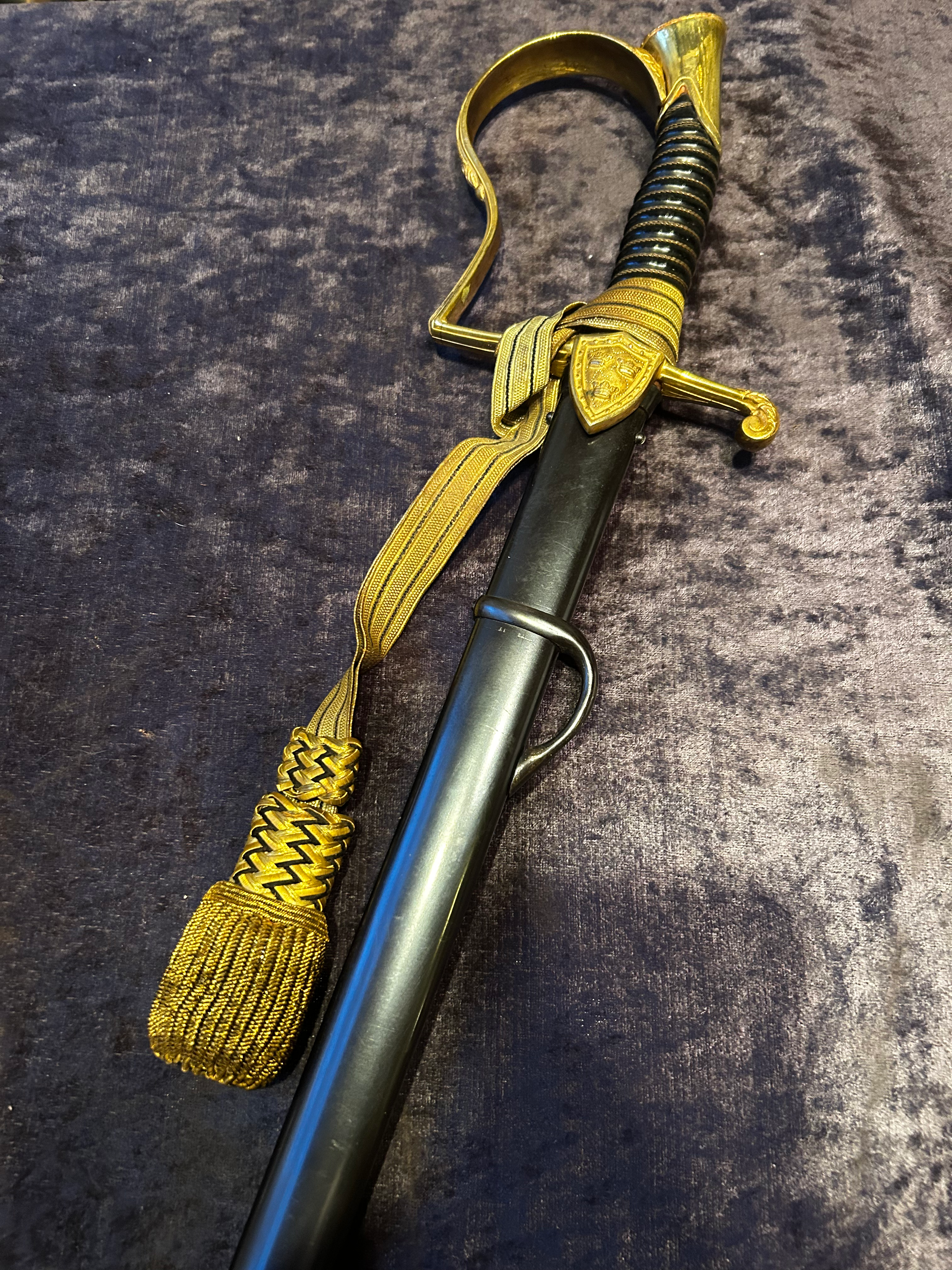
Artilleri officerssabel m/1889.
  • Nation : -
  • Local Price : 6,500 kr
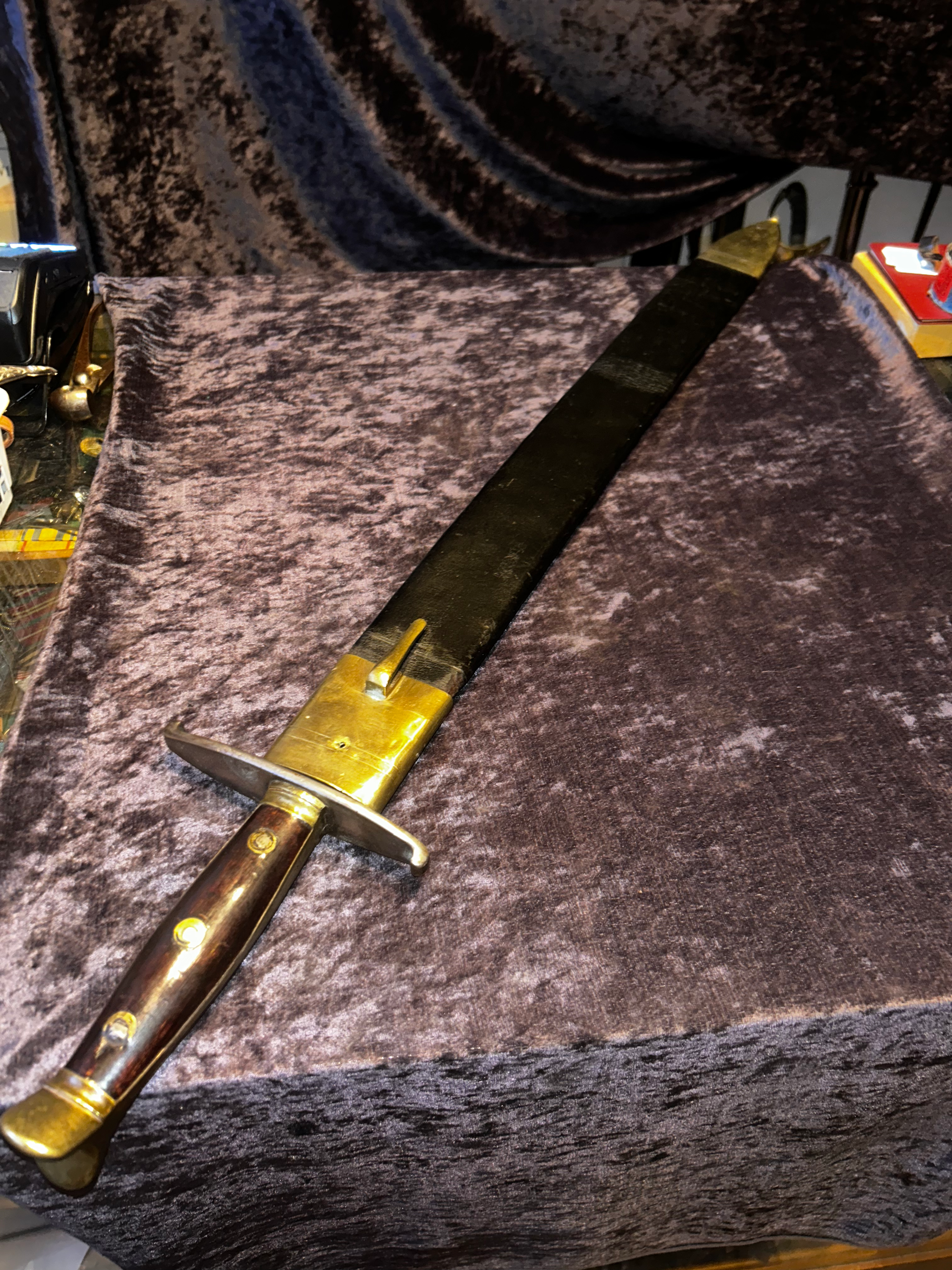
Sv sk Gotlandshuggare m/1810.
  • Nation : -
  • Local Price : 6,500 kr
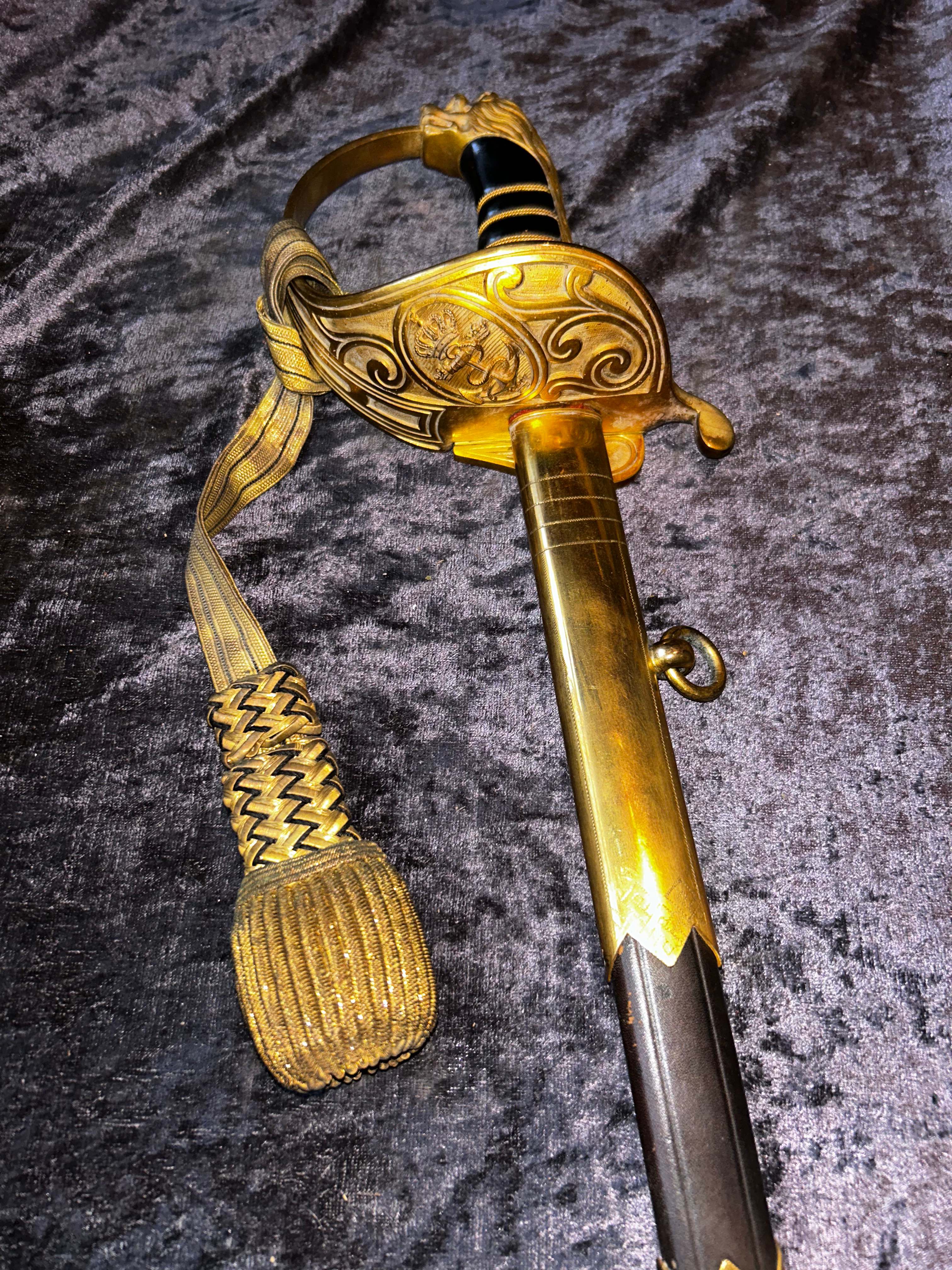
Sv marinsabel m/1915.
  • Nation : German
  • Local Price : £500.00
German Flintlock Travelling Pistol. 80 Bore German Flintlock traveling Pistol, Circa 1770. With sighted barrel formed in two stages, with a round barrel and octagonal breech. Flat lock fitted with bolt safety-catch, with a beveled cock and faceted pan. Full stock carved with a bouquet about the tang, iron mounts including ’bird’s head’ pommel with foliate terminal, trigger-guard en suite, sideplate and ramrod-pipe. Rifled barrel with 6 lands and groovesAn interestingly over-engineered pistol commonly carried for self defense
  • Nation : British
  • Local Price : £500.00
British 1827 Pattern Naval Officer’s Sword, Early 20th Century by Gieves. Description Single fullered, spear-pointed &#acute;Wilkinson&#acute; type blade, 31¼ inches in length, 37 inches overall. Gilt brass half-basket hilt cast with a St Edward&#acute;s crown and fouled anchor within a cartouche, hinged folding inner guard, gilt brass backstrap with lion head pommel, ball tang button, white shagreen grip bound with wire, brass ferrule, blue & gold cord knot. Buff leather washer. Black leather scabbard with gilt brass throat, chape and middle pieces, hanging rings on the throat and middle. The blade is etched at the ricasso on one side with a six-pointed star surrounding the stamped letters &#acute;PROVED&#acute; “ echoing the form of a traditional inset brass proof slug without actually adding one. It is etched at the ricasso on the other side with the retailer&#acute;s mark &#acute;GIEVE&#acute;S THE HARD PORTSMOUTH&#acute;. The blade is further etched with a fouled anchor, the royal coat of arms and foliate motifs. The firm of Gieves was a successor to that of Joseph Galt, who had James Gieve as a partner from around 1863 until he took over the business in 1887 and renamed it James Gieve & Son, trading on 111 High Street, Portsmouth. Gieve brought in new partners Henry Matthews and Edwin Seagrove in 1907, the resulting firm trading at multiple addresses within Portsmouth. In 1911 the partners consolidated all Portsmouth operations at one premises at 22 The Hard, with other shops located in London and Devonport. In 1916 the partnership was presumably dissolved as the firm reverted to &#acute;Gieves Ltd&#acute; at the same premises. This allows this sword to be dated to the period from 1916 to 1956: after Elizabeth II took the throne in 1956 the crown used on the hilt was changed from the St Edward&#acute;s to the Tudor crown. This is admittedly quite a wide range. Based on its style and construction I think this sword lies on the earlier end and very likely predates WW2, but that is a matter of opinion. Gieves appears to have retailed swords made by others “ for instance the firm is listed as a trade customer in the records of the Wilkinson Sword Company “ but did also produce them under its own roof. It was one of the very few British swordmakers to survive into the late 20th century, confirmed as of 1953 to still have a small workshop via a subsidiary company. Gieves merged with the fellow military outfitters Hawkes & Co in 1979 to form Gieves & Hawkes. This company still trades today as a military outfitter and bespoke tailor, although their swords are now supplied from outside sources. Introduced to coincide with a major overhaul of naval officers&#acute; uniforms, the 1827 Pattern sword was based upon the 1822 Pattern Infantry Officer&#acute;s sword then in use with the Army, especially in the hilt design, but with the gaps between the bars of its hilt filled in to create a solid half-basket. Early versions used a curved pipeback blade, which was superseded in 1846 by the new &#acute;Wilkinson&#acute; type blade which was fullered and only slightly curved. These blades were considered a great improvement and were used on infantry, cavalry, artillery and naval officer&#acute;s swords at various times. The scabbard, sword knot and carrying slings went through some changes over time, but the 1827 Pattern sword carried by naval officers is not drastically different in form today than in 1846. Some small spots of pitting to the corners of the spine of the blade, not impacting the crisp etching, and on the ricasso&#acute;s corners. The hilt retains a great deal of its original gilding, with wear in only a few spots such as the outside edge of the guard revealing patinated brass. The folding guard is fully functional and locks the sword into the scabbard. The shagreen grip is in good shape with no significant handling wear, its wire binding is all present and tight. No fray to the sword knot. The scabbard fittings have only a little gilding but all the exposed brass has only a light patina and is free of dents. The scabbard leather is excellent with no creasing or significant surface wear.
  • Nation : British
  • Local Price : £500.00
British 1890 Pattern Cavalry Trooper&#acute;s Sword, Duke of Lancaster&#acute;s Own Yeomanry. Description Curved, single fullered blade, ambidextrous basket hilt with pierced Maltese Cross symbol and turned-over edges, black pressed leather grips secured by five steel rivets, brown leather washer. Steel scabbard with fixed opposed hanging rings. Overall length 38 7/8 inches (98.7cm) blade length 33 3/8 inches (84.7cm). Traces of orange-brown paint to the lip of the guard on one side. The spine of the blade is stamped with &#acute;/90&#acute;, indicating that it is an 1890 Pattern, and a crown inspection mark for Enfield. The flat of the blade is stamped at the forte on one side with a broad arrow and &#acute;EFD&#acute;, indicating War Department property made at Enfield, another Enfield inspection mark and an &#acute;X&#acute; indicating that the blade passed a manufacturer&#acute;s bending test. On the other side it is stamped with an issue mark &#acute;97 for 1897, another for 1899, and two further Enfield crown inspection marks. The outside of the guard is stamped near the spine of the blade with another &#acute;EFD&#acute; below a broad arrow. The inside of the guard is stamped with &#acute;8 97&#acute; indicating issue in August 1897, matching that on the blade, and the unit mark &#acute;13 / A.S.C. / 6&#acute;, indicating the Army Service Corps. The exposed tang is stamped near the guard with &#acute;M&#acute; and &#acute;P&#acute;. The scabbard is stamped at the face side of the throat with &#acute;8 1893&#acute;, above &#acute;Y / DLO / 212&#acute;, indicating sword number 212 issued to the Duke of Lancaster&#acute;s Own Yeomanry. The opposite face side is stamped with &#acute;MOLE PATENT&#acute; indicating the manufacturer Mole of Birmingham. The trailing side of the throat piece is stamped with another /90, which probably indicates the pattern rather than manufacture date (which would be rendered &#acute;90). The flat spine of the scabbard body is similarly stamped with a broad arrow and &#acute;WD&#acute;, indicating War Department property, another /90 and a crown inspection mark with &#acute;B&#acute; for Birmingham. The dissimilar maker&#acute;s and unit markings on sword and scabbard suggest that they are a non-original pairing “ whether they were brought together during their service life or later is impossible to tell, though they are in similar condition. The Duke of Lancaster&#acute;s Own Yeomanry was formed in 1828 out of several troops of yeomanry based in the county of Lancashire. Initially named the Lancashire Corps of Yeomanry Cavalry, it was honoured by King William IV with the title &#acute;Duke of Lancaster&#acute;s&#acute; in 1834 “ the Duke of Lancaster being one of the British monarch&#acute;s several titles. In 1893 the DLOY had four squadrons, with its headquarters at Worsley. Together with the Lancashire Hussars it contributed two companies of volunteers to the Boer War, which operated as mounted infantry and earned the regiment&#acute;s first battle honour &#acute;South Africa 1900-02&#acute;. It became part of the Territorial Force in 1908, headquartered in Manchester. Being one of the more senior yeomanry regiments in the TF it was chosen to remain a mounted cavalry unit after WW1. It mobilised as cavalry for WW2 but was abruptly transferred to the Royal Artillery in 1940. After WW2 it became an armoured reconnaissance unit. Its lineage is maintained by B Squadron of the Queen&#acute;s Own Yeomanry. The Army Service Corps (ASC) was responsible for much of the transport and logistics of the British Army, supplying food, water, fuel, clothing and other domestic goods, as well as some technical equipment. Supplying armaments was the responsibility of the Royal Army Ordnance Corps. It was formed in 1888 out of the Commissariat and Transport Department, plus the War Department Fleet and some transport elements from the Royal Engineers.
  • Nation : British
  • Local Price : £500.00
1845 Pattern British Infantry Officer Sword. A good, clean example of the 1845 pattern Infantry Officers sword with a Wilkinson style blade. The sword is etched both sides with Royal Crown, VR all surrounded by floral decoration plus brass proof plug. Regulation gilt hilt with VR and crown to centre. Fish skin grip bound with gilt wire, and it unusually retains the leather insert for the guard. The brass scabbard has some dents otherwise in good order. Originally Retailed by Hawkes & Co London.Replacing the old 1822 pattern, the new style of blade was promoted for British officers’ swords by Henry Wilkinson from 1844-45 and it was made official regulation for Army officers in 1845 and for Naval officers in 1846
  • Nation : British
  • Local Price : £500.00
British 1879 Pattern Martini Henry Artillery Carbine Bayonet. Description Straight single-fullered blade with sawback, steel knucklebow hilt with slit for sword knot and muzzle ring. Black pressed leather grips with chequering (technically, knurling), steel pommel with external leaf spring. Black leather scabbard with steel chape and throat with teardrop frog stud. Blade 25 3/4 inches in length, the bayonet 31 1/4 inches overall, muzzle ring 0.65 inches in diameter (1.65cm). The blade is profusely stamped on one side of the ricasso with a crown over &#acute;V.R.&#acute; (Victoria Regina), a Birmingham repair/refurbishment mark of a crown over &#acute;BR&#acute; over &#acute;66&#acute;, seven crown inspection marks with &#acute;E&#acute; indicating the Royal Small Arms Factory at Enfield, and reissue dates &#acute;96. &#acute;97, &#acute;99, &#acute;01, &#acute;02, &#acute;03, &#acute;04, &#acute;05, &#acute;06 for 1896 etc. On the other side it is stamped with a broad arrow atop &#acute;WD&#acute;, meaning War Department property, another crown inspection mark with &#acute;E&#acute; and an &#acute;X&#acute; which indicates that the blade passed a manufacturer&#acute;s bending test. The spine of the blade has another Enfield stamp, a &#acute;W&#acute; and an &#acute;R&#acute;. The exposed tang has another Birmingham repair stamp, &#acute;1&#acute;, &#acute;08&#acute;, &#acute;B&#acute; and &#acute;P&#acute;. The pommel is stamped near the mortise slot with another Enfield crown inspection mark, and near the locking button with serial or rack numbers &#acute;33&#acute; (this later cancelled with strikethroughs) and &#acute;15&#acute;. The leather of the scabbard is stamped next to the seam with a broad arrow, another Birmingham repair mark with &#acute;BR&#acute; over &#acute;44&#acute; and another faint crown inspection mark. On the other side it is stamped with &#acute;W.A.C.&#acute;, the &#acute;C&#acute; double stamped, and another mark which has been cancelled with an ornate strikethrough (a circle and two teardrop shapes). When mounted to a carbine-length Martini Henry rifle the 1879 Pattern bayonet gave a soldier good overall reach, and with its substantial hilt it could also serve as a fighting sword. Its saw-toothed back would have found use in brush-cutting, like other similar designs popular during the 19th century. Production of the bayonets at Enfield continued until 1890. The blade has a bright polished finish with only a few tiny spots of patination. The tip of the blade has been sharpened and may have been reshaped, noting that the blade is about ¼ inches shorter than standard. The sawblade is excellent, with no broken teeth and only the uppermost tooth having any significant tip wear. The leather grips have very little handling wear, a few chips and abrasions to the edges of the scales where they contact the exposed tang. The hilt and steel pieces of the scabbard have a lightly patinated finish overall with some spots of darker patination. The exposed tang and pommel have even moderate patination. The chape piece of the scabbard has some small dents. One fold has occurred in the scabbard leather just above the chape piece, which has resulted in a crease on the front face and a crack to the leather on the rear face which opens slightly with the weight of the chape piece. This does not interfere with sheathing and drawing. Take care to support the scabbard when the blade is unsheathed to prevent the crack opening and propagating.
  • Nation : British
  • Local Price : £500.00
West Lothian Constabulary Sabre. An excellent example of an early police sabre carried by the West Lothian, Linlithgow county police. Dating from 1840 to 1856, when the scabbards were modified with a scabbard catch to prevent the swords being easily removed. The sword is etched for the Linlithgow county police, with rack number, and the retailer Parker Field & Sons of Holborn London. The sword is contained in its leather scabbard with belt mount and belt with a West Lothian Constabulary Belt Clasp showing the Victorian Crown.Both the sword and scabbard are in excelent condition with no pitting, staining or rust. The handle and blade are poth solid with no movementWest Lothian Constabulary were formed as a result of an Act of Parliament in 1839, which provided for the formation of County Police Forces. In 1840, the first Constables were appointed to the Linlithgowshire Force under the command of Adam Colquhoun who had previously served as a Lieutenant in Edinburgh City Police. Linlithgowshire&#acute;s first police station was set up in the County jail, and the station remained in operation until 1942Police swords were introduced following the widespread riots by agricultural workers, known as the swing riots and the assault of two officers in Tulse Hill. Home Secretary, Lord Melbourne, who &#acute;approved of the proposal that each Police Officer in that district should be provided with a Cutlass for his defence&#acute;
  • Nation : Dutch
  • Local Price : £500.00
Dutch M1911 Klewang / Marechauseesabel by Hembrug. Description Curved, single-fullered blade with clipped point, steel hilt with pierced openings to form side bars as well as a sword knot slit, wood slab grips secured with three brass rivets, exposed tang. Leather scabbard with riveted leather throat piece incorporating a frog strap, brass button chape reinforced with copper wire. Blade 24¾ inches in length, the klewang 29 5/8 inches overall. The ricasso of the blade is stamped on one side with the maker&#acute;s mark &#acute;Hembrug&#acute;. Based in Zaandam, Holland, this manufacturer held the original Dutch contract for mass production of this pattern. It is stamped on the other side with a crown inspection mark. The inside of the hilt is stamped with another crown inspection mark and the serial number &#acute;566 B&#acute;. The scabbard is stamped on one side next to the seam with the non-matching serial number &#acute;8881 A&#acute; and stamped faintly on the body under the frog strap with what looks like &#acute;AD A&#acute;. These swords were issued to Dutch colonial police and security forces, termed Marechausee, in the Dutch East Indies (now Indonesia). These units were founded in 1890 and deployed in a counter-insurgency role in the Acinese Wars that had been dragging on since 1873. The Acinese guerillas were expert jungle fighters and ambushers, and it was found that European sabers were too cumbersome for close quarters, unsuitable for cutting vegetation (requiring a second blade to be carried) and hard for locally-recruited auxiliaries to wield. The native Acinese ’klewang’ blade was much more suitable, and was unofficially adopted very quickly by the troops. Early designs for Marechausee klewangs used a European-style hilt with a local blade, or a European sword ground into a more suitable shape “ these ideas were used to produce the first standardised klewang in 1898 on the principle of a light, short sword good for both combat and as a tool. This is the M1911, which was the first version to be produced in Europe rather than in the East Indies, and the first to contain all original parts, rather than using repurposed cavalry sword hilts, which were heavier and had a relatively thin tang. Many klewangs were captured during WW2 by the Japanese during their occupation of the East Indies and converted into &#acute;Heiho&#acute; blades “ the blade was shortened and the guard almost completely removed to produce a machete-like tool for use in the jungle. This example survives in its original form as used by the Dutch. The blade retains almost all of its original blueing, with a streak of wear on one side due to sheathing and drawing revealing bright steel, the only other notable spots of rubbing being at the tip and on the corners of the spine. A few small nicks to its edge. The hilt is likewise blued with some rubbing at its edges, some patination on the outside around the sword knot slit, spotted patination and rubbing wear overall on the inside. Some dents to the wood grips, no cracks or chipping. The brass rivets to the grip and scabbard have an even patina. The scabbard is in good condition, with its stitching intact and the leather strong with some flexibility; these did not always fare well in the humid climate they were used in. However, there is some bowing along the length of the scabbard and undulation on the surface of the seam side, that suggests the leather has slightly shrunk. Probably because of this, the klewang fits tightly in the scabbard “ with patience and pressure it will sheath and draw, but take care.
  • Nation : ?
  • Local Price : 500.00
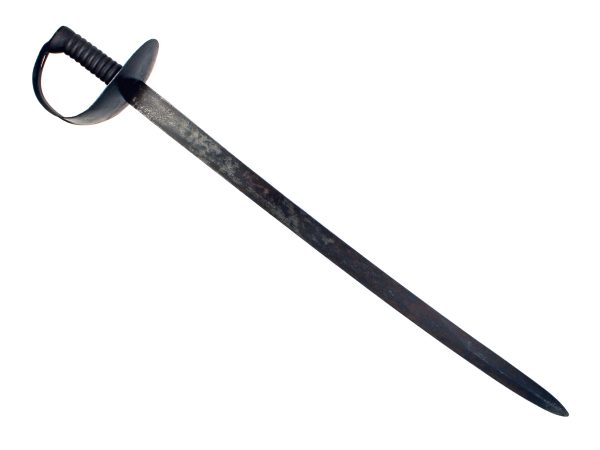
. An 1845 Pattern Naval Cutlass, With slightly curved single edged blade, double edged towards the point, stamped '82' towards the forte, ribbed steel grip and steel bowl guard. Dimensions: Blade Length: 29 Inches (73.66 cm) Overall Length: 34 Inches (86.36 cm)
  • Nation : Dutch
  • Local Price : £500.00
Dutch M1911 Klewang / Marechauseesabel by Hembrug, Unit Marked. Description Curved, single-fullered blade with clipped point, steel hilt with pierced openings to form side bars as well as a sword knot slit, wood slab grips secured with three brass rivets, exposed tang. Leather scabbard with large brass chape piece, riveted brass band at the throat and leather frog strap. Blade 24 1/8 inches in length, the klewang 29 inches overall. The ricasso of the blade is stamped on one side with the maker&#acute;s mark &#acute;Hembrug&#acute;. Based in Zaandam, Holland, this manufacturer held the original Dutch contract for mass production of this pattern. It is stamped on the other side with a crown inspection mark. The inside of the hilt is set with a square brass plate bearing a stamped unit mark &#acute;1-Inf. XI 141&#acute;. The scabbard is stamped with &#acute;CW N&#acute; and &#acute;3 39&#acute;. The wood grips are stamped on one side with &#acute;3 / 4&#acute;. These swords were issued to Dutch colonial police and security forces, termed Marechausee, in the Dutch East Indies (now Indonesia). These units were founded in 1890 and deployed in a counter-insurgency role in the Acinese Wars that had been dragging on since 1873. The Acinese guerillas were expert jungle fighters and ambushers, and it was found that European sabers were too cumbersome for close quarters, unsuitable for cutting vegetation (requiring a second blade to be carried) and hard for locally-recruited auxiliaries to wield. The native Acinese ’klewang’ blade was much more suitable, and was unofficially adopted very quickly by the troops. Early designs for Marechausee klewangs used a European-style hilt with a local blade, or a European sword ground into a more suitable shape “ these ideas were used to produce the first standardised klewang in 1898 on the principle of a light, short sword good for both combat and as a tool. This is the M1911, which was the first version to be produced in Europe rather than in the East Indies, and the first to contain all original parts, rather than using repurposed cavalry sword hilts, which were heavier and had a relatively thin tang. Many klewangs were captured during WW2 by the Japanese during their occupation of the East Indies and converted into &#acute;Heiho&#acute; blades “ the blade was shortened and the guard almost completely removed to produce a machete-like tool for use in the jungle. This example survives in its original form as used by the Dutch. The blade shows signs of use. It retains its original blueing only in places, mainly at the ricasso, on the spine and in the fullers. The edge is sharp with visible sharpening marks along its whole length.  There are numerous small nicks to the edge in the upper section of the blade and the tip has chipped (
  • Nation : British
  • Local Price : $950.00 CAD
BRITISH GENERAL AND STAFF OFFICER’S P.1822/45 SWORD. BRITISH GENERAL AND STAFF OFFICER’S P.1822/45 SWORD: Maker: “E THURKLE, MAKER, SOHO, LONDON” etched on the ricasso. Thurkle worked at this address from 1876 to 1899. Brass hilt with crossed sword and baton in the cartouche. Wire bound fish-skin grip is excellent. The etching on the blade is very nice with a Victorian Crown over “VR” on the left side and a Crown over a crossed sword and baton on the right side. The 33 inch blade is bright with some patches of light pitting. The hilt retains the original gold and crimson sword knot, although the colours are now quite dark. The brass scabbard which, by 1831 had become standard for Generals and Staff Officers is very nice with only minor insignificant small dents. This model is quite rare. VG + (Robson #193) $950.00
  • Nation : British
  • Local Price : $950.00 CAD
BRITISH P.1880 EXPERIMENTAL, CONVERTED. BRITISH P.1880 EXPERIMENTAL, CONVERTED: Both sword and scabbard are unmarked. Grips are excellent plus. There are some grain stains on the blade. Note the sword knot slits in the bowl guard which is the distinguishing feature; basically the same as the P.1882 and P.1885. There are a couple of minor dents on each side of the scabbard. This is an extremely rare pattern. Robson Pg.39 $950.00
  • Nation : Austrian
  • Local Price : 695.00 USD
Early 18th Century German Officer’s Small Sword / Rapier!. A beautiful circa 1700 – 1725 German officer’s sword with a wonderful all brass hilt and a super rapier blade! The all brass hilt is in outstanding condition with a super deep age patina. No issues! It even retains its buff leather sheath washer. The 33.5” , diamond in cross section, blade is in outstanding condition with no pitting or damage. The blade is stamped “ME FECIT IN SOLINGEN” both sides. On the reverse the word “ME FECIT” is worn. This wonderful example of an early 18th century sword may have seen service in the War of the Spanish Succession, the War of the Quadruple Alliance, the War of the Polish Succession, the War of the Austrian Succession and the Seven Years War. This rare sword is in top museum condition for the most advanced collector! Price is firm. Thanks for looking! Be sure to check out our other listings for more great swords, arms and armor! Our direct email address is: fineartlimited@yahoo.com
  • Nation : ?
  • Local Price : 695.00
. A Pretty Silver Mounted Pocket Pistol by Ant. Chadon, St. Etienne. With flared cannon barrel, octagonal breech, border engraved tang, decorated with flowers, rounded bevelled lock, signed beneath the pan, full-stocked in walnut with engraved silver screw escutcheons, engraved silver trigger guard and ramrod pipes, with horn tipped ramrod. A sweet little pistol of high quality. Ant. Chadon. Dimensions: Bore: 40 bore Barrel Length: 3.5 Inches (8.90 cm) Overall Length: 7.5 Inches (19.05 cm)
  • Nation : British
  • Local Price : £495.00
Forfar Artillery Officer&#acute;s Sword. 3rd Forfar Artillery Officer&#acute;s Sword with three bar hilt and fish skin grip. The blade backed and with good engraving one side 3rd Forfar  volunteers Artillery plus owner initial the reverse with  flaming grenade and canon marked Hobson and Son London, complete with steel scabbard and officer&#acute;s sword knot Information: Reference: Swords of the British Army Revised Edition Page 187 Blade Length: 81cm Overall Length: 96cm
  • Nation : British
  • Local Price : £495.00
Scottish Dirk. #2508007. This is a large Scottish dirk, which I believe dates to the 19th Century. The blade has been made from a re-profiled late 18th Century sabre, something like a 1788 or 1796 cavalry sabre. It is likely that the piece was made by a town smith as opposed to being more commercially produced.The 420mm single-edged blade has a broad, shallow fuller that merges into the narrow, double-edged spear point. The blade is double edged for the final 80mm and has pitting along its length. The broad blade is 37mm wide at the ricasso and the spine is 10mm thick. I have cleaned the blade as it was very rusty when I acquitted the piece and the blade has been coated with Renaissance Wax to prevent the rust from returning. The patina and pitting cover the whole blade, including the cutting edge and the spine, indicating that the re-working of the blade was carried out some considerable time ago. The position of the nick in the cutting edge suggests that it happened during the blade’s life as a dirk, as opposed to its life as a sabre. A contact nick this close to the base of a sabre blade would be unlikely.The blade is set into a stag antler grip, with a brass or bronze (before cleaning I believed the metalwork to be iron because of its dark colour) bolster and a scalloped pommel piece. The scallop-edged disk is cut with the cross of St. Andrew (Saltire) and has a hand forged pommel nut through which the tang is peened. The brass/bronze retains a great patina and the blade is firm in the hilt.This is a large and interesting Scottish dirk, probably locally made and dating to the early or mid-19th Century. Was: £495.00Now:
  • Nation : British
  • Local Price : £495.00
British 1885 Pattern Cavalry Trooper’s Sword, Worcestershire Yeomanry. Description Curved, single fullered blade, ambidextrous basket hilt with pierced Maltese Cross symbol and turned-over edges, black pressed leather grips secured by five steel rivets. Overall length 1.02m (40 inches) blade length 88cm (34½ inches). Wood-lined steel scabbard with two fixed mounting rings near the throat. The blade is stamped on one side with the maker&#acute;s mark &#acute;Weyersberg Kirschbaum & Co Solingen&#acute; and issue dates &#acute;5/88&#acute; and &#acute;6/89&#acute;, and on the other side with &#acute;Y C&#acute; indicating issue to a unit of Yeomanry Cavalry, a broad arrow and &#acute;WD&#acute;, indicating War Department property, two crown inspection marks with &#acute;S&#acute; for Solingen, a crown inspection mark with &#acute;BR&#acute; indicating that the sword underwent repair at Birmingham, and a mark of eight lines radiating from a circle, the meaning of which is unknown “ I have seen it on other Solingen import blades of the period so it may be a factory mark. The spine of the blade is stamped with the same Solingen inspection mark. The outside of the hilt is stamped with another broad arrow War Department mark. The inside of the hilt is stamped with another issue date &#acute;8/89&#acute;, &#acute;WR YC&#acute;, indicating the Worcestershire Yeomanry Cavalry, and &#acute;22&#acute;, a rack number. The flat base of the mounting ring on the scabbard&#acute;s trailing edge is also stamped with &#acute;WR YC&#acute; and &#acute;22&#acute;. Above this mounting ring the throat piece of the scabbard is stamped with another broad arrow War Department mark, and the date &#acute;/88&#acute;. Below the mounting ring the spine of the scabbard is stamped with a further broad arrow War Department mark, a Solingen inspection mark identical to those on the blade and the date &#acute;/88&#acute; again. Based on the commonality of markings the blade and scabbard must be an original pair. British domestic manufacturers in the late 1800s could not always meet government production contracts for swords and bayonets, and the excess was typically outsourced to the large German factories based in the city of Solingen, of which Weyersberg, Kirschbaum and Co was one of the most prominent. British government inspectors on site ensured quality was maintained. The Worcestershire Yeomanry Cavalry was formed in 1794 as part of a nationwide raising of volunteer units to counter the threat of French invasion. It was disbanded in 1827 but a noted rise in civil unrest in the county led to it being reformed in 1831 - yeomanry could be called upon to support the civil powers in case of riot or unrest and were often an effective deterrent. In 1837 it became The Queen’s Own Regiment of Worcestershire Yeomanry Cavalry. Edwin &#acute;Balaclava Ned&#acute; Hughes, the last survivor of the Charge of the Light Brigade, was sergeant-instructor to the regiment from 1873 to 1886. In 1887 the regiment was awarded the title of the Queen’s Own Worcestershire Hussars (although it remained yeomanry). In 1899 the Imperial Yeomanry was formed to allow yeomanry cavalry to serve in the Boer War and the QOWH provided 129 volunteers, which formed the 6th Squadron, 5th Regiment Imperial Yeomanry under Colonel Meyrick, of which 16 were killed and 20 wounded. During WW1 volunteers of the QOWH formed part of the 1st Midland Brigade, which arrived in Alexandria, Egypt in April 1915 where they assisted in unloading the dead and wounded arriving from Gallipoli. In August they themselves were dispatched to Gallipoli where they fought as infantry until the evacuation in January 1916. They thereafter returned to Egypt and were assigned to patrol the Qatia (or Katia) area east of the Suez Canal, monitoring for Ottoman incursion and protecting the railway and water supply. The Ottomans, under the German commander von Kressenstein, attacked in force in April 1916, overwhelming the outnumbered 5th Brigade at the Battle of Katia. The Worcestershire contingent took particularly heavy losses with more than 300 killed or captured, only one officer remaining to lead the retreat. The 5th Brigade went on to mount the Charge at Huj, the last British charge against guns in history. The cavalry, consisting of men from the Worcester Yeomanry and Warwickshire Yeomanry, attacking with swords drawn, successfully overran and captured the Ottoman artillery and machine guns. The regiment became field artillery in 1922, then an anti-tank regiment in 1938. It remained in that role during WW2, notably forming a rearguard at Cassel to destroy vehicles advancing towards the evacuating forces at Dunkirk. As 53rd (Worcestershire Yeomanry) Air Landing Light Regiment, RA, part of the 6th Airborne Division, it was deployed from gliders near Caen in June 1944 “ the first British field battery ever to be deployed by air. During the Battle of the Bulge the regiment claimed to have been the first in the war to land their shells on German soil. They were airdropped again behind German lines in 1945 as part of Operation Varsity. Immediately after the war the regiment was deployed to policing duties in Palestine. It was reconstituted in 1947 as the 300th (Worcestershire Yeomanry) Anti-Tank Regiment, then converted to an armoured regiment in 1950, returning to its old cavalry name of the Queen’s Own Worcestershire Hussars. It was amalgamated with the Warwickshire Yeomanry in 1956 to form the Queen’s Own Warwickshire and Worcestershire Yeomanry. In 1967 the regiment was reduced in size and reconstituted as infantry. In 1969 it was effectively disbanded - reduced to a cadre of five members. Around 100 former members were invited to form a signals squadron “ designated 67 (Queen’s Own Warwickshire and Worcestershire Yeomanry) Support Squadron - within the 37 (Wessex and Welsh) Signal Regiment. This unit still exists today under the same name, but was renumbered 54 in 2009. In 1971 the five-man cadre was expanded again to a squadron and amalgamated with the Staffordshire Yeomanry and Shropshire Yeomanry, each forming one of the three squadrons of the new Queen’s Own Mercian Yeomanry, a reconnaissance regiment. In 1992 this was amalgamated with The Duke of Lancaster’s Yeomanry to form The Royal Mercian and Lancastrian Yeomanry, with A Squadron carrying the lineage of the Staffordshire, Warwickshire and Worcestershire Yeomanry. The RMLY was disbanded in 2014, with A Squadron transferring to the Royal Yeomanry. This leaves the Worcestershire Yeomanry with two modern successors: B (Warwickshire and Worcestershire Yeomanry) Squadron, Royal Yeomanry and 54 (Queen’s Own Warwickshire and Worcestershire Yeomanry) Support Squadron, 37th Signal Regiment. The blade is bright with some peppered pitting towards the tip. Some pitting to the hilt. The pressed leather grips are in good condition with little handling wear to the chequering,. The original leather washer has been lost. The scabbard has some patination and areas of light pitting, and three small dents to its lower section.
  • Nation : Russian
  • Local Price : £495.00
WW1 Era Imperial Prussian Alcoso (Alex Coppel Solingen) 1918 Pattern Light Cavalry & Artillery Officer’s Sword With Scabbard. Sn 22441:13 -. This original WW1 Era Prussian 1918 Pattern Sword & Scabbard are in excellent condition (see page 200 of the book World Swords 1400-1945 by Withers). Prussian swords like our example had a shallower curve in their sabre blades than German examples and were used by Light Cavalry and Artillery. The sword has a clean single edged, fullered, 29 ¾” light sabre blade with Prussian shallow curve (34 ¾” overall). The blade has Alex Coppel Solingen scales trademark (illustrated) Its cross guard, flat knuckle & pommel are clean & undamaged. Its ribbed polished horn grip is undamaged and has all off its original brass wire binding all present tight and intact. The sword is complete with its original steel scabbard with single hanging ring and large shoe. The scabbard has no dents and retains its original black paint. The price includes UK delivery. Sn 22441:13
  • Nation : Spanish
  • Local Price : £495
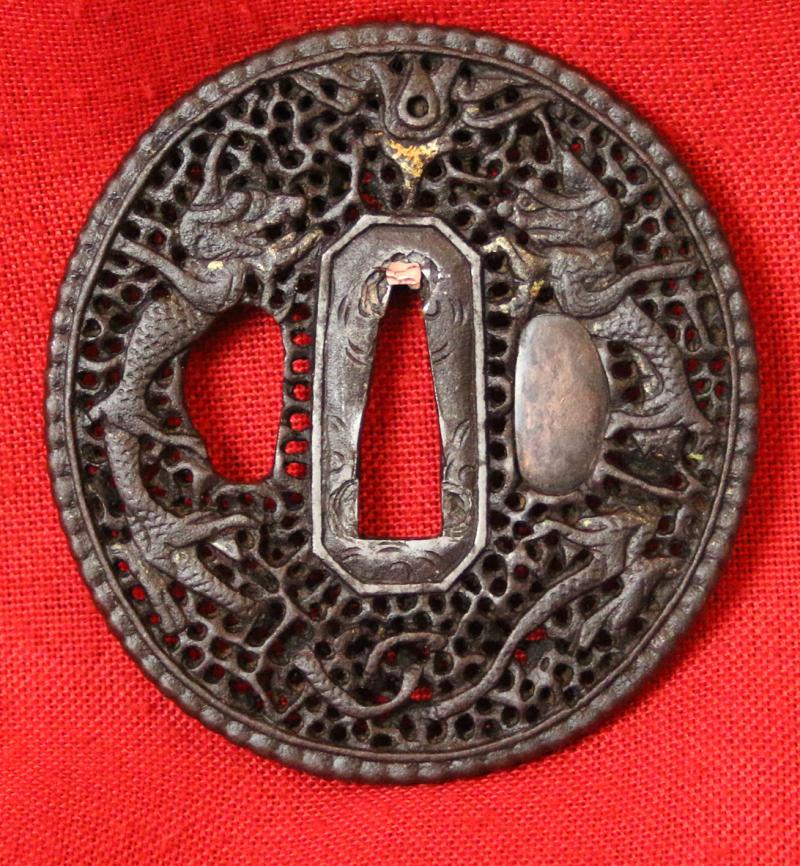
Click and use the code >26169 to search for this item on the dealer website Openwork Iron Nanban Tsuba With A Pair of Dragons and Golden Nunome-Zogan Decor. A Most Fine Japanese 17th Century Sword Guard
  • Nation : French
  • Local Price : £495.00
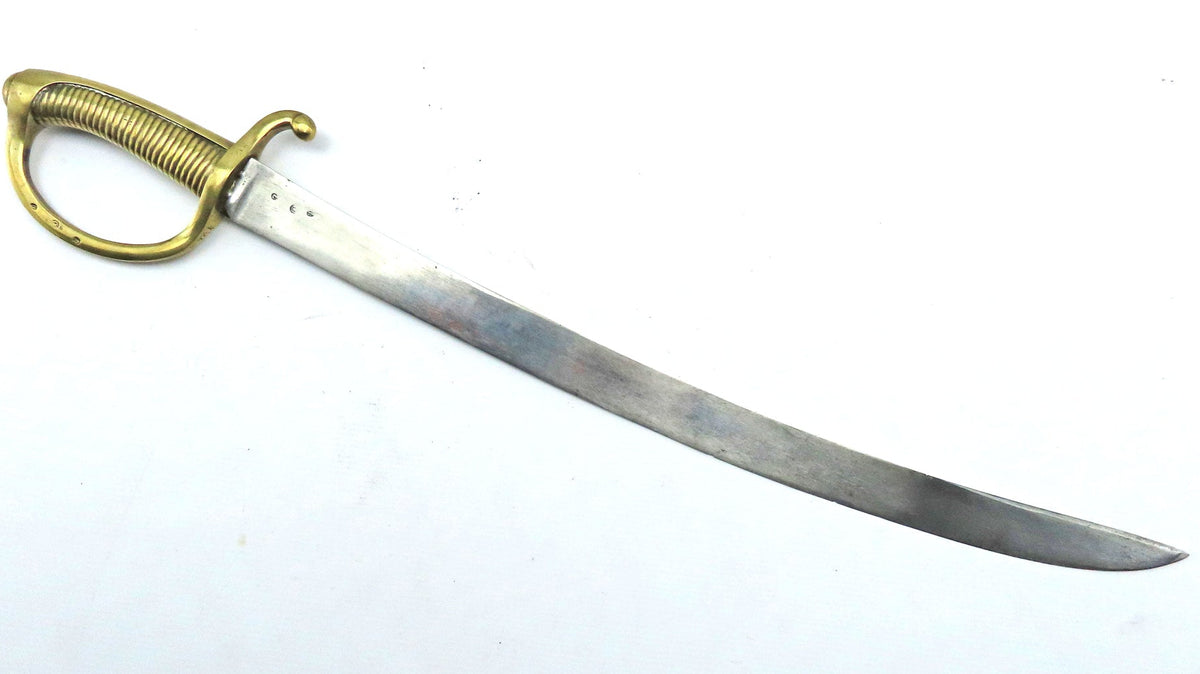
French ANXIII Infantry Sword, ´Sabre Briquette´. Ref 9276. A French ANXIII&194;&160; Infantry Sword, ´Sabre Briquette´. 29&157; overall, 23 1/2&157; slightly curved single edged blade, stampedwith the poinçons of Borson, Bick and Lobstein on the hilt, back edge of blade engraved´ Mf ture Roydu Klingenthal Aout 1814´. Brass hilt with ribbed grip, & rack number 406H Dated August 1814 In good condition, rare to fine a Bourbon Restoration example. No scabbard &194;&160;&194;&160;&194;&160;&194;&160;&194;&160;&194;&160; Images courtesy of West Street Antiques (https://antiquearmsandarmour.com/)
Page 22 of 41

The following items match your search but are currently listed on Ebay. We take no responsibility for any aspect of the listings or their accuracy.


Sorry, there is not any matching items.