
(You must register and have a linked account first)
View Privacy Policy


OR

Show


Forgot your password?

Error message here!

Error message here!

Error message here!

Error message here!

Show Error message here!

Show Error message here!


Lost your password? Please enter your email address. You will receive a link to create a new password.

Error message here!

Back to log-in

Close

For Sale

The following items are listed by for sale by users of the site and dealers. They are in no way endorsed or guaranteed by www.oldswords.com

Add a Classified Item
to

Clicking on the sword will take you through to the relevant classified item or dealer site.
Don't miss out! - Do you want to be kept informed weekly of new aditions? Just join our weekly update list.

You can also receive regular email notifcations when items match your keywords. To recieve them just register or logon at the top right of this page.

Page 47 of 54
  • Nation : US
  • Local Price : £220.00
US 1873 Socket Bayonet for the Springfield Trapdoor Rifle, New Jersey National Guard. Socket bayonet for the Model 1873 .45-70 Springfield Trapdoor rifle, with fullered triangular blade and steel scabbard. Scabbard with drainage hole and frog hanging hook, black leather frog with rotating belt loop. The ricasso of the blade is stamped ‘US’. The brass swivel of the belt frog is cast with ‘NJ’ indicating that it was made for the New Jersey National Guard. The leather inside of the scabbard loop is also roughly inscribed with ‘AL’, presumably a soldier’s initials. The last model of standard-issue socket bayonet, the M1873 was used with the 1873 and 1879 ‘Trapdoor’ Springfield rifles, until 1884 when the new model introduced a rod bayonet. Both bayonet and scabbard have been deeply blued and retain a great deal of this original finish. Some rubbing and flaking to the belt loop in places, the leather is stiff but undamaged and the loop still rotates freely. A few small patches of pitting to the blade, some edge chipping towards the point. The scabbard body is free of dents with rubbing wear to the bluing towards the chape.
  • Nation : British
  • Local Price : £220.00
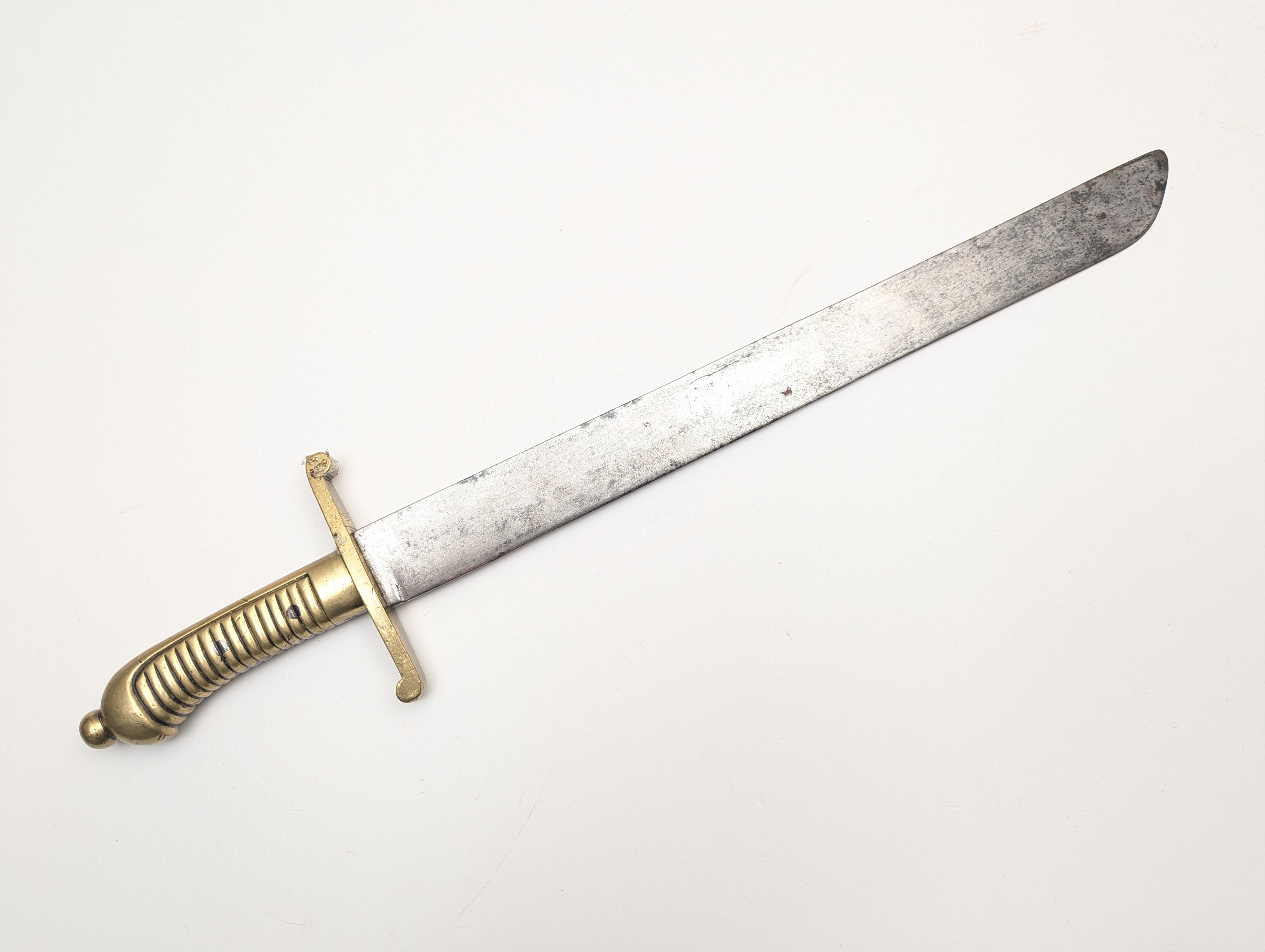
French Model 1831 Artillery Sidearm, Dated 1839 by Chatellerault. Straight double-edged blade, unfullered with diamond profile and spear point. One-piece cast brass hilt, grip and pommel, the hilt with circular finials, the grip ribbed, the pommel oval with a domed circular tang button. Black leather scabbard with brass throat and chape pieces, the throat piece with a frog loop, the leather section with two debossed lines lengthwise on the front face, similar on the reverse face but with one line being the stitching. Blade 48.8cm in length (just over 19 1/8 inches), the sword 63.9cm (just over 25 inches) overall. The blade is engraved on one side at the forte with the maker’s mark ‘Manufre Rale de Chatellerault’ (Manufacture Royale) and on the other side with ‘Fbre 1839’ next to which it is stamped with two French ‘poincon’ inspection stamps at the shoulder. The hilt is stamped on one side with the serial number ‘165’. The chape piece of the scabbard is faintly stamped with two poincons. The leather of the scabbard is stamped with the maker’s mark ‘GIRARD LOUIS A CHÂTELLERAULT’. Created in 1816, the Manufacture de Chatellerault, near Poitier, was a key arms factory for the French state. In the 1830s it took over from the Maubeuge, Charleville and Klingenthal plants, all of these being considered too close to the German border to be relied upon during a war. Girard Louis would have been a private contractor producing scabbards for the government plant, or possibly just their leather bodies. During the late 19 th and early 20 th centuries production of swords at Chatellerault decreased while firearms manufacture surged. Despite increasing use of machine tools and the nearing obsolescence of the sword, its blades were all hand-forged until 1916. Swordmaking there ceased in 1937. Sidearms with the form of a neoclassical ‘gladius’ appear to have originated with the French 1771 ‘Eagle Head’ Artillery sword. A series of very similar-looking short swords were subsequently designed, including the French 1816 & 1831 Artillery models, the US Model 1832 Foot Artillery, the Swiss 1842 Pioneer’s, the Russian 1848 Pioneer’s and the British 1855 Land Transport. They were simple and robust but not particularly useful for combat (the gladius having become obsolete for good reasons) so remained either ceremonial items or in the role of a machete for various field tasks such as clearing brush. Many examples of this type have been repolished, sometimes many times over to keep the brass bright, which results in surface wear and obscures markings. This example is one of two held in the same family by descent from a French ancestor since at least the late 19 th century (the other also for sale), and has been stored well but otherwise left alone, lending the brass an evenly aged patina. [Click here for the other example of the pair] The blade is unsharpened with multiple nicks to both edges. The blade has light speckled patination, with some spots of heavier patination including at the shoulder. A few small dents to the brass throat piece of the scabbard. The scabbard leather is good with some small dents on both sides and chunks of abrasion on the lower front face. All of its stitching is intact.
  • Nation : French
  • Local Price : £220.00
French M1892 Mannlicher Berthier 2nd Pattern Bayonet. Single-fullered straight blade, wood grips (meaning that this is the 2nd pattern, the 1st having composite grips) secured with two rivets. The blade has notches near the hilt which engage with a mechanism locking the blade into the scabbard. Steel scabbard, brown leather frog. Hilt with muzzle ring and quillon. The quillon has been reduced in size, a modification carried out during WW1. The quillon of the bayonet and the scabbard are both stamped with the serial number ‘8279’, indicating an original matching pair. Some light patination to the blade, hilt and pommel. The wood grips are undamaged. The scabbard has numerous small dents to its lower section. The leather frog is in good condition, with all stitching intact.
  • Nation : South African
  • Local Price : £220.00
British / South African Lee Enfield 1907 Pattern Bayonet, Dated 1917 by Wilkinson. Straight single-fullered knife blade, steel hilt with muzzle ring, wood slab grips secured by two screws, steel beaked pommel with oil hole and locking button. Black leather No. 1 Mk 2 scabbard with steel locket & teardrop-shaped frog stud and steel chape piece. Brown leather belt frog with buckled scabbard retaining strap. The ricasso is stamped on one side with a crown over 1907 (the pattern) ‘8 ‘17’, indicating the manufacture date of August 1917, and the maker’s mark ‘Wilkinson’. On the other side it is stamped with a ‘broad arrow’ War Department stores mark, three crown inspection marks with ‘E’ from Enfield, a reissue date stamp ’27 for 1927 and an ‘X’ indicating that it passed a manufacturer’s bending test. The front of the belt frog is stamped with ‘42’ and a ‘U’ containing a broad arrow, the government ownership mark of the Union of South Africa. The leather of the scabbard is faintly stamped with the manufacture date ’15. The scabbard’s chape is stamped beside the staple with ‘RE’ within a circle, suggesting manufacture by Remington. On the rear of the frog’s belt loop is written ‘C T Overbeck 70438296’, which seems to be a name and perhaps service number. Above this is a crossed-out name in a different hand, harder to read. The blade has a matte grey parkerised finish other than a blued band at the ricasso, with no edge damage. The wood grips have no damage or noticeable dents. The hilt, pommel and scabbard parts all have a blued finish, this has worn in places but a dark patina matches it. Likewise the scabbard fittings, blued with some patinated wear, one very shallow dent to the chape piece. The scabbard leather is undamaged with a few minor impressions, the frog is flexible with no damage to the stitching.
  • Nation : French
  • Local Price : £215.00
French M1892 Mannlicher Berthier 1st Pattern Bayonet. Straight blade with spear point, single fuller on each face as well as short fuller on the spine running to the tip. Black slab composition grips (meaning that this is the 1 st pattern, the 2 nd pattern having wood grips) secured to the exposed tang by two steel rivets. Hilt with muzzle ring overlapping the grip and a hooked lower quillon. Many M1892 bayonets had the quillon removed during WW1 – this example remains intact and original. Steel pommel with locking button. Steel scabbard with frog loop, brown leather frog of the correct type for the M1892, with strap and brass buckle. The bayonet’s quillon is stamped with a cursive F and the serial number ’38157’. The scabbard is also numbered on the frog loop band but because of the black paint that has been applied to it this number is illegible, so I cannot tell if the bayonet and scabbard are a matching pair or not. The scabbard has a small ‘S’ inspection mark next to the rivet hole on one side. The blade is bright with some light frosting and a few small spots of patination in the fullers. The edge of the blade has been sharpened with visible grinding marks – the tip has also been ground but is not particularly sharp, probably because of its thick point intended to pierce without breaking. The hilt, tang and pommel have areas of patination, the pommel some speckled cleaned light pitting. Some small indentations to the grip slabs. The scabbard has been painted gloss black – this is mostly intact with just a few small chips revealing steel. The rivet near the throat of the scabbard is missing. The leather frog has some surface rubbing and loss of stitching in places.
  • Nation : US
  • Local Price : £210.00
US M1873 Socket Bayonet for the Springfield Trapdoor Rifle, Pennsylvania National Guard. Socket bayonet for the Model 1873 .45-70 Springfield Trapdoor rifle, with fullered triangular blade and steel scabbard. Scabbard with drainage hole and frog hanging hook, black leather frog with rotating belt loop. The brass swivel of the belt frog is also cast with ‘N.G.P.’ indicating that it was made for the Pennsylvania National Guard. The leather inside of the scabbard loop is also roughly inscribed with ‘WM’, presumably a soldier’s initials. The last model of standard-issue socket bayonet, the M1873 was used with the 1873 and 1879 ‘Trapdoor’ Springfield rifles, until 1884 when the new model introduced a rod bayonet. The blade is bright with some patination, likewise the socket apart from the shank, which has bluing. The scabbard body is free of dents, it has been painted black with substantial flaking to the paint revealing patinated steel, particularly along edges. The leather frog is partly cracked along the seam attaching the semicircular ‘ear’ piece to the scabbard loop – it can support its own weight but should be handled with care. Some rubbing to the leather frog, surface flaking to the belt loop in places. The loop still rotates freely. One small dent to the flat side of the scabbard body.
  • Nation : British
  • Local Price : £210.00
British Lee Enfield 1907 Pattern Bayonet, Ampleforth College Officers Training Corps. Straight single-fullered knife blade, steel hilt with muzzle ring, wood slab grips secured by two screws, steel beaked pommel with oil hole and locking button. Black leather No. 1 Mk 2 scabbard with steel locket & circular frog stud and steel chape piece. The ricasso is stamped on one side with a crown over ER, 1907 (the pattern) ‘10 16’, indicating the manufacture date of November 1916, the manufacturer’s mark ‘WILKINSON’, two crown inspection stamps with ‘E’ indicating the Royal Small Arms Factory at Enfield, and a reissue stamp dated ’27. On the other side it is stamped with a ‘broad arrow’ War Department stores mark, four more crown inspection stamps with ‘E’, a reissue stamp ’19 and an ‘X’ indicating that it passed a manufacturer’s bending test. The pommel is stamped with ‘O.T.C’ over ‘AMP’ over ‘170’. This indicates that this was bayonet number 170 used by the Ampleforth College OTC (Officers’ Training Corps). The leather of the scabbard is stamped next to the seam on one side with another broad arrow, the manufacturer’s mark ‘EFD’ for Enfield, another crown inspection mark with ‘E’, and the manufacture date ’26. On the other side of the seam is stamped a letter ‘W’ indicating that the scabbard leather was made with a waxed finish. The throat piece of the scabbard is stamped at the mouth with the serial number ‘223’, and next to the staple with another crown inspection mark. The chape piece is stamped next to the staple with ‘RE’, indicating that this component was manufactured by Remington in the United States. Most of the blade markings are somewhat rubbed yet are blued over, with the exception of the ’27 reissue stamp which looks crisper. Combining this fact with the 1926 manufacture date of the scabbard suggests to me that this bayonet may have been officially refurbished in around 1927 involving refinishing of the blade and fitting of a new scabbard. A large number of volunteer units sprang up across the United Kingdom during the late 1850s after a national appeal by the Secretary of State for War, due to a perceived threat of invasion of Britain by France. Oxford and Cambridge universities were quick to join in with the formation of their own units of Rifle Volunteers, and some schools also followed suit from 1860. As years went by the number of school volunteer units only increased until by 1898 there were 39, with another surge of interest due to the Boer War nearly doubling that number by 1902. These units provided early experience for young men who would then be in a good position to move up to the university units and perhaps a military career afterward. There was lively competition between Corps for shooting prizes in particular – although it may be said that success came in part with a school’s willingness to spend on equipment and training. The Officers’ Training Corps were established in 1906 as part of the wide-ranging Haldane Reforms to the British Army’s structure. The OTCs were intended to alleviate the shortage of trained officers in the various volunteer units (Militia, Yeomanry, Volunteer Force and Reserve of Officers) by forming a system of junior training units in public schools and senior ones in universities. Some of the junior OTCs were formed out of the existing school Cadet Corps, which by this date numbered more than fifty, while senior OTCs were often formed from the university units. Ampleforth College’s OTC was established in 1911, relatively late and with no previous history of Cadet activity at the school. 9 boys from its OTC were gazetted as Army officers from its founding up to 1914. During WW1 the OTCs became training units for supplying officers to the regiments, an OTC Certificate generally being considered full qualification to become an officer, although some individuals chose for various reasons to enlist in the ranks. Ampleforth OTC supplied 24 officer recruits and 15 other ranks between August 1914 and March 1915. During WW2 a group of related officers who trained in the OTC together at Ampleforth in the 1920s came to play key roles in the British special forces – David Stirling and his brother William joined the SOE then were founding members of the SAS, while their cousin Simon Fraser, 15th Lord Lovat, led 4 Commando at Dieppe and the Special Service Brigade at the Normandy landings. The Ampleforth College Corps still exists today as part of the Combined Cadet Force (CCF), with Army and RAF contingents. Under the modern Army structure it serves as a leadership and training organisation, teaching a number of military skills but with no obligation to go on to full military service. The blade has a matt parkerised finish with some small spots of light patination. No damage to its edge, which is sharp, while its tip is very fractionally rolled. The blued band at the shoulder of the blade is intact although as noted may have been refinished during its service life. The hilt, exposed tang, pommel and scabbard fittings are blued with some light rubbing on raised edges, most notably the locking button. Some very small spots of rust patination on the pommel end. A few small dents to the wood grips. The leather scabbard body has some light dents and surface abrasion to the otherwise glossy waxed finish. All the scabbard’s stitching remains intact.
  • Nation : British
  • Local Price : £210.00
British 1887 Pattern MkIII Martini Henry Sword Bayonet by Wilkinson. Straight unfullered spear-pointed blade. Steel hilt with comma-shaped quillon and stepped muzzle ring. Chequered leather grips (technically, knurled) secured by two steel rivets with washers. Black leather scabbard with steel mounts at the throat and chape, with frog hook. The blade is stamped at the ricasso on one side with a crown over ‘V.R.’ for Queen Victoria, an issue stamp 4 ’98 for April 1898, and the maker’s mark ‘WILKINSON SWORD COMPANY LONDON’. It is stamped on the other side with a War Department mark of a broad arrow over ‘WD’, a crown inspection mark with ‘W’ for Wilkinson and an ‘X’ indicating the blade passed a manufacturer’s bending test. The spine of the blade is stamped with two further crown inspection stamps for Wilkinson. The scabbard is stamped at the throat with the serial number ‘6843’. The throat piece of the scabbard is stamped under the staple on the front side with a crown inspection mark. The reverse of the scabbard is stamped next to the seam with further marks - these usually consist of another broad arrow over ‘WD’ and another crown inspection mark but are illegible on this example due to rubbing. The 1887 Pattern bayonet was introduced into service in the face of the ‘British Bayonet Scandal’ – a controversy (eagerly whipped up by the media) that British Army bayonets were made of inferior metal and/or badly heat-treated, and the Army was outsourcing blade manufacture overseas to the detriment of British industry. The Government responded by centralising bayonet manufacture as much as possible at the RSAF in Enfield. However, Enfield was already overstretched and would not be able to manufacture the new pattern for some time. A tender was put out for private manufacturers to fill the gap – German manufacturers made the cheapest offers but politics moved the government to choose the British firm Wilkinson of Pall Mall. This contract was instrumental in the rise of Wilkinson as a company and they manufactured around 42,000 1887 Pattern MkIIIs in 1888 and 1889, which made up 83% of the total supplied. The blade has a light patina with some old polishing marks – it appears to have been refinished during its service life as the issue stamp is fresher and less rubbed than the maker’s mark next to it. Only a couple of very tiny nicks to the edge, not readily visible. The hilt and pommel have light patination in their recesses. The leather grips have some moderate handling wear that has somewhat smoothed the knurling, some small spots of losses to the leather on one side. The chape piece of the scabbard has some light dents, these do not interfere with sheathing and drawing. The leather of the scabbard has surface rubbing and some spots of abrasion near the throat and beside the seam. All its stitching remains intact.
  • Nation : British
  • Local Price : £210.00
British Lee Enfield 1907 Pattern Bayonet, Chromed with Unusual Reverse Seam Scabbard. Straight single-fullered knife blade, steel hilt with muzzle ring, wood slab grips secured by two screws, steel beaked pommel with oil hole and locking button. Black leather No. 1 Mk 2 scabbard with reversed seam, steel locket & teardrop frog stud and steel chape piece. White leather parade frog. The ricasso is stamped on one side with a crown over G.R., 1907 (the pattern), a very faint manufacture date stamp which I believe reads 12 ‘16, which would indicate December 1916, and the maker’s mark ‘Wilkinson Pall Mall’. On the other side it is stamped with a ‘broad arrow’ War Department stores mark, four crown inspection marks with ‘E’ from Enfield, the reissue date ‘18 and an ‘X’ indicating that it passed a manufacturer’s bending test. The leather section of the scabbard is stamped with a diamond-shaped manufacturer’s mark. The reverse of the frog is stencilled with the serial number ‘593’ and inked with the name ‘Connolly’ and some indistinct numbers, probably a soldier’s name. The stand-out feature on this bayonet is its unusually constructed scabbard, which has its seam running down the front panel on the same side as the frog stud, the reverse of the usual arrangement. ‘Double-stitched’ scabbards with seams on both the front and back sides were produced in Australia in the 1920s, which allowed smaller pieces of leather to be used in their construction, but why one would be produced anywhere with this single reversed seam is unclear. All metal parts of the blade and scabbard have been chrome plated. This plating has worn in places, particularly the pommel and along the edge of the blade. Some small nicks to the blade’s edge, particularly towards the point. The wood grips are undamaged with only a few tiny dents. Some light rubbing to the scabbard leather on its flat face (the inside as worn). No dents to the scabbard fittings.
  • Nation : Turkish
  • Local Price : 200.00 USD
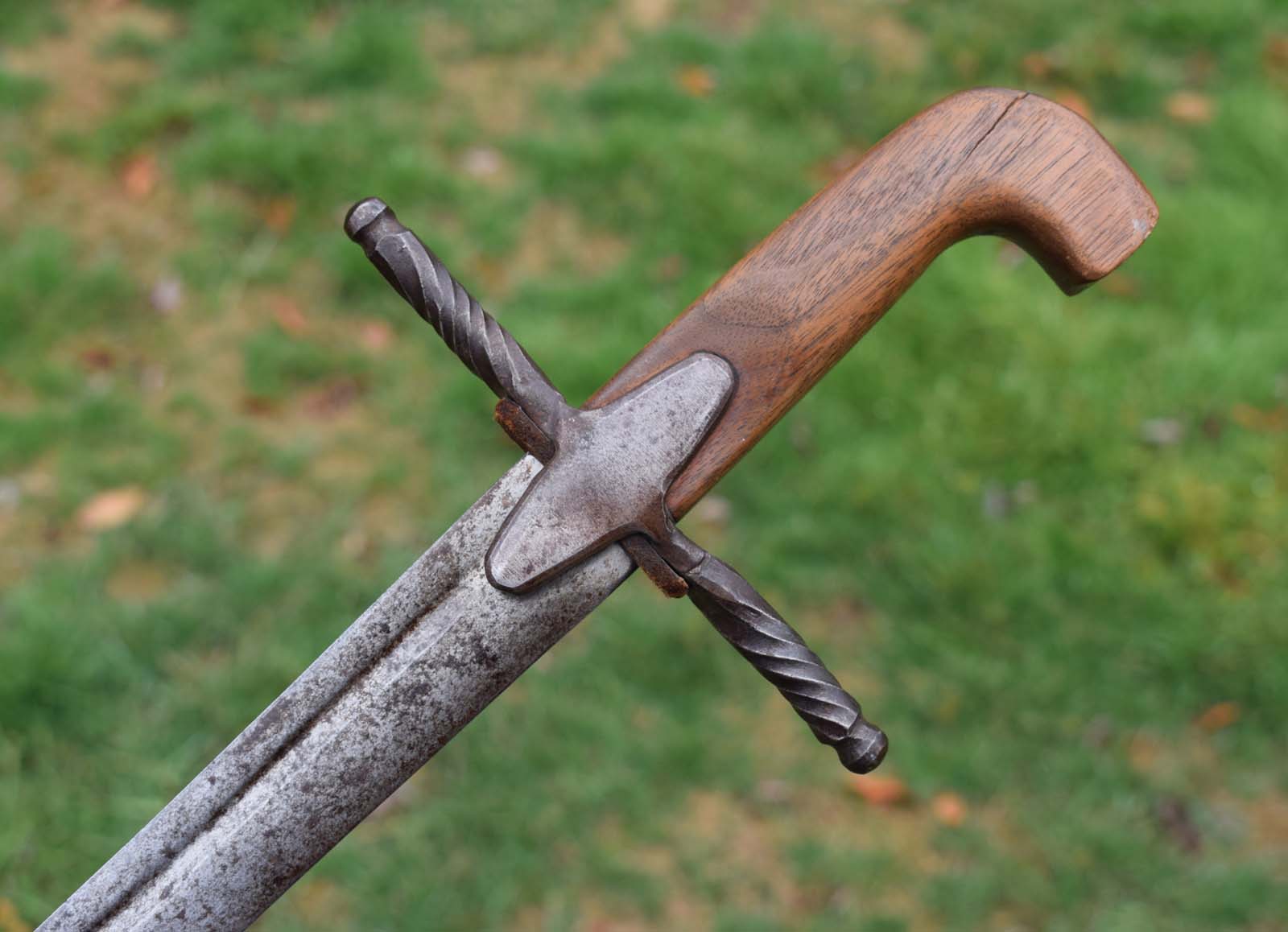
19th Century Turkish Or Hungarian Sword (shamshire)!. Here we have a wonderful Turk or Hungarian drastically curved saber! Blade is 31" long. Hilt has wonderful twisted iron guard and original wood "pistol" grip (some age cracks). A very impressive and very sturdy weapon! Selling at a bargain price! Price is firm. Thanks for looking! Be sure to check out our other listings for more great swords, arms and armor! Our direct email address is: fineartlimited@yahoo.com
  • Nation : US
  • Local Price : £200.00
US M1873 Socket Bayonet for the Springfield Trapdoor Rifle, Massachusetts National Guard. Socket bayonet for the Model 1873 .45-70 Springfield Trapdoor rifle, with fullered triangular blade and steel scabbard. Scabbard with drainage hole and frog hanging hook, black leather frog with rotating belt loop. The ricasso of the blade is stamped ‘MASS US’. The brass swivel of the belt frog is also cast with ‘MASS’ indicating that it was made for the Massachusetts National Guard. The leather inside of the scabbard loop is also roughly inscribed with ‘AL’, presumably a soldier’s initials. The last model of standard-issue socket bayonet, the M1873 was used with the 1873 and 1879 ‘Trapdoor’ Springfield rifles, until 1884 when the new model introduced a rod bayonet. Both bayonet and scabbard have been deeply blued and retain a great deal of this original finish. The leather frog is partly cracked along the seam attaching the semicircular ‘ear’ piece to the scabbard loop – it can support its own weight but should be handled with care. Some very minor flaking to the frog’s surface in places. The loop still rotates freely. One small dent to the flat side of the scabbard body.
  • Nation : British
  • Local Price : £200.00
British L1A3 Bayonet, Converted L1A1, Dated 1957 by Enfield. Straight single fullered blade with clipped Bowie point. Black finished steel hilt, black painted sheet steel slab grips secured by two rivets around concealed tang. Steel pommel with locking button, black finished steel scabbard with circular frog stud, frog of white woven plastic. The blade is stamped at the ricasso on one side with a broad arrow War Office ownership stamp and ‘57D’, the ‘D’ having a horizontal stroke extending from the vertical. The ‘D’ with a stroke extending from the vertical is a mark of the Royal Small Arms Factory at Enfield, while 57 is the date of manufacture. The grip slabs are each stamped with another ‘D’ with a stroke Enfield stamp and another broad arrow. The pommel is stamped on its base with the model ‘L1A3’, as well as with ‘0’ and ‘257’, the latter probably a serial or weapon number. The L1A1 bayonet for the SLR rifle was sealed as a pattern in 1957, and the L1A3 bayonet in 1958. Most of the newly made L1A1s were converted to L1A3s (which only involved milling a recess into the pommel allowing the press stud to be replaced) and later more L1A3s were newly manufactured. Being dated 1957 this example is most likely one such conversion of an L1A1. Its markings also show signs of conversion: the grips of either an L1A1 or L1A3 would normally be stamped with their model and NATO item number, but these would be incorrect after conversion and I think they have been deliberately removed on this example by grinding, and only new Enfield ‘D’ stamps were applied before the grips were refinished. The new model mark ‘L1A3’ was then applied by manual stamping on the pommel rather than trying to replace the factory stamping on the grips. The blade retains its black parkerised finish with only tiny bright spots of wear on raised edges. Some dimpled forging imperfections to the blade which have been parkerised over. Likewise some spots of wear to the finish on raised edges of the hilt, grips and pommel, a couple of very small chips to the scabbard with light rubbing at its chape end.
  • Nation : East India Company
  • Local Price : £200.00
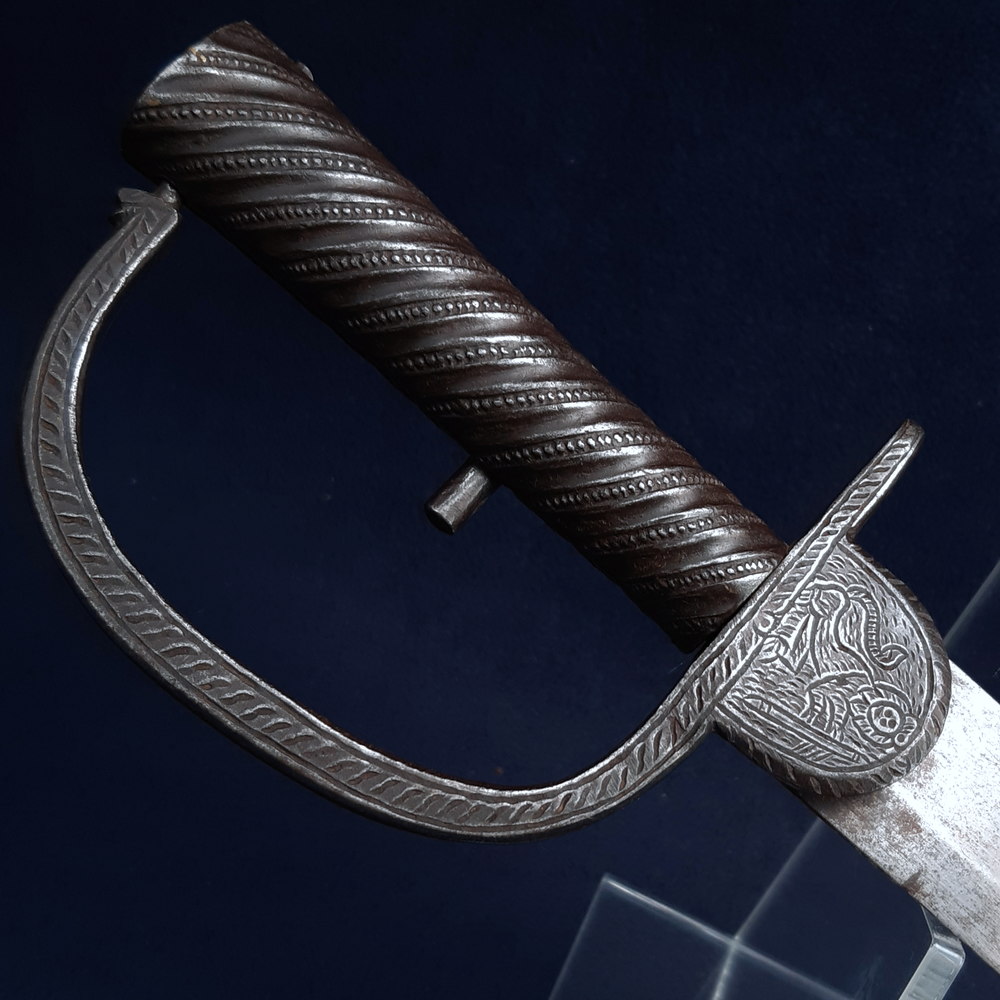
Indian or Nepalese 19th Century Baker-Style Bayonet. Straight, spear-pointed blade. Steel hilt with semioval langet on one side only and D-shaped knucklebow. Steel grip with beading and ribbing to its surface, formed of two halves brazed together, with mortise slot and inset steel leaf spring locking mechanism attached with a single screw. Blade 21 5/8 inches in length, 1.2 inches wide at the shoulder, with false edge for the last 5¾ inches, the bayonet 26 1/8 inches overall. The langet bears a chiselled design of a lion rampant with its paws on a staff with pennant or a flagpole – this resembles the badge of the East India Company, which was a lion rampant holding a crown between its forepaws, and it even more closely resembles the supporters of the Company’s coat of arms, which were lions rampant holding flags of St George on flagpoles. These bayonets are thought to have been manufactured in India or Nepal, probably to fit to locally-made percussion rifles made in the style of the British P1837 Brunswick rifle, this being cheaper than importing ‘official’ Brunswick bayonets. The design clearly harks back to the bayonet for the Baker rifle which preceded the Brunswick, that had been very popular among Indian troopers. Being local crafts purchased outside the Army procurement structure they carry no production markings. Some were found in the huge cache of surplus arms kept at the Royal Palace in Kathmandu, Nepal, and sold off in 2008. See page 346 of British Commonwealth Bayonets by Skennerton & Labudda, or page 318 of British & Commonwealth Bayonets by Skennerton & Richardson, for an example of this model (referred to as I3) and discussion of several variations of the type. Skennerton notes that the higher quality versions are those with steel hilts – this would make sense given the cost of steel hilts over brass. The locking mechanism functions, although I have not tested whether it will fit to a Brunswick. The blade has some forging imperfections, light scratching and some small spots of patination and light cleaned pitting in places, particularly towards the tip, which is rounded by ~3mm. A number of tiny nicks to both edges, one small notch to the true edge. The hilt has a dark forged finish with light rubbing wear to raised edges showing bright steel. The blade is solidly peened to the grip, slight movement to the knucklebow & langet.
  • Nation : French
  • Local Price : 195.00 USD
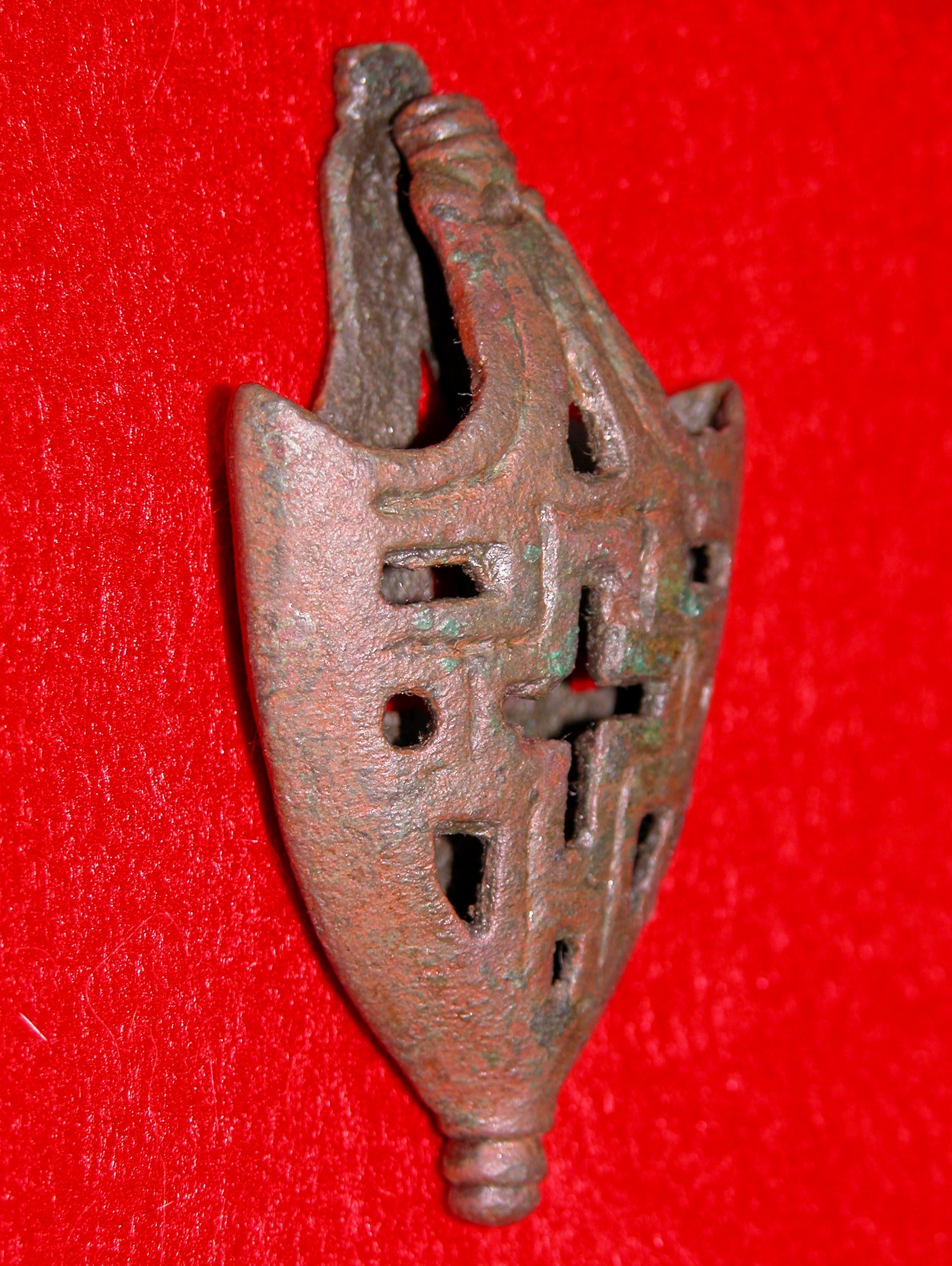
Crusader's Openwork Bronze Sword Scabbard Chape W/ Cross. #ac 123. Here is a very good decorated chape (drag) from a medieval sword circa 1200 AD. It was found in France with a metal detector in the late 20th century. It is in perfect condition with a slight bend from burial, see photo. It has a deep bronze/green patina overall. About 3†tall x 1 ½†wide. A nice example of early Christian art. The openwork is superb. Price is firm. Thanks for looking. Be sure to check out our other listings for more great swords, arms and armor! Our direct email address is: fineartlimited@yahoo.com
  • Nation : Chinese
  • Local Price : £195.00
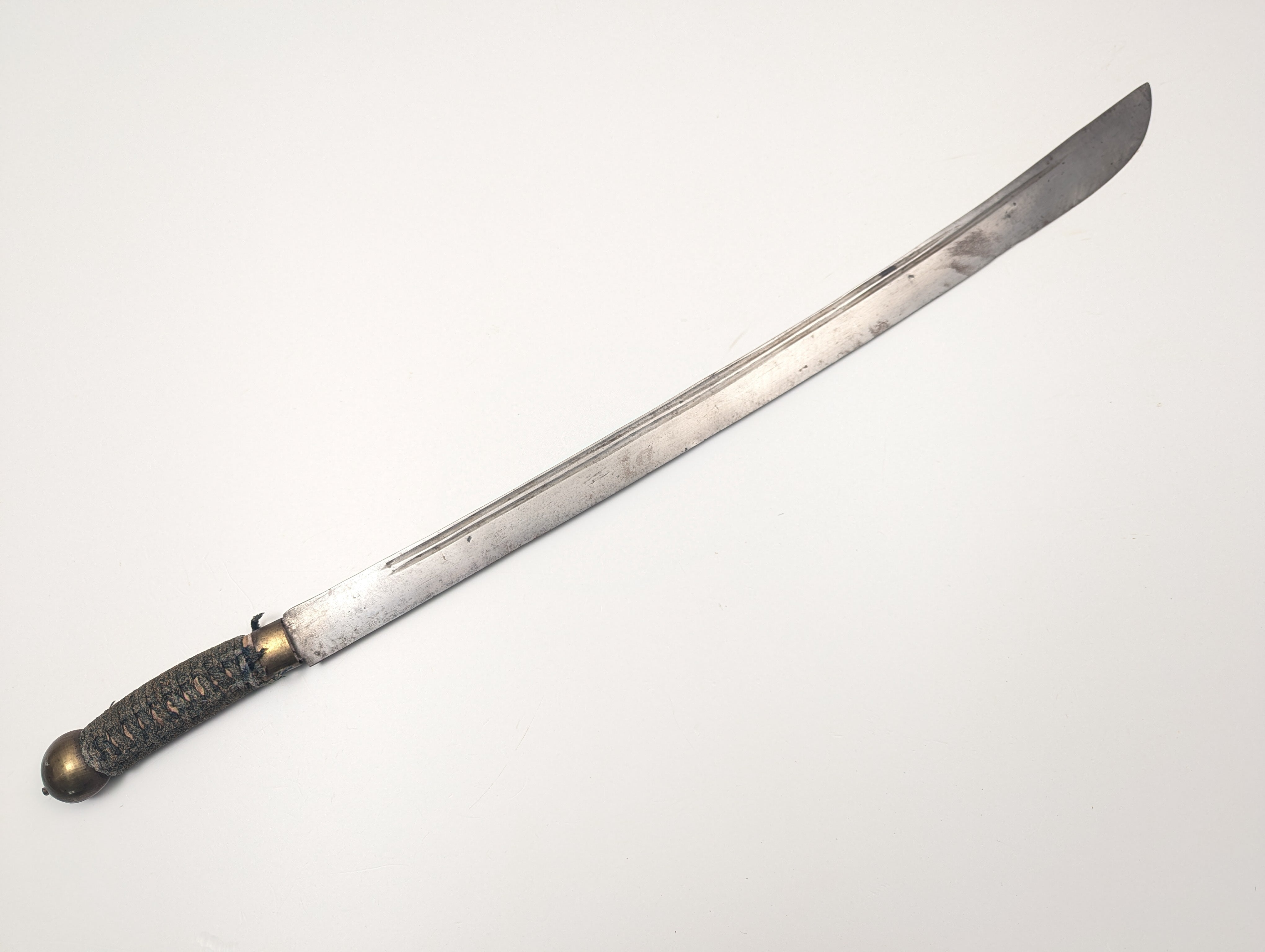
Chinese Military Sabre. Origin: China, Culture: Chinese, Period: 19th Century. A Qing period military sabre, lacking scabbard.
  • Nation : German
  • Local Price : £195.00
M1845 Saxon Infantry Pioneers Tessak. Origin: Kingdom of Saxony, Culture: Saxon, Period: 19th Century. M1845 Saxon Infantry Pioneers short sword.
  • Nation : Austrian
  • Local Price : £195.00
Austrian Socket Bayonet for the 1854 Lorenz rifle 1854-1867 -. 8424:60 An original Austrian socket bayonet for the 1854 Lorenz rifle 1854-1867. The bayonet is a cruciform socket bayonet (no. 17) which is distinquished by the helical locking slot as can be seen in one of the photographs. many of the bayonets were exported to the United States during the American Civil War. The blade measures 18" and the bayonet measures 22" overall. The socket measures 80mm and has an inside diameter of 22mm. The socket has a rotating locking ring which has a screw adjuster. The cruciform blade is in very good condition. On the ricasso there is a small manufacturers proof mark. On the elbow it is stamped with "26 490" and what looks to be "J5" The socket has helical slot. The bayonet has no scabbard. The price includes Uk delivery.
  • Nation : -
  • Local Price : £195.00
Norwegian M4 Bayonet Made By Coverting the Krag M1916 Shortened Bayonet, Scabbard & Frog Sn 8881:7 -. 8881:7 A coverted Norwegian M4 Bayonet made by coverting the Krag M1916 shortened bayonet, scabbard and frog. The bayonet was made by converting the Krag M1916 shortened bayonet from the 1930's by welding a muzzle ring to the crossguard. This was done in the 1950's when Norway, like the Dutch and many other countries were being supplied by the U.S.A. The bayonet has a 8 1/2" long singl edged blade which has a makers stamp at the ricasso "K" (Krag) It has a stepped muzzle ring welded to the crossguard and also has a push button to release the bayonet from the scabbard, as can be seen in one of the photographs. It has smooth wooded grips secured with one screw bolt. The scabbard is the correct scabbrd for the bayonet and is steel, painted black. It has a catch to secure the bayonet. The green webbing frog is riveted to the top of the scabbard and is stitched to form a belt loop and it also has a wire belt clip in the US style. The bayonet, scabbard and frog are all in very good condition. The price includes Uk delivery.
  • Nation : Indian
  • Local Price : £195.00
Indian Pattern No 1 MK II* Bayonet with unfullered blade, complete with Original No1 Shortened Scabbard. Sn 10880:35 -. 10880:35 An Indian Pattern No 1 MK II* bayonet with unfullered blade and complete with the original No1 shortened scabbard. This is a newly made bayonet by R.F.I. (Rifle Factory in Ishapore) in December 1942 which has a shorter unfullered blade and is not a conversion. (see page 349 item 154 in Skennerton's 'British & Commonwealth Bayonets' book). The bayonet has an unfullered 12" long blade which is blackened. It has slab grips secured by two screw bolts which have a white painted band around them. The pommel has a push button release and clearance hole, it has "68" stamped into it on one side. The crossguard is straight. The ricasso is stamped on one side with inspection marks on one side and with the Crown above "G.R.I. MK I* 12 42 R.F.I.". The No 1 scabbard is leather with metal chape and locket, it has two white paint bands around it. The scabbard has a large round frog button and three rivets above. The price includes UK delivery. P 1907 BOX. Sn 10880:35
  • Nation : -
  • Local Price : £195.00
Danish HTK M62 Bayonet, Scabbard & Intergral Frog. ED 2383 -. ED 2383 A Danish HTK M62 bayonet, scabbard and integral frog with belt loop and wire belt hooks. This was an American style M5A1 bayonet but newly made for the Danish Army and used as a trench knife. It is in it's correct scabbard with British 37 Pattern belt hooks added to the webbing frog. The bayonet has a steel pommel. It has black plastic diamond grips secured with two screw bolts. The grips incorporate a thumb push next to the cross guard which releases the bayonet. This operates smoothly and as it should. The cross guard is straight and has a locating pin attached to it. The blade is Parkerised and measures 6 1/4" long. The body of the scabbard is wood grain effect and the throat is marked with the Danish Crown over HTK (Haerens Tekniske Korps- Army Technical Corps). This is a scarce bayonet. (see pages 57 & 58 of 'An Illustrated History Of Bayonets' by Martin Brayley). The price includes Uk delivery. ED 2383
  • Nation : German
  • Local Price : £195.00
WW1 Imperial German Model 1888/98 Ersatz Bayonet And Scabbard. BAYO 39 -. Bayo 39 An original, excellent, example of a WW1 German Ersatz M88/98 bayonet with solid steel hilt. It has a half hoop, one piece stepped muzzle ring. (see page 143 & 153, No. 338 of The Bayonet Book by Watts & White). It has a 12 1/4" fullered blade which has just light staining consistent with age and is complete with it's original steel scabbard. The throat of the scabbard has a fixed locket and oval frog stud. Price includes UK delivery. BAYO 39
  • Nation : French
  • Local Price : £195.00
French M1956 Bayonet, Scabbard and Leather Frog. Bayo 255 -. Bayo 255 This is an early M1956 bayonet for the 49/56 MAS Rifle. It has the first pattern blade with the longer false edge and is contained in the first pattern scabbard of steel with leather frog. The crossguard is stamped with an "E" followed by "HF" The blade is parkerised and the grips are black plastic. It has an unusual double muzzle ring arrangement which was necessitated by the integral grenade launcher on the rifle. These bayonets are getting harder to find on the collectors market. (See 'An Illustrated History of Bayonets' by Martin J. Brayley, pages 78 & 79). The price includes UK delivery. Bayo 255
  • Nation : Unknown
  • Local Price : £195.00
A Beautiful Sword of the Mandinka, West African, with Elaborate Decorative Fittings 20th. Century. Curved on both sides, fluted back blade with baluster contrast stitching and leather-covered handle. Geometrically patterned leather scabbard with traditional banding patterns, stitched raffia decorations and braided suspension cords and leather fringe tassels. In some areas they are referred to locally as termed a 'kota' and that the scabbard was termed 'holga' ( house 'for the sword') The Mandinka are the descendants of the Mali Empire, which rose to power in the 13th century under the rule of king Sundiata Keita, who founded an empire that would go on to span a large part of West Africa. They migrated west from the Niger River in search of better agricultural lands and more opportunities for conquest. Nowadays, the Mandinka inhabit the West Sudanian savanna region extending from The Gambia and the Casamance region in Senegal to Ivory Coast. Although widespread, the Mandinka constitute the largest ethnic group only in the countries of Mali, Guinea and The Gambia. Most Mandinka live in family-related compounds in traditional rural villages. Their traditional society has featured socially stratified castes.Mandinka communities have been fairly autonomous and self-ruled, being led by a chief and group of elders. Mandinka has been an oral society, where mythologies, history and knowledge are verbally transmitted from one generation to the next. Their music and literary traditions are preserved by a caste of griots, known locally as jelis, as well as guilds and brotherhoods like the donso (hunters). Between the 16th and 19th centuries, many Muslim and non-Muslim Mandinka people, along with numerous other African ethnic groups, were captured, enslaved and shipped to the Americas. They intermixed with slaves and workers of other ethnicities, creating a Creole culture. The Mandinka people significantly influenced the African heritage of descended peoples now found in Brazil, the Southern United States and, to a lesser extent, the Caribbean
  • Nation : -
  • Local Price : £195.00
WW2, India Pattern No 1 MK.II Bayonet, Scabbard & Frog. Sn. 14931:5 -. 14931:5 WW2, Indian Pattern No. 1, MK II bayonet and leather scabbard. This is a newly made and not a converted 1907 bayonet. The bayonet is marked on the blade with a crown over G.R.I. followed by MK II 7 43 (July 1943) and R.F.I. (Rifle Factory Ishaport) The blade, retaining all of its original bluing has a false edge to the tip. The bayonet has slab wood grips which are secured with two screw bolts. The pommel has the correct release button which operates smoothly and it has a clearance hole. The leather scabbard is the correct shortened Pattern 1907 with steel mounts. The bottom chape carries the stamp E.E. over 41. The frog is standard Pattern 37 webbing with a top loop. (see page 348-351, item 154 in Skennerton's 'British & Commonwealth Bayonets book). The price includes UK Delivery. Sn 14931:5
  • Nation : -
  • Local Price : £195.00
U.S. Army Model 1873 Socket Bayonet For Springfield Trapdoor Infantry Rifles. BAYO 404 -. BAYO 404 This is an excellent, original, U.S. Army Model 1873 Socket Bayonet For Springfield Trapdoor Infantry Rifles This model of bayonet was the last to be adopted as standard issue by U.S. Forces (see White & Watts item No 909 Pages 410 & 430). It has a 18" Tri-form blade which is straight and has just light staining. It measures 20.875” overall length. The blade is stamped ‘U.S’ (Army) above letter ‘S’ inspection mark. The socket is complete with locking ring. The bayonet’s muzzle ring diameter is 19.5 mm. The price includes UK delivery. BAYO 404
  • Nation : German
  • Local Price : £195.00
Imperial German WW1 1915 Dated Old Pattern Model 1898/05aA (aA alter Art) Sawback Bayonet Complete With Steel Scabbard. BAYO 516 -. BAYO 516 This is a 1915 dated 1898/05aA ‘butcher’ bayonet with no flash guard and extended muzzle ring ‘ears’. The old pattern bayonets were issued without flash guards but early on in the war it was found that the muzzle flash from the K98 rifle was causing the wooden grips to char or even be blown off. It was then decided to fit a steel flash guard along the top edge of the hilt. This example pre-dates the fitting of this flash guard and also as the longer ears or extensions of the crossguard. The blade carries the Simson and Co. Suhl trademark and the spine carries a crowned W over 15. Most of Simpson and Co’s production took place in 1915 as they then concentrated on the production of rifles as did Haenel and Schilling. See German Bayonets, The Models 98/02 and 98/05 by Anthony Carter, pages 86 and 87. The price includes UK delivery. BAYO 516
  • Nation : -
  • Local Price : £195.00
WW2 India Pattern No1 MkIII* Bayonet, Scabbard And Frog. BAYO 513 -. BAYO 513 This is a nice and crisply marked No1 MkIII* India pattern bayonet. The blade carries the crown over GRI and MKII over 13 44 (December 1944 date) and R.F.I.. This bayonet was therefore made at the Rifle Factory Ishapore in December 1944. The bayonet has the squared pommel and parallel tang and grips which was a feature of these later bayonets, done in order to; save on machining time. The bayonet has an 11.9 inch blade with a false edge to the tip and carried several inspectors stamps. Many of these bayonets are marked on the blade as MK II when in fact the official designation was No 1 MK III*. The bayonet is contained in its original long No1 MKI scabbard with a tear drop frog stud. The frog is a P ’37 webbing version. See Skennerton item 156 on pages 346 – 356, in particular his comments of page 350 for items 155 and 156. This is a nice India pattern variation bayonet. The price includes U.K. delivery. BAYO 513
  • Nation : German
  • Local Price : £195.00
As Found WW1 (1917 Dated) German Imperial M84/98 2nd Model Bayonet, By J.A. Henckles, And Scabbard. Sn BAYO 524 -. BAYO 524 This is a WW1 (1917 dated) Imperial German M84/98 2nd Model bayonet by J.A. Henckels. The bayonet is stamped on the blade J.A. Henckels below their trade mark. The spine of the blade is stamped with a Crown over W 17 (1917) along with an inspection mark. The pommel also is stamped with an Imperial inspection mark. The bayonet is complete with its steel scabbard. See White & Watts No 283 on pages 115 & 128. The price includes UK delivery. (Box 2) BAYO 524
  • Nation : German
  • Local Price : £195.00
WW1 Imperial German Ersatz Bayonet. BAYO 571 -. BAYO 571 This is a scarce model of a German Ersatz bayonet with an extended muzzle ring. Ersatz bayonets usually have no muzzle ring or just a rudimentary ‘ears’ type configuration. This bayonet is similar to item 311 in The Bayonet Book by Watts &Watts and will only fit the Belgian Mauser M1889 rifle. The grip also appears to be the same shape as the Belgian model. This is a scarce variation that justifies further research. The price includes UK delivery. BAYO 571
  • Nation : -
  • Local Price : £195.00
Czech Knife Bayonet for the Model 58 Rifles & Scabbard. BAYO 6288. -. BAYO 6288 This is an excellent Knife Bayonet for Czech Model 58 rifles. The bayonet has a 6 3/4" parkerised single edged fullered blade with medial ridge. It measures 11 1/2" overall. The blade is stamped with the number '3801M'. The reverse is stamped '114'. It has curved wood grips and is without muzzle ring. It's leather scabbard is in similar excellent undamaged condition. It has a single angled belt loop, retaining strap and stud fastener. The rear is ink stamped with a 'crossed swords 64' ink stamp and partial circular ink stamp at the rear lower tip. All leather & stitching are intact. Price includes UK delivery. BAYO 6288. (Other Countries Box 2)
  • Nation : Italian
  • Local Price : £195.00
Italian WW2 Era, Model 1891 Carcano Leather Bayonet Frog. -. L 262 This is an original WW2 era Italian black leather bayonet frog for the Model 1891 knife bayonet fitted to the Model 1891 Mannlicher-Carcano service rifle. The leather frog is in excellent condition with no rips or tears. The stitching is complete and in good order. See item 337, Carter, Bayonet Belt Frogs Part II. The price includes UK delivery. (Belts Box). L 262
  • Nation : -
  • Local Price : £195.00
WW2.1943 Dated India Pattern No 1 MK.II* Bayonet And Scabbard -. BAYO 277 This is a nice WW2, 1943 dated Indian Pattern No. 1, MK II* bayonet and leather scabbard. This is one on the many variations of these bayonets and a large collection could be amassed of all the different patterns and variations with this pattern bayonet. This bayonet has a false edge tip to the blade and the ricasso carries 11* over N.W.R. (North West Railways) and 43 (denoting a 1943 manufacture date). See Skennerton item 154 on page 349 for similar and pages 346 – 351 for full descriptions of all the variations. The scabbard is a cut down No1 with steel mounts and a black leather body. The mount carries AK1941 and AH stamped into it. The rounded pommel has the correct release button which operates smoothly and it has a clearance hole. The price includes UK Delivery. BAYO 277
Page 47 of 54

The following items match your search but are currently listed on Ebay. We take no responsibility for any aspect of the listings or their accuracy.


Sorry, there is not any matching items.