
(You must register and have a linked account first)
View Privacy Policy


OR

Show


Forgot your password?

Error message here!

Error message here!

Error message here!

Error message here!

Show Error message here!

Show Error message here!


Lost your password? Please enter your email address. You will receive a link to create a new password.

Error message here!

Back to log-in

Close

For Sale

The following items are listed by for sale by users of the site and dealers. They are in no way endorsed or guaranteed by www.oldswords.com

Add a Classified Item
to

Clicking on the sword will take you through to the relevant classified item or dealer site.
Don't miss out! - Do you want to be kept informed weekly of new aditions? Just join our weekly update list.

You can also receive regular email notifcations when items match your keywords. To recieve them just register or logon at the top right of this page.
Page 24 of 41
  • Nation : British
  • Local Price : £465.00
British Enfield 1899 pattern Cavalry Troopers Sword. British 1899 pattern Cavalry Troopers Sword slightly curved blade in good condition spine stamped 99 and crown 75 E which is repeated on the blade the reverse side with issue and inspection dates plus EDF and broad arrow plus date 02. Steel bowl guard with reinforced edge, chequered leather grip fixed with three rivets, bowl guard stamped with unit marks – issue. It is complete with steel scabbard which shows inspection and issue stamps Overall length 40.5 inches blade 33.5 inches
  • Nation : Portuguese
  • Local Price : £465
Click and use the code >16828 to search for this item on the dealer website Good & Rare Antique, Malaysian, Kampilan Long Sword. A Sword Very Rarely Seen in Europe. The Kapampangan Name of the Kampilan was "Talibong" and The Hilt on the Talibong Represented the Dragon Naga,
  • Nation : British
  • Local Price : £465.00
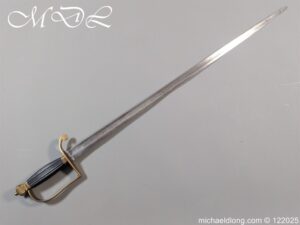
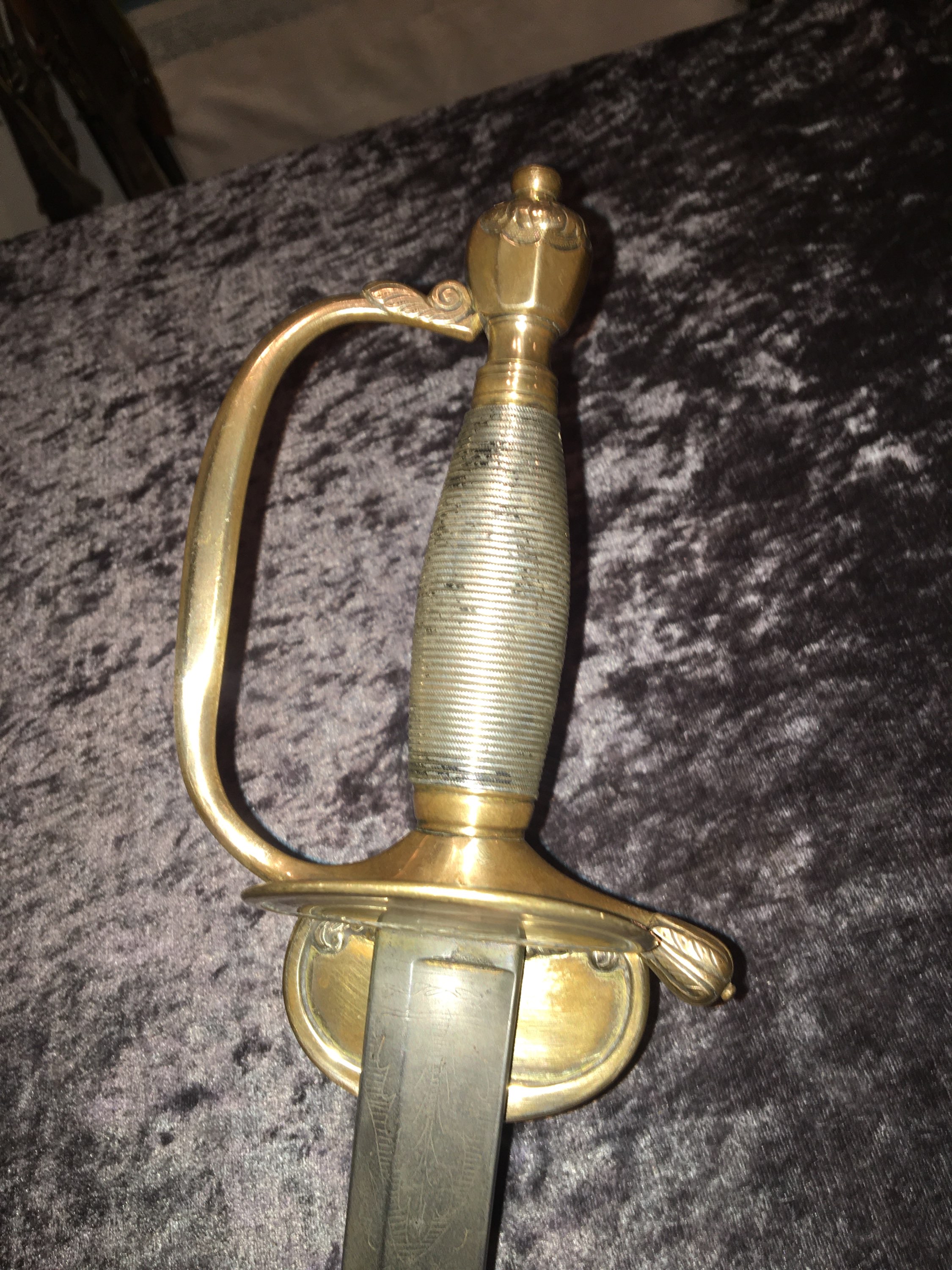
English Officers Spadroon c 1795. English Officers Spadroon c 1795 straight single edged blade with brass hilt comprising of pommel cap and raised tang button, knuckle bow and straight cross bar with fluted ebony grip. Overall length 37.25 inch the blade 31.5 inch
  • Nation : ?
  • Local Price : 475.00
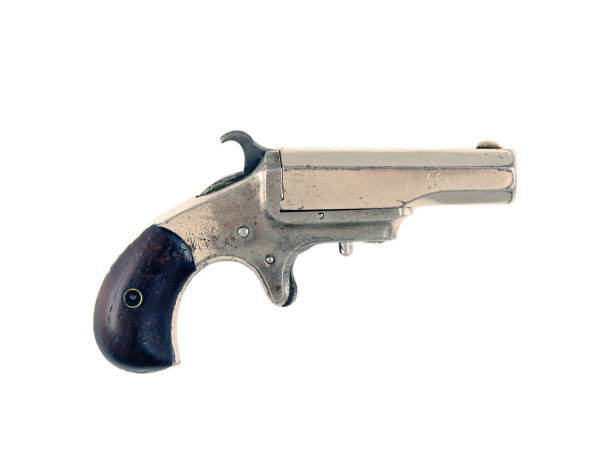
. An XL Derringer Pistol. Octagonal sighted barrel, stamped, ‘XL DERRINGER' along the top flat and the left hand side stamped, ‘PAT. APR. 5. 1870.' Retaining all original nickel plating, steel frame, with slab rosewood grips. Notes: Trigger return spring not working on this pistol. Dimensions: Bore: .41 Rimfire Barrel Length: 6.5 cm Overall Length: 12 cm
  • Nation : ?
  • Local Price : 475.00
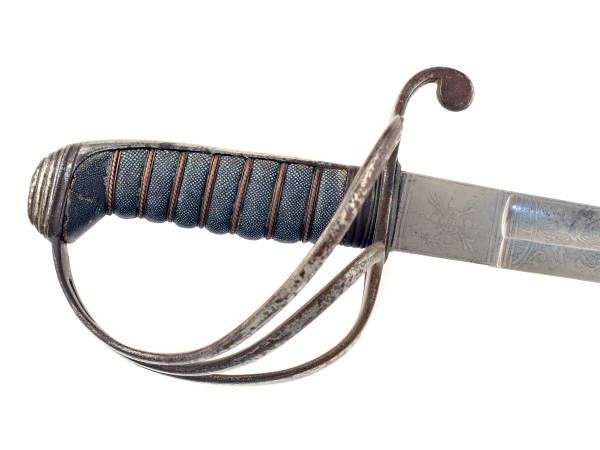
. A Scarce Prize Sabre for the Newcastle & Northumberland Vol. Cavalry which was the original name of the Northumberland Yeomanry. Formed in 1819 by Colonel Brandling for the purpose of ‘rendering effectual aid to the civil power in case of disturbance' the NNVC did indeed have to fulfil this function on several occasions in the early years including the strike riots of keelmen in 1822 when they remained on duty for 21 days and the miners strike of 1831 when they did 31 days on duty, in time such disturbances became less and the yeomanry were retained ‘for the purpose of defence against possible invasion'. They undertook 8 days annual training on the Town Moor and it was probably on these occasions that prize sabres were awarded for competitions or achievements such as best swordsman in a troop or proficiency in training. Prize sabres were often privately purchased and presented to troopers by officers or other benefactors of the regiment. The name of the regiment was changed to Northumberland (Hussars) Yeomanry Cavalry in 1876 and it went on to serve in the Boer War as Imperial Yeomanry where, along with Durham, Northumberland provided more volunteers than any other district and saw extensive service and in the First World War where the regiment was one of the first territorial units into active service and saw at action at First Ypres and many other engagements on the Western Front and at Gallipoli and other campaigns in the Middle East. 1821 pattern cavalry sabre with bright single edged blade double edged at the point, cut with a long fuller running along the back-edge, decorated with royal arms, scrolling foliage and, 'N.N.V.C. PRIZE SABRE' on a scroll, regulation steel hilt, with wire bound fish-skin grip, in original steel scabbard with two suspension rings. The fullered ‘Wilkinson' type blade indicates a date after 1845 but the lack of a proof slug and the style of the etching suggests a relatively early date of perhaps about 1845-50. Dimensions: Blade Length: 35.5 Inches (90.10 cm) Overall Length: 41 Inches (104.10 cm)
  • Nation : British
  • Local Price : £460.00
British 1899 Pattern Cavalry Trooper&#acute;s Sword, 18th Hussars and Surrey Yeomanry. Description Curved single-fullered blade with spear point, Steel bowl guard with turned-over inside edge, black pressed leather grips secured to the exposed full-width tang with three large rivets, steel pommel. No washer. Steel scabbard with two fixed hanging rings on opposing sides just below the throat piece. The ricasso of the blade is stamped on one side with a broad arrow War Department mark, the maker&#acute;s mark &#acute;EFD&#acute; for the Royal Small Arms Factory at Enfield, a crown inspection mark with &#acute;E&#acute; for Enfield, and an &#acute;X&#acute; indicating that the blade passed a manufacturer&#acute;s bending test. The ricasso is stamped on the other side with &#acute;01, its manufacture date, and another crown inspection mark with &#acute;E&#acute;. The spine of the blade is stamped with &#acute;/99, its pattern, and another Enfield crown inspection mark. The outside of the guard is stamped with &#acute;EFD&#acute; and another Enfield crown inspection stamp. The body of the scabbard is stamped on one side with the unit mark &#acute;18 H&#acute; indicating the 18th Hussars. The throat piece of the scabbard is stamped on the face side with the issue date &#acute;5 / 02&#acute;, another unit mark &#acute;3 P H&#acute; and serial number &#acute;133&#acute;. This unit mark and number have been cancelled with strikethroughs. I am not certain which regiment this signifies. It is stamped on the other side with &#acute;Y&#acute; over &#acute;S R&#acute;, over &#acute;37&#acute; (or possibly 87) indicating the Surrey Yeomanry. The throat piece of the scabbard is further stamped on the spine side with &#acute;01, the manufacture date, and a crown inspection mark with &#acute;W&#acute; for Wilkinson. The fixed hanging ring is stamped with &#acute;P 99&#acute;, the pattern. The body of the scabbard is stamped on the spine side with another broad arrow, another &#acute;01 date, and other Wilkinson crown inspection mark. Cavalry swords were typically handed down from regular cavalry units to yeomanry as they wore out or the pattern was replaced. As only the scabbard of this example is marked, one should note that it and the sword might not be an original pair, although their production dates are the same. The sword&#acute;s hilt shows signs of past repolishing, which may have removed unit markings in the usual position inside the hilt. The 1899 Pattern cavalry trooper&#acute;s sword was introduced on the 19th October 1899, eight days after the Second Boer War broke out. It was intended to be a refinement on the 1890 Pattern, with a slightly shorter blade, greater protection for the hand and a longer grip. Users generally considered it on the heavy side and much more effective in the thrust than the cut: this cemented the growing consensus that cavalry swords should be built entirely for thrusting.
  • Nation : French
  • Local Price : 635.00 USD
FRENCH ARTILLERY NON COMMISSIONED OFFICER’S SWORD 1884. 1816 pattern which was adopted after Napoleon's defeat. 31 ½” double edged double fullered blade of fighting weight. The base with cursive maker's inscription and date 1884. Brass hilt with double shell guards. The right with the artillery flaming bomb and the left, folding (fully functional). Wire wrapped grip. Brass mounted leather scabbard in excellent preservation. Superior example of an early Third Republic sword.
  • Nation : American
  • Local Price : £455
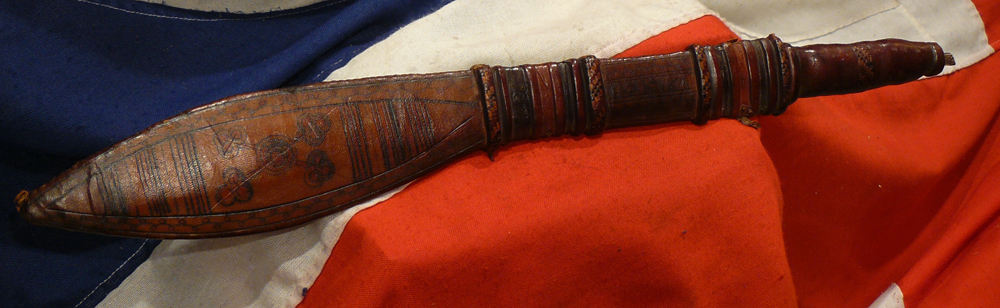
Click and use the code >17969 to search for this item on the dealer website 19th Century, Antique, Mandingo Mandinka Chief´s Slave and Gold Trader´s Sword With Tattooed-Leather Covered Wooden Scabbard
  • Nation : German
  • Local Price : 5,800 kr
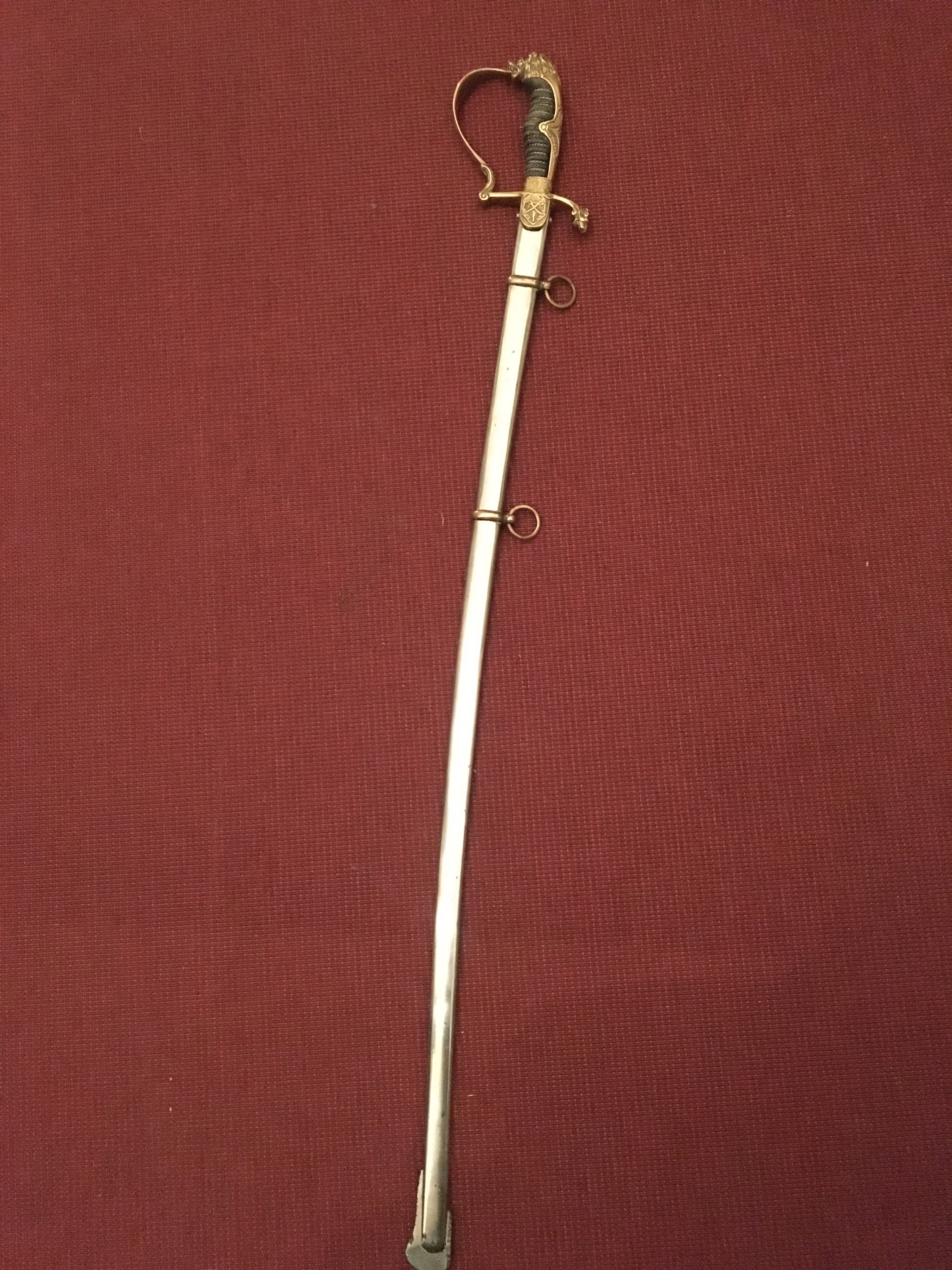
German cavalry officer saber 1860-1900.
  • Nation : British
  • Local Price : £450
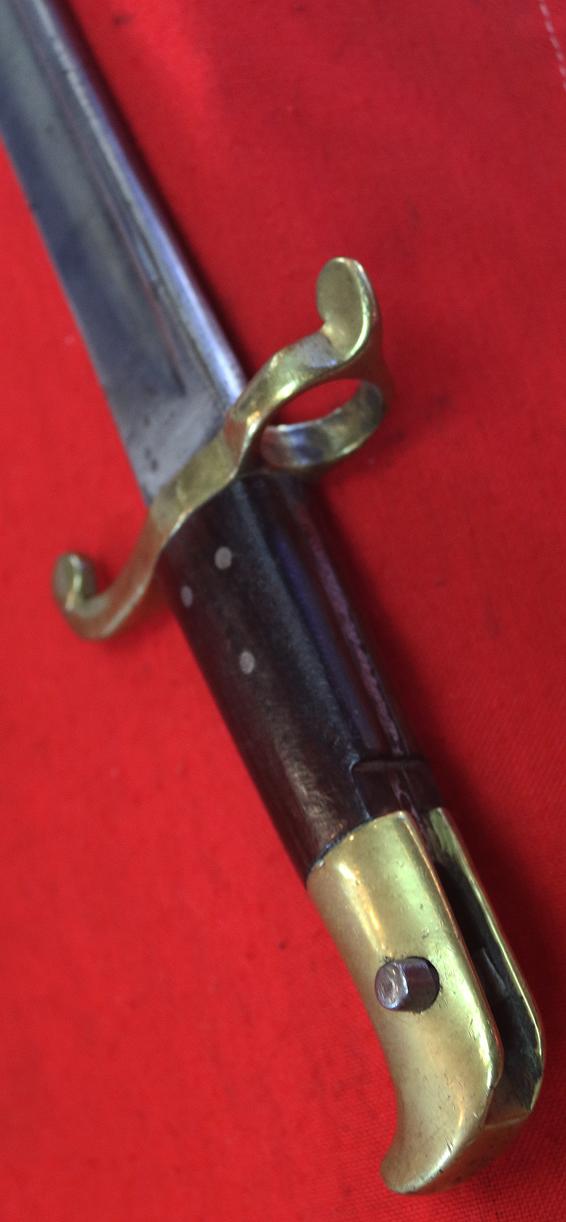
Click and use the code >25179 to search for this item on the dealer website Scarce Lancaster Oval Bore Rifle Sword Bayonet, Sappers and Miners 1855, Shortened Quill Back Blade
  • Nation : Japanese
  • Local Price : £450.00
Japanese Model 1899 Type 32 Army NCO Sword. Otsu. #2509011. The Type 32 (Model 1899) had a machined blade and was manufactured at the Tokyo Hohei Kosho Arsenal. The sword saw service during the Russo-Japanese War (1904-1905), World War One (1914-1918) and on into World War Two (1939-1945).Two patterns of the Type 32 were produced. The first pattern, known as ‘Ko,’ was issued to cavalry troopers and had a blade length of around 830mm. The second pattern, known as ‘Otsu,’ was issued to army NCOs and was shorter, with a blade length of around 770mm. This example is an ‘Otsu’ pattern Type 32 infantry NCO’s sword. The 770mm Katana profile blade has a single edge and long, narrow fuller below the flat spine. The slightly curved blade is in good condition with sharpening scratches along the cutting edge. The ricasso is stamped with the serial number 102629.The steel D guard has a crosshatched steel back strap and dove head pommel. The hilt retains its original finish. The crosshatched wooden grip is in good condition. The locking catch is in good working order. The front of the guard bears Tokyo arsenal and inspection stamps.The sword is complete with its blackened steel scabbard with a single hanger-ring. The scabbard is in very good condition. The shoe of the scabbard bears the serial number 102921. The sword sheathes and draws smoothly and is held firmly within the scabbard. This is an increasingly hard to find Imperial Japanese army NCO’s Type 32 sword in good, honest condition.
  • Nation : French
  • Local Price : £450.00
French M1882 Light Cavalry Trooper&#acute;s Sword by Chatellerault, 1883. Description Straight fullered blade with spear point. Black leather washer. Brass three-bar hilt, brass oval pommel cap. Grip of black leather over wood, bound with brass wire. Steel scabbard with single band with hanging ring. The spine of the blade is engraved with &#acute;Mre d&#acute;Armes de Châtt Janvier 1883 Cavrie legere Mle 1882&#acute;, indicating that it is the Light Cavalry Model 1882, and was made at the state arsenal at Chatellerault in January 1883, during the Third Republic. The knucklebow of the hilt is stamped with the serial number &#acute;2861&#acute;, and several poinçons (punch marks). The blade is stamped at the forte on one side with three poinçons, one of a star within a triangle, another of the letter &#acute;R&#acute; within an circle and a third of the letter &#acute;B&#acute; within a circle. The upper band of the scabbard is stamped on one side with the partly legible serial number &#acute;28__&#acute;, which suggests it and the sword are probably a matching, original pair. There are a few scattered stamps on the spine of the scabbard near the throat, including the numbers &#acute;22&#acute; and &#acute;8&#acute;. Created in 1816, the Manufacture de Chatellerault, near Poitier, grew to become a key arms factory for the French state. In the 1830s it took over from the Maubeuge, Charleville and Klingenthal plants, all of these being considered too close to the German border to be relied upon in a war. During the late 19th and early 20th century production of swords at Chatellerault decreased while firearms manufacture massively increased. However, despite increasing use of machine tools and the nearing obsolescence of the sword, the blades continued to be hand-forged until 1916. Production of swords there ended in 1937. The blade is bright with only a few areas of light patination mainly in the fuller. Its unsharpened edge has only one very small nick, its tip is undamaged. The brass hilt and pommel have an even patina with a few spots of darker patination. The grip has some handling wear, the leather covering worn away in places on the ridges of the ribs, exposing the wood core. The wire binding of the grip has mostly been lost, with only two loops remaining at the pommel end. There is a split running along most of the grip, perhaps due to leather shrinkage with age or the lack of wire binding to hold the leather in place. This gap has been filled in with a hard black material matching the black leather. The scabbard is free of dents but is pitted overall, most heavily at the chape end.
  • Nation : German
  • Local Price : £450.00
Prussian M1816 Infantry Hanger / Sabre. Description Curved hanger blade with single narrow fuller running close to the spine and hatchet point. Cast brass heart-shaped hilt with short quillon and knucklebow, black leather washer, brass grip with diagonal grooves on one side and smooth on the other, round brass pommel. Black leather scabbard with inset brass frog hook and brass button chape. Blade 25 1/8 inches (64.2cm) in length past the washer, the sword 31 inches (78.7cm) overall. The blade is etched at the forte on both sides with the crown and cypher of King Friedrich Wilhelm (Frederick William). Depending on when this blade was made this would be either Friedrich Wilhelm III or IV. A small floral motif is etched below. The knucklebow is stamped with a Prussian unit mark reading &#acute;3: No. 122.28.L.R.&#acute;. The outside of the hilt is stamped with &#acute;1Y.1.6.&#acute;, which may be another unit mark. The M1816 was a near-copy of its predecessor the M1715 infantry sword. The Napoleonic Wars having finally concluded, the Prussian army chose in 1815 to adopt the French infantry saber as standard for their infantry “ the Guards regiments however preferred the old Prussian model and so new stocks were produced. The blade is of the form the English called a &#acute;hanger&#acute; although German sources consider it a sabre. Sturdy and simple to produce, these swords had a long service life, remaining in use longest as a parade weapon with the SchloÃ&159;garde-Kompanie (guards of the royal palaces) until they units were disbanded with the end of the Prussian monarchy in 1918. The blade is bright and clean with only a few tiny spots of patination and no damage to its edge. Two small spots of pitting near the etching on one side. The brass of the hilt has a light, even patina and no major dents or cracks. The leather of the scabbard has some cracking and flaking but is generally in good order, the sword sheathes and draws smoothly.
  • Nation : Swiss
  • Local Price : £450.00
Swiss m1878 Pioneer Sword. A Swiss Model 1878 Pioneer short sword by Gerbrueder Weyersberg SolingenThe steel sawbacked blade has a fuller on one side of the blade, the front is marked with makers name and Swiss cross and the reverse has the serial number 1349 and the date the date 1883. The handle has black chequered grips secured by 5 brass rivets, brass pommel cap and crossguardIt measures 25" overall with a 19" blade. A scarce Swiss sword in Excellent condition
  • Nation : Swiss
  • Local Price : £450.00
Swiss 1842 Pattern Sawback Pioneer’s Sidearm, Dated 1891 by Wester & Co., Solingen. Description Straight double-edged blade with sawback. Ribbed solid brass hilt with cross guard and oval pommel. Scabbard of black leather-covered wood with brass fittings at throat and chape. Maker&#acute;s marked to the ricasso with &#acute;Wester & Co Solingen&#acute; and on the opposite face stamped with the serial number &#acute;21964&#acute; and date of manufacture &#acute;1891&#acute;. Sidearms with the form of a neoclassical &#acute;gladius&#acute; appear to have originated with the French 1771 &#acute;Eagle Head&#acute; Artillery sword. A series of very similar-looking short swords were subsequently designed, including the French 1816 & 1831 Artillery, the US Model 1832 Foot Artillery, the Swiss 1842 Pioneer&#acute;s, the Russian 1848 Pioneer&#acute;s and the British 1855 Land Transport. While durable and simple to manufacture, they were not particularly useful for combat (the gladius having become obsolete for good reasons) so remained either ceremonial items or in the role of a machete for various field tasks such as clearing brush. Blades with a saw-toothed back were also tried during this same period in an attempt to add functionality as a tool, such as on the British 1871 and 1879 pattern bayonets for the Martini-Henry rifle, and the Pioneer&#acute;s swords of various nations. Such attempts were generally considered failures, as a sawblade needs to be much narrower and longer than a short sword or bayonet to cut efficiently, and the soldiers had trouble sharpening the saw after use. This model combines both fanciful features in one. Blade is mint. Leather washer is present and intact, the leather of the scabbard has minor scuffing consistent with age. The scabbard&#acute;s frog hook is very slightly bent, still intact and usable.
  • Nation : Swiss
  • Local Price : £450.00
Swiss M1878 Vetterli Sawback Bayonet. Description Straight spear pointed blade with sawback and false edge, with single fuller on one side, the other side completely flat. Steel hilt with upper muzzle ring & foresight notch and lower lobe quillon, beaked steel pommel with locking button and external leaf spring for the locking mechanism. Slab grips of chequered gutta percha (a form of natural rubber) secured by four steel rivets, the leaf spring running through and screwing into the centre of the grip on the fullered side. Brown leather scabbard with steel throat and chape pieces, the throat piece with frog loop, the chape piece with ball finial. Leather frog, its front side black, reverse brown. The blade is stamped at the ricasso with the manufacturer &#acute;S J G Neuhausen&#acute;, and on the hilt with the serial number &#acute;14460&#acute;. The pommel is stamped with &#acute;D&#acute; and the lobe quillon is stamped with a Swiss cross and &#acute;C&#acute;. The frog is stamped with &#acute;J. Schmid 1888&#acute;, probably its manufacture date, and the reverse is stamped with a Swiss cross and &#acute;B&#acute;. The scabbard finial is stamped with a Swiss cross. Thought to have been inspired by the British Elcho bayonet, the Swiss M1878 fitted to the 10.5mm Vetterli repeating rifle. This rifle was introduced in 1869 and originally used a socket bayonet. When the switch to a sword bayonet was ordered, the new model was designed to mount on the right side of the barrel rather than below it, like a socket bayonet, and with unusual projections from the muzzle ring that engaged with the foresight as it locked into place. Its blade is also unusual in that it is flat on one side and with a ground edge on the other. It incorporated the then-popular &#acute;sawback&#acute;, saw teeth cut into the spine of the blade intended to make it useful for field work like cutting brush. The bayonet&#acute;s length is noticeable “ when mounted the rifle and bayonet together are more than 6 feet in length. There are several successor models which used the same blade - the M1878 is the earliest version, produced for only three years, distinguishable by the four rivets used in its grip (reduced to three in the M1881). The blade is bright and clean overall, with only some very small spots of pitting towards the point on the flat side. The saw&#acute;s teeth are unbroken and do not appear heavily used. The grips are in good condition with no cracking, a couple of small chips around the rivets. No dents to the scabbard fittings. Some light dents and occasional scratches to the scabbard leather, its stitching is all intact. The black finish has rubbed on the front of the frog&#acute;s belt loop, but only where the pommel contacts it while sheathed. No retaining strap “ this is a separate leather piece that would thread through the loop on the scabbard&#acute;s throat piece and attach to the buckle on the frog. The scabbard still sits in the frog correctly but can&#acute;t be locked in place with the belt & buckle system.
  • Nation : British
  • Local Price : £450.00
British 1905 Pattern Infantry Staff Sergeant&#acute;s Sword by Enfield, George V Rehilt and Conversion. Description Straight single-fullered spear-pointed blade. Pierced hilt similar in form to the 1897 pattern infantry model, with pierced decoration including the crown and cypher of King George V. Fully chequered backstrap, integral oval pommel with tang button. Wire-bound shagreen grip, brown leather washer. Blade length 32¼ inches, 38 inches overall. Nickel-plated steel infantry parade scabbard with two hanging rings. The blade is stamped at the forte on one side with a broad arrow, indicating War Department property, the maker&#acute;s mark &#acute;EFD&#acute;, indicating the Royal Small Arms Factory at Enfield, a crown inspection stamp with &#acute;E&#acute; for Enfield and an &#acute;X&#acute; indicating that the blade passed a manufacturer&#acute;s bending test. It is stamped on the other side with two further crown inspection stamps for Enfield, the manufacture date &#acute;00, and issue stamps &#acute;01 and &#acute;03. What sets this sword apart is its blade, which on close inspection is not the symmetrical infantry officer&#acute;s model introduced in 1892. Its fuller is wider and runs more along one edge of the blade. Rather than tapering as the blade does it remains about as wide, taking up almost the full width of the blade by the end of the fuller. This suggests that it is in fact not an infantry blade at all, but a modified 1899 Pattern cavalry trooper&#acute;s sword blade. Surplus cavalry blades of this pattern were used to manufacture the 1905 Pattern staff sergeant&#acute;s sword, an uncommon type which is thought to have been brough in to replace swords lost in the Boer War without too much expenditure. Unlike officers who privately purchased and owned their own swords, staff sergeants were issued their swords from regimental stores like a musket or bayonet, and the swords remained government property. In 1912 both the 1898 and 1905 Pattern staff sergeant&#acute;s swords were officially rehilted to replace the old royal cypher with the new one of King George V. This sword may be one of these modified examples, although its modifications have gone much further than rehilting. The blade has been shortened and narrowed (1 inch wide at the shoulder and 5/8 of an inch at the end of the fuller), with material removed from the belly and the false edge. The spine has been slightly narrowed and rounded. This has entirely removed the cutting edges, and a new thinner spear point has been created and profiled, although not sharpened. The overall effect is to bring the blade closer to that of the infantry sword, to such an extent that it now fits in an infantry officer&#acute;s scabbard. This version would certainly have stood out less on parade than the larger scabbard which had to be made for the 1905 Pattern. The issue stamps seen on the blade match those seen on 1899 Pattern swords and suggest that the blade might have seen some use before being used in the conversion “ with the degree of modification even a damaged or training-purpose cavalry blade could have been used. The blade is bright with only very light patination in places and a polished finish. The hilt is undamaged with a light patina. The shagreen of the grip is all intact with very little handling wear, the wire binding is all present with very slight movement to the loops. The ferrule can shift slightly side to side with pressure “ I suspect as a result of the conversion the tang is not quite the right thickness. The scabbard is bright, free of dents with only a few tiny areas of wear to the plating.
  • Nation : -
  • Local Price : 625.00 USD
NEW YORK MILITIA PRESENTATION SWORD 1912. Standard pattern. See The American Sword, Peterson #11. Gilt brass hilt with bow tie form guard and plumed helmet pommel, retains considerable gold finish. Fine reeded bone grip. 30” straight double edged blade decorated first half with foliage, U. S. and maker's name Ridabock & Co. New York on gold ground, one side. The opposite with profuse elegant presentation inscription to Sgt. Samuel R Burns, 4th Co., 7th Reg., NY National Guard. Date Jan 15, 1912. Brass mounted leather scabbard with stabilized kink, otherwise excellent. Very rarely encountered.
  • Nation : American
  • Local Price : 625.00 USD
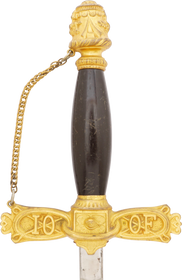
FINE AMERICAN SECRET SOCIETY SWORD C.1880. The Odd Fellows, founded in England in the 18th century, was a secret society which promoted brotherhood and good will among its members. It is thought that the name referenced skilled workers in fields outside the organized guilds and thus outsiders to the main workers community. This sword is a fine example, beautifully finished and lavishly overlaid in pure gold, nearly all of which remains in bright presentation. The 28” blade, in virtually as new condition, is decorated with gilt foliate panels with King David Encampment No. 42 Fitchburg Mass. and the owner's name. Maker's name f t Littlefield Portland Maine the ricasso. The whole is as fine a preservation as can be found for the period. The owner's name, C M Flinh, which we ordinarily do not list, is of such rarity as to beg for further research. Exhaustive search by AI reveals a single Flinh family in Maine in 1880. As information on the internet evolves, it is likely that further details of the family and this sword's owner will become available. That aside, it is as fine a sword of the period as can be found. If it were a military sword, it would command a price in the $3000-4000 range.
  • Nation : -
  • Local Price : 625.00 USD
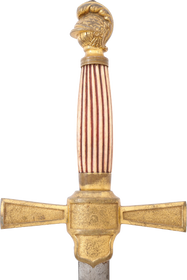
RARE EARLY MASONIC SWORD C.1840-50. An example of the swords produced for private purchase in the Ante Bellum period and sold extensively to militia officer's, North and South. This example saw service as a Masonic sword, differing only in that the scabbard is engraved with the Masonic square and dividers surrounding G, and the bone grip has been painted maroon. The hilt and scabbard mounts retain near all original gold finish. The scabbard covering appears newer, replaced during its working life. The 25 ¾” blade is etched with Franklin R A Chapter on one side and Greenfield Mass. the other. The Franklin Royal Arch Chapter was established Jan. 17, 1818 so this sword was that of a very early, if not founding member. It dates to the period of the Anti-Masonic fervor of the 1820s–1830s. About 75% of U.S. lodges disbanded or went dormant by the mid-1830s.
  • Nation : German
  • Local Price : 625.00 USD
IMPERIAL GERMAN OFFICER’S SWORD, 19TH CENTURY. Second half of the 19th century. Gilt brass hilt with P form guard slotted for a sword knot, retains about 90% original gold surface. Wire wrapped black leather grip. 31 ½” curved broad fullered blade with near all bright finish and scattered freckling of oxidation only, unmarked. Iron scabbard shows chocolate brown patina with frosty surface. No damage or dents. The gilt mounts with about 50% gold surface intact.
  • Nation : British
  • Local Price : $850.00 CAD
BRITISH “LEAD-CUTTING” NO. 1 P.1870. BRITISH “LEAD-CUTTING” NO. 1 P.1870: Maker: MOLE. Massive 31 inch heavy blade. Some stains otherwise excellent. The cutlass style hilt with iron grip retains much of the original black paint. These swords were used for strengthening the troopers’ arms. (Robson #233) $850.00
  • Nation : British
  • Local Price : $850.00 CAD
BRITISH P.1822/66 SERGEANT’S SWORD. BRITISH P.1822/66 SERGEANT’S SWORD: Maker; MOLE. Birmingham Inspector’s stamp on the ricasso of the plain 32 ½ inch blade. Brass hilt and scabbard mounts. Wire-bound fish-skin grip is excellent. Victorian cartouche in hilt. (Robson P.217) $850.00
  • Nation : British
  • Local Price : $850.00 CAD
CANADIAN LORNE SCOTS BROADSWORD WITH CROSSBAR HILT. CANADIAN LORNE SCOTS BROADSWORD WITH CROSSBAR HILT: Lovely 33 inch blade with the Tudor Crown over the Lorne Scots Crest on one side, the other side is etched with the Tudor Crown over the Cypher of George V. Some minor speckles on the blade. Wire-bound fish-skin grip shows a little wear. Robson P.184 & 185. $850.00
  • Nation : British
  • Local Price : $850.00 CAD
BRITISH P.1822 INFANTRY ADJUTANT OFFICER’S SWORD. BRITISH P.1822 INFANTRY ADJUTANT OFFICER’S SWORD: With Cypher of William IV (1830-1837). The Pipe-back blade is excellent with etched panels of William IV on each side. Brass hilt with folding guard and cartouche of William IV, wire-bound fish-skin grip is excellent. In April 1832, adjutants were ordered to carry a steel scabbard except at Levees, and evening dress when the brass mounted black leather scabbard was to be worn. Robson #144. Rare in the steel scabbard. $850.00
  • Nation : British
  • Local Price : $850.00 CAD
CANADIAN TRIALS P.1864 TROOPERS SWORD. CANADIAN TRIALS P.1864 TROOPERS SWORD: Maker: Mole, stamped on back edge by the hilt. Blade is otherwise unmarked. It is well known and documented that the major complaint of the P.1864 sword was that of the hilt which damaged the trooper’s tunics. This is a Canadian attempt to rectify that problem, by cutting away the inner edge to lessen the chafing on the uniform. The lip of the guard is stamped “25”over “B”. At this period in time, that would have been B Troop of Leeds, (Brockville). The scabbard is stamped “E” over “46” and at this period in time that would have been 1st Guelph. The scabbard is the very rare Canadian modification of the P.1853 scabbard by placing the rings at the top of the scabbard, dating this modification to Post 1885 as this method was adopted for the P.1885 sword (see Vol. 13 C.J.A.C. – copy with sword). The model P,1864 was never popular with the troops, many attempts were made to improve it, hence the adoption of the P.1882 and P.1885 swords. $850.00
  • Nation : British
  • Local Price : $850.00 CAD
BRITISH P.1889 SERGEANT’S SWORD. BRITISH P.1889 SERGEANT’S SWORD: Maker: Mole. Marked to the 35th Regiment of Foot, The Royal Sussex Regiment. MATCHING marks on the guard and scabbard. Brass hilt with Victorian Cartouche is a lovely plum brown. The bright, clean 32 ½ inch blade is dated AUG. 1890 and 1904 with Birmingham Proofs. Small area of light scratches on the left side. The wire-bound fish-skin grip is very good. Portions of the large central wire are missing. The scabbard throat is stamped “MOLE’s PATENT”. This scabbard is unique to this model. (Robson #199) $850.00
  • Nation : British
  • Local Price : $850.00 CAD
BRITISH ROYAL ENGINEER’S DRIVER’S SWORD. BRITISH ROYAL ENGINEER’S DRIVER’S SWORD: Blade by Schnitzler & Kirschbaum (ceased operations Circa 1864/65). Back edge is stamped CROWN over “FW” (Frederick Wilhelm) and dated 1849. The left ricasso is stamped with the Crown over “L” over “8”,the British Liege Inspector’s stamp. The 35 inch blade with cancelled BROAD ARROWS is very nice as is the iron hilt. Black leather covered grip. This was a German Trials Pattern Sword M.1849. It would appear it was also on trial with the British. Robson Pg.213. VERY RARE. $850.00
  • Nation : Indian
  • Local Price : £445
Click and use the code >24207 to search for this item on the dealer website Beautiful Early Sikh Khanda Hilt Firangi Sword 17th to 18th Century
  • Nation : Austrian
  • Local Price : 615.00 USD
AUSTRIAN 1861 INFANTRY OFFICER’S SWORD. Iron hilt with double slotted guard. Brass wire wrapped ray skin grip (small loss at the heel). 29 3/4” slightly curved broad fullered blade with dedication at the forte: Ehre (honor) W T Flicht 1878-1898, commemorating his service upon retirement. Reverse with E JUNG, Vienna sword maker. Hilt shows most original plating with uniform smooth brown patina to the balance. Iron scabbard complete, with remnants of plating. 
  • Nation : Chinese
  • Local Price : £440.00
Chinese Shuangjian Double Shortswords, Late 19th Century. Description Two straight, spear-pointed blades with flattened diamond cross-section, each with cast brass hilt and pommel, horn grips, both fitting together into a wooden scabbard covered with smoothed rayskin, with five cast brass fittings, two with fixed hanging rings. A fine brass chain is attached to a loop on the pommel of one of the swords, the other pommel has the same loop but no attached chain. Blade length 16.5 inches, overall length of each sword 22 inches. The hilt of each sword depicts a taotie or &#acute;greedy glutton&#acute;, a Chinese mythological monster which was one of the &#acute;Four Perils&#acute;, lacking a lower jaw to emphasise its insatiable hunger. Like the lion often used on European swords, the taotie symbolized both threat towards enemies and protection of one&#acute;s own. The pommel is cast with a foliate pattern, and the scabbard fittings with a dragon motif framed by a Greek key or &#acute;rolling thunder&#acute; pattern and more foliate designs. Jians were commonly worn in China during the Qing period. Shuangjian (é›&#acute;å
  • Nation : British
  • Local Price : 5,600 kr
English infantry officer sword m/1796.
Page 24 of 41

The following items match your search but are currently listed on Ebay. We take no responsibility for any aspect of the listings or their accuracy.


Sorry, there is not any matching items.