
(You must register and have a linked account first)
View Privacy Policy


OR

Show


Forgot your password?

Error message here!

Error message here!

Error message here!

Error message here!

Show Error message here!

Show Error message here!


Lost your password? Please enter your email address. You will receive a link to create a new password.

Error message here!

Back to log-in

Close

For Sale

The following items are listed by for sale by users of the site and dealers. They are in no way endorsed or guaranteed by www.oldswords.com

Add a Classified Item
to

Clicking on the sword will take you through to the relevant classified item or dealer site.
Don't miss out! - Do you want to be kept informed weekly of new aditions? Just join our weekly update list.

You can also receive regular email notifcations when items match your keywords. To recieve them just register or logon at the top right of this page.

Page 25 of 41
  • Nation : British
  • Local Price : $795.00 CAD
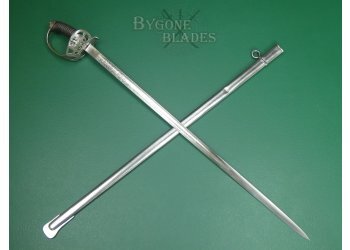
BRITISH P.1822/45 GENERAL OFFICER’S SWORD. BRITISH P.1822/45 GENERAL OFFICER’S SWORD: Maker: E. THURKLE, Maker, SOHO, LONDON. Thurkle worked at this address from 1876 to 1899. Very nicely etched blade with Victoria’s Cypher on the left side and crossed batons on the right. Some patches of light to medium pitting on the lower half of the blade. Wire-bound fish-skin grip is excellent. Brass Scabbard is very nice with only a few minor dents. The brass scabbard was instituted in April 1832. With original General Officer’s Sword Knot. ROBSON # 191 & 193 $795.00
  • Nation : Russian
  • Local Price : 575.00 USD
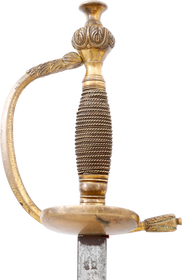
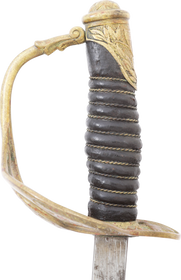
PRUSSIAN M.1819 INFANTRY OFFICER’S SWORD. Late 19th-century. Standard pattern. Brass hilt with double raised edge shell guards, the left folding dating it after 1882. Significant gold surface remaining. Brass wire wrapped grip, sound and tight. 34 3/8” broad fullered single edged blade, finely decorated half its length with scrolling foliage, military trophies and arms of Prussia. Blade shows mottled gray patina throughout.
  • Nation : German
  • Local Price : 575.00 USD
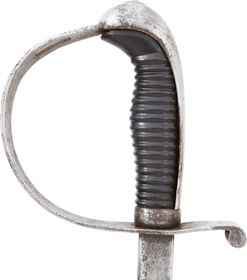
BAVARIAN ARTILLERY OFFICER’S SWORD. Late 19th century. Iron hilt with D form guard and composition grip. 32” curve broad fullered blade with maker's mark of A C S with scale, Alexander Coppel, Solingen. The blade decorated first half with and artillery emplacement with cannons and artillerymen. The opposite with foliage, horse head and  inscription panel, Kgl Bayr. 12 Feldaetilln Regt. That inscription identified it as the sword of an officer of the Royal Bavarian Army, 12th Field Artillery Regiment. That unit was garrisoned at Landau in der Pfalz (in the Bavarian Palatinate region), part of the 3rd Bavarian Infantry Division in World War I (under the 6th Army).  The decoration well preserved with ricasso lightly pitted. The point, right side with lamination. The hilt with carefully cleaned light to medium pitting. Rare with historic background.
  • Nation : French
  • Local Price : 575.00 USD
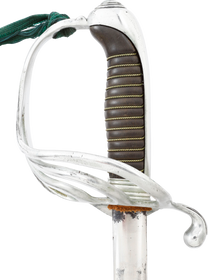
FRENCH INFANTRY OFFICER’S SWORD C.1870-80. Plated hilt with three bar guard and wire wrapped horn grip, with its original green sword knot. 32 ¾” double edged blade with narrow fullers off set in the French taste. The base with the F B D helmet mark of Francois Delacour & Bakes, Parisian sword maker and supplier active during that period. Hilt, grip and blade, excellent. Plated scabbard with no dents, pitting speckles one side and the plating near complete and bright.
  • Nation : -
  • Local Price : 575.00 USD
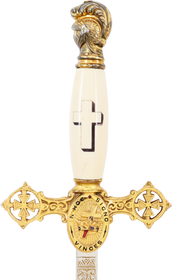
FINE KNIGHTS TEMPLAR SWORD. Mid 20th century. 29 7/8" blade finely decorated with Crusades scenes and motifs, owner's name, with the gold background just showing light wear and about 50% bright. Gilt hilt with faux ivory grip inscribed with cross, Masonic motifs and monogram. Gilt scabbard with finely detailed mounts. Fine enamel inlay to the guard and scabbard mounts (small losses). Excellent quality and excellent preservation for impressive bright presentation. 
  • Nation : American
  • Local Price : 575.00 USD
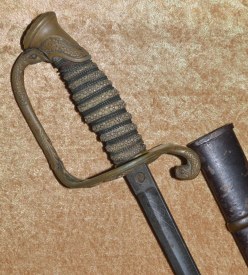
US 1872 CAVALRY OFFICER'S SWORD. See The American Sword, Peterson #86. Custer era and showing distinctive Western Frontier character. 31 3/4" broad fullered blade unmarked. Brass hilt with three bar guard and wire wrapped leather covered grip (dry but complete and excellent). Blade crisp with gray patina and minor oxidation the mid point right side, negligible. Early Custer era example with great age appearance which exudes Western/cowboy character. 
  • Nation : Russian
  • Local Price : 575.00 USD
PRUSSIAN M.1819 INFANTRY OFFICER’S SWORD LATE 19TH CENTURY. Late 19th-century. Standard pattern with 33” broad fullered single edged blade, finely decorated half its length with scrolling foliage and military trophies. The ricasso with the Z in shield mark of Clemen & Jung of Solingen. Brass hilt with double raised edge shell guards, the left folding with dark patina. Wire wrapped grip, sound and tight. The blade with scattered minor smooth black staining, heavier at the extreme tip as shown.
  • Nation : German
  • Local Price : 575.00 USD
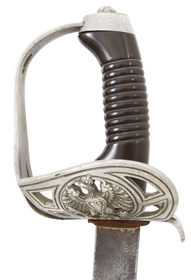
IMPERIAL GERMAN M.1889 CAVALRY OFFICER’S SWORD. Plated hilt with folding side guard with Prussian eagle badge. Composition grip with finger stall and medial fluting. 30 ½” straight broad fullered blade shows gray patina with weak etched decoration at the forte.
  • Nation : Russian
  • Local Price : 565.00 USD
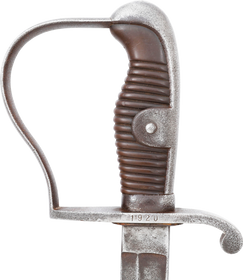
PRUSSIAN M.1873 ARTILLERY SABER. Iron hilt with P form guard and ribbed composition grip. The cross guard with 5 cancelled regimental issue numbers and serial number opposite. 29 3/4” broad fullered blade, with ALEX COPPELL SOLINGEN make's mark to the ricasso. Shown uniform medium gray patina. The back ordnance marks. A well used veteran showing its years of service. 
  • Nation : American
  • Local Price : 565.00 USD
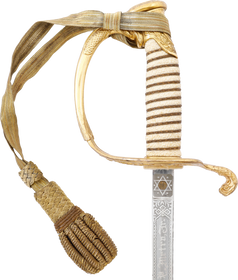
US 1852 PATTERN NAVAL OFFICER’S SWORD. See The American Sword, Peterson #138. Pattern used through the Civil War and current today. This example is from the mid 20th century. Gilt brass hilt with pierced USN guard with virtually all its bright gold surface. Wire wrapped simulated ray skin grip. Original sword knot with gold bullion tassel. 30” broad fullered blade decorated with foliage, USN, eagle, stars & bars, anchor and officer's name. The ricasso with inset proof and German maker's mark, N S MEYER. Crisp and bright.
  • Nation : British
  • Local Price : £400.00
British c1860 Volunteer Lancaster Bayonet. Description Unfullered pipeback blade with quill point, steel cross hilt with straight lower quillon with round forward-swept finial, and upper quillon projecting from the muzzle ring. Grip slabs of pressed black leather over wood, secured to the exposed tang with four rivets, one of which secures the external leaf spring which actuates the locking catch. Black leather scabbard with steel throat piece with oval frog stud and steel chape piece. Blade 58.9cm (~23 3/16 inches) in length, the bayonet 72.4cm (28½ inches) overall, muzzle ring diameter 20mm. The blade is stamped at the ricasso on one side with the maker&#acute;s mark &#acute;CHAVASSE&#acute;, indicating manufacture by Chavasse & Co, Birmingham. The pommel is stamped with the number &#acute;208&#acute;, probably a rack or weapon number. The Lancaster carbine was adopted by the Royal Sappers and Miners (the precursor to the Royal Engineers) in 1855, and came with a bayonet that was unusual for British Army issue, as it used brass for its hilt, pommel and scabbard fittings and had a conspicuously long pipeback blade. Pipeback blades for swords had fallen out of usage on British swords in the 1840s: while they were intended to be stiff in the thrust with a durable point, they were difficult to forge, easily bent and the cutting edge was so thin as to be fragile. The design might have fared better on a bayonet for which thrusting was paramount, and the shorter blade was less likely to flex, but fullered blades were the norm and the Lancaster would be the only British pipeback bayonet. While its looks were striking on parade, the Lancaster bayonet was fragile, requiring more frequent repairs than other models. Despite this issue, sheer decorative appeal meant that the bayonets outlasted the carbines they were made for, being repurposed as parade sidearms for the Royal Army Medical Corps and remaining in service into the early 20th century. Shortly after the Lancaster&#acute;s introduction, growing tensions in Europe raised concerns about Britain&#acute;s vulnerability to potential invasion. To bolster national defenses the War Office sanctioned the establishment of &#acute;Volunteer Corps&#acute; in 1859. These units were somewhat a reinvention of the militia “ non-professional soldiers who were expected to provide their own uniform and equipment, train at regular intervals and be ready for mobilisation in case of invasion. Providing their own equipment extended to arms too “ some volunteer rifle units were provided with Army surplus but many instead pooled money and purchased weaponry from the commercial market. Volunteer rifle units generally purchased carbines wherever possible, and one option for a bayonet to pair with these was the Lancaster. Its looks may have appealed to volunteer soldiers, or its potential to double as a bayonet and a sidearm. Commercial versions differed from the service model: they usually had steel components instead of brass, and a different scabbard closer to that of the contemporary cutlass bayonets. See British & Commonwealth Bayonets by Skennerton, p123. These were not necessarily fitted to Lancaster carbines “ each bayonet would have been hand-fitted and this may have been to the Enfield short rifles or carbines, of which there were multiple models. The blade is unsharpened with no nicks to its edge. Some grinding and polishing marks to the blade, with some spots of patination, some frosting at the hilt end, areas of moderate pitting along the spine and small spots of heavy pitting on the flat of the blade in the pipeback section, some of these contacting the edge. The hilt, pommel, rivets and exposed tang have heavy dark patination and speckled light pitting, moderate pitting to the muzzle ring and upper quillon. The locking button functions well. The leather grips are very good with no apparent wear to the knurling, beside some surface rubbing at the pommel end. One small dent to the exposed tang. The scabbard leather has some surface rubbing and flaking but is generally strong with all of its stitching intact, able to support its own weight. The scabbard throat and chape pieces are heavily patinated with peppered heavy pitting, some small dents to the chape piece which do not interfere with sheathing and drawing.
  • Nation : French
  • Local Price : £400.00
French 1870 Franco-Prussian War ’Defense Nationale’ Bayonet for the Remington Rolling Block Rifle, Repurposed M1831 Sword Blade. Description Straight unfullered blade with spear point, cross hilt with muzzle ring and hooked lower quillon with ball finial. Ribbed cast brass grip and beaked pommel, one steel rivet which also secures the external leaf spring which actuates the locking catch, peened tang at the pommel. Steel scabbard with frog loop. Blade length: 48.6cm (19 1/8 inches), overall length 61.1cm (~24 inches), muzzle ring diameter 18mm. The hilt is stamped on one side with the serial number &#acute;859&#acute;. These bayonets were made at the French arsenal of Chatellerault for two months of the year 1870 during the Franco-Prussian War (July 1870 - January 1871), intended to fit the Remington Rolling Block rifle. They are sometimes referred to as &#acute;Defense Nationale&#acute; bayonets, presumably because they were commissioned as a matter of emergency for national defense. They are in many respects like the German &#acute;ersatz&#acute; bayonets of WW1, including the use of repurposed materials: the French combined the hilt and grip of the M1866 Chassepot bayonet with blades of the much older M1816 and M1831 infantry sidearms, (both of &#acute;gladius&#acute; style). These obsolete short swords were presumably seen as expendable sources of good blade steel, but they needed significant reshaping to make serviceable bayonets. One edge of the double-edged, diamond profile blade has been ground down to form a flat spine and clear the way for the rifle to be fired. The blade was originally leaf-shaped broadening slightly along its length, and this is still visible in the remaining edge. The shoulder of the blade has been slimmed on both sides. With no fuller and no additional distal taper the blade remains noticeably heavy for a bayonet: a standard M1866 weighs 622g while this piece weighs 774g, despite being nearly 10cm (4in) shorter. Note the small divots on the third rib of the brass grips, placed as a guide to where a second grip rivet would usually be located. That rivet is always absent on these models. Its scabbard is a modified version of the standard M1866 scabbard: identical in its upper section but in its lower section it remains straight rather than curving as the M1866 must to accommodate a yataghan blade. It is oversized in length relative to the bayonet it holds. They were finished in bright steel, never blued. The French acquired around 210,000 Rolling Block rifles from Remington during the Franco-Prussian War, most being the model ordered by Egypt in 1869, chambered in .43. The Egyptian government had been delinquent in payment so Remington happily resold its initial order of 60,000 to France and produced the rest thereafter “ the Egyptians had to wait until 1876 to get theirs. Many of the rifles acquired by France were adapted to use the M1866 Chassepot bayonet but these rare bayonets are examples of an attempt to go in the opposite direction. One may marvel today at the very idea of there ever having been a shortage of Chassepot bayonets. See page 415 of Collecting Bayonets by Maddox for discussion of this type.
  • Nation : -
  • Local Price : 555.00 USD
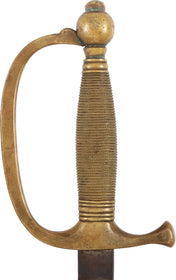
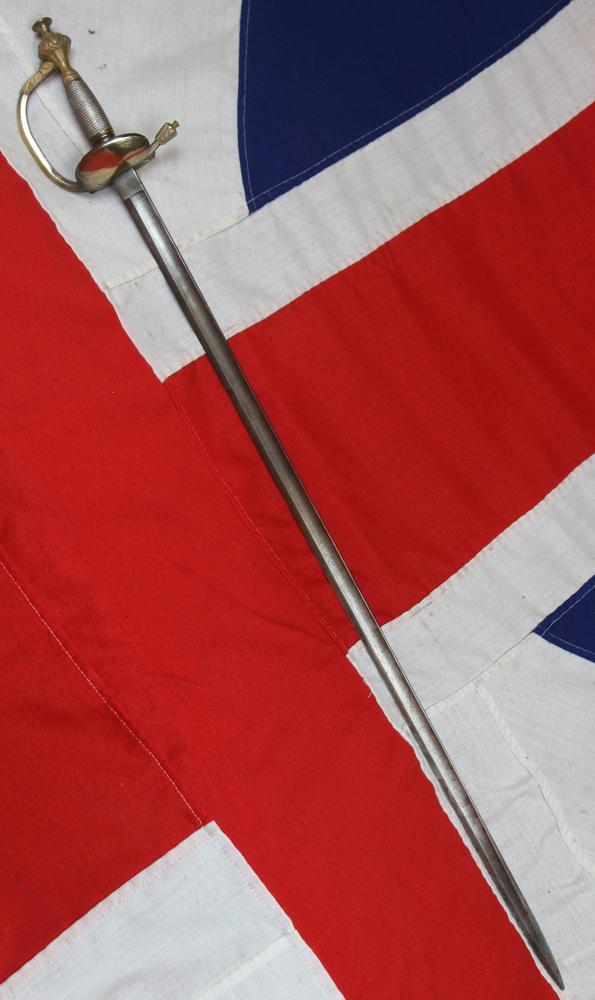
1840 PATTERN MUSICIAN'S SWORD. German made with HORSTMAN SOLINGEN maker's mark. Undated and not US marked, indicative of militia use.  Very likely fought for the Confederacy. Musicians marched at the head of the attack and were recognized as a stabilizing and stimulating force. Musicians marched at the head of the attack and were recognized as a stabilizing and stimulating force. They were attacked to silence them and a few including Robert Henry Hendershot and John Clem became legends for their bravery on the battlefield. Union musicians were equipped with the 1840 pattern sword and no other weapon. From the famed American Sword Collection of Frank Barnyak.
  • Nation : American
  • Local Price : $399.00
US M1852 Naval Officer’s Sword, ca. 1880. The US Model 1852 Naval Officer’s Sword has been in use since it was introduced in 1852 and is still carried by naval officers today. The design has remained virtually unchanged, yet over time the blades became narrower. Civil War era blades were over 1” wide, but more modern examples often have blades as narrow as 5/8”.  This example by Horstmann (1817-1893) was made in their later years of operation.  It features a brass hilt of regulation pattern with “USN” among oak leaves on the guard; reverse scroll quillon and knuckle bow, both in the shape of a sea serpent, and slanted pommel with oak leaves on the side and an eagle surrounded by 13 stars on the top.  Wood grip with sharkskin cover and double twisted brass wire wrap (small piece of sharkskin missing at the top).  Straight, single-edged 30″ long by 3/4″ wide blade with broad 3/4 length single fuller, the ricasso marked “HORSTMANN/PHILADELPHIA” on one side and 6-pointed star with brass-inlaid “PROVED” in the center on the other side; acid etched on both sides over 2/3 of its length with scrolling foliage, patriotic and nautical motif, and “U.S.N.” in a ribbon.  Associated brown-painted iron scabbard with two brass carry bands and rings.  The scabbard is Civil War era and fits most M1850 Foot Officer’s and M1850 Staff & Field Officer’s swords.  The brass carry bands and rings are typical of Confederate scabbards, but it does not have the crude seam of most Confederate scabbards.  Very good condition; the brass with golden brown patina and patches of green showing; blade shows age and minor rust markings, but etching is clear; scabbard paint heavily chipped, with dark brown patina underneath.  Overall length 35 1/2″, not including scabbard.
  • Nation : -
  • Local Price : 550.00 USD
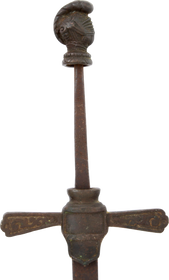
CIVIL WAR MILITIA NCO SWORD, CHARLESTON. Pattern used by northern and Southern Militias in the Antebellum period and which subsequently served in the Civil War on both sides. See The American Sword, Peterson, #11. Brass hilt the “bow tie” form guard and plumed helmet pommel, shows dark patina. The grip perished. 28” diamond section blade with crusty surface rust.   Purchased in the 1970's at Schindler's Antiques, King St. Charleston South Carolina. It was said to have come from a Charleston house clearance and to have been carried by a Confederate soldier during the Civil War. That time was just 100 years after the war and hardly anyone collected anything. Such items with good honest provenance could be purchased very cheaply.
  • Nation : British
  • Local Price : £395.00
Scottish Military Dress Dirk. Glasgow City Piper. #2502010. This late 19th/early 20th Century Scottish military-style dress dirk bears the city coat of arms of Glasgow. It is likely that the dirk was used by a Glasgow city piper.The 236mm single-edged blade has a scalloped spine above a deep, narrow fuller and terminates in a double-edged spear point. The blade is in very good condition, retaining its original polish with only minor patches of pale tarnish. The edge remains sharp.The carved ebony hilt has an intricate basket weave design and the white metal bolster is heavily embossed with Scottish thistles. The pommel is capped with the coat of arms of the city of Glasgow, bordered with embossed thistles. The blade is firm in the hilt.The black leather covered wooden scabbard is decorated with white metal shields embossed with Scottish thistles. The locket bears the Glasgow city coat of arms. The by-knife and fork are unfortunately absent. The belt for attaching the dirk to the piper’s belt is present and in good order.The dirk sheathes and draws smoothly from the scabbard.This is a good example of a scarce Glasgow City piper’s dress dirk.
  • Nation : Russian
  • Local Price : £395.00
German. Prussian Hussars KD1889 Cavalry Sword. #2404015. The KD 1889 (Kavalerie Degen 1889) was carried by all light cavalry troopers of the Imperial German Army until after the Great War. This Prussian model is marked to a Hussars regiment.The 808mm single-edged blade has a slightly rounded spine that is etched for almost half of its length with a foliate pattern. The blade has a single, three-quarter length fuller immediately below the spine and terminates in a spear point.The blade is beautifully etched with roses and a trophy of arms, followed by a panel containing the regimental designation “Husaren-Regiment Landgraf Friedrich II von Hessen-Homburg (2. Kurchessisches) Sr. 14.”This translates as the 2nd company of the 14th regiment of Count Friedrich II of Hessen-Homburg Hussars.The obverse is etched with intertwined roses, a scene of a cavalry charge and the Prussian coat of arms and royal cypher of Friedrich II. The blade is in good condition with some scattered pinprick bubbling small spots of tarnish and is unsharpened.The nickel-plated guard has a folding section incorporating the Prussian eagle. The guard is in good condition and the folding section is crisp and tight. The composite grip is in good condition with a small hairline crack at the front. There is some slight movement of the blade in the hilt. The rear of the quillon is stamped with 14 H 5 over 102.The sword is complete with its original plated steel scabbard with a fixed suspension ring and bar. The scabbard is in good condition with one small ding and a speckled patina. The sword sheathes and draws smoothly and is held firmly within the scabbard.This is a good example of a Great War period German (Prussian) cavalry sword model 1889. Was: £395.00Now:
  • Nation : British
  • Local Price : £395.00
British 1821/45 Pattern George V WW1 Royal Artillery Officers Sword. Wilkinson. #2511013. This British 1821/45 pattern Royal Artillery Officer’s Sword dates to between 1914 and 1918. The sword appears to have been made by the Wilkinson Sword Company during WW1.The 865mm single-edged blade has a flat spine and wide single fuller on both sides, tapering to a double-edged spear point. The blade is double-edged for the final 260mm and retains its fighting edge.The blade is etched on one side with the winged lightning bolts of the Royal Artillery amidst foliate scrollwork incorporating the flowers of the union. The obverse is etched with foliate scrollwork and flowers of the union surrounding the Georgian crown and the royal arms. A pair of thistles flank a small royal cypher of George V, suggesting that the sword was the property of a Scottish officer. A field gun and the motto, “UBIQUE.” Complete the etching. The blade and etching are in good condition. The etching is clear and the blade retains its polish with only minor speckles of tarnish.Interestingly, the spine is without a Wilkinson serial number, the spine is only marked “Made in England.” The ricasso bears an un-stamped hexagonal proof disk. The hexagonal disk would normally show an italicised letter H identifying the sword as being a “Wilkinson best quality.” The obverse ricasso is blank. The lack of maker identification could be due to wartime expedience but it is unusual.The 3-bar steel hilt is in very good condition and retains its original plating. The ray skin grip is in good condition with use-related wear and fading. The twisted wire binding is intact. The knurled steel back strap has a stepped pommel and rounded tang nut. The blade is firm in the hilt.The 1901 pattern brown leather covered field scabbard in in good condition and remains strong with the stitching intact. The leather at the top of the scabbard is stamped with the Wilkinson makers details, making the lack of maker identification on the sword more surprising. There are age and use related scuffs and marks. The sword sheaths and draws smoothly and is held firmly in the scabbard.This is a very good and interesting example of a WW1 production Royal Artillery officer’s sword made by the Wilkinson Sword Company.
  • Nation : American
  • Local Price : £395
Click and use the code >23991 to search for this item on the dealer website WW1 Imperial German Officer´s sword 73rd Reserve Regiment. Company 16 Sword 1
  • Nation : Spanish
  • Local Price : £395.00
**MINT**Spanish Model 1895 Mounted Carabineros Cavalry (Civil Guard) Officer’s Sword With Toledo Blade Etched Crossed Swords Guard & Scabbard. Sn 22441:10 -. The Spanish city of Toledo has a sword smithing history dating back hundreds of years. This is a near mint Spanish Model 1895 sword these swords were issued to Carabineros (Civil Guard), Artillery & Engineers Corps. This Carabineros Cavalry officer’s Sword has a Toledo steel blade & Scabbard. Our example in near mint condition has a 30 ¼” long, curved sabre blade (36 ½” overall). One side of the plated blade is marked ‘Toledo 19895 (Model)’. The reverse has heraldic arms. The blade has its original leather hilt washer. It has a plated full knuckle guard etched with crossed swords Cavalry device within panel. Its contoured chequered hilt is undamaged (either bakelite or polished horn). The sword is complete with its original plated steel scabbard also in near mint condition. The scabbard The scabbard has its original single hanging ring. The price includes UK delivery. Sn 22441:10
  • Nation : British
  • Local Price : £395.00
C1817 English Gentleman’s Root Cane Mallaca Sword Stick with Knurled Handle & Silver Band by Silversmith Joseph Hicks. ED 827. -. This is an excellent English Masonic gentleman’s swordstick made sometime in the early 19th century. Joseph Hicks was a well-known and prolific Exeter maker. He was apprenticed in 1771 and in 1778 took on his own apprentice, so will have been operating as a silversmith in his own right by then. He was admitted as a member of the company in 1785. Joseph Hicks died on 26th February 1835. It has a knurled wood pommel & 15” blade (22 ½” overall length – not including sheath). The blade is true with age related staining and tapers to a pin sharp point. The sword stick measures 35 ¼” overall in its scabbard. The root cane Mallaca scabbard is undamaged and has a brass-coloured ring to the base. The price includes UK delivery. ED 827
  • Nation : British
  • Local Price : £395.00 GBP
Roxburgh & Selkirk (The Border) Scottish Rifles Officer's Sword, Edward VII. A scarce officer&#acute;s sword of the 1st Roxburgh & Selkirk (The Border) Rifle Volunteers, dating to the reign of Edward VII. From 1888, the regiment formed part of the South of Scotland (Scottish Border) Brigade, which later saw service in the First World War. The blade, bearing a Pillin proof disc and retailed by Hobs"
  • Nation : British
  • Local Price : £395.00
**NAMED**British WW1 August 1915 Dated George V 1897 Pattern British Infantry Officer’s Sword By Deakin & Sons Sheffield With Etched Blade to ‘A.H. Hunnings’ & Leather Field Combat Covered Wood Scabbard With Sam Browne Pattern Leather Swo. This is an excellent original, George V 1897 Pattern British Infantry Officer’s Sword with Leather Field Combat Covered Wood Scabbard With Sam Brown Pattern Leather Sword Frog. The Sword has a 32 ¾” single edged blade with fullers (38 ¾” overall). The blade has etched panels to both sides. One side has a foliate etched panel and Ordnance proof star and inlaid brass roundel. The reverse has foliate etched panels King’s crown above ‘GR V’ Royal cypher (King George V Rex), Maker or retailer name within panel ‘James Deakin & Sons Ltd Sheffield’ together with trademark and Panel inscribed to ‘‘A.H. Hunnings August 1915’ no doubt the name of the British Officer who commissioned this sword or was presented with it. The hilt is fitted with its original leather washer. It has an ornate bowl guard with stylised King’s crown & Royal Cypher ‘GR V’ and undamaged wire bound fish skin grip together with stepped steel pommel with ball top. It is complete with its brown leather covered field scabbard which has a German silver insert in the throat and Sam Browne pattern leather sword frog with brass stud that fastens to a retaining strap and hanging straps with brass buckles. All leather & stitching of the scabbard and frog is clean & intact. There are no visible maker or date marks on the scabbard or frog. The price for this early WW1 sword worthy of further research regarding the named Officer includes UK delivery. Sn 22391
  • Nation : Belgian
  • Local Price : £395
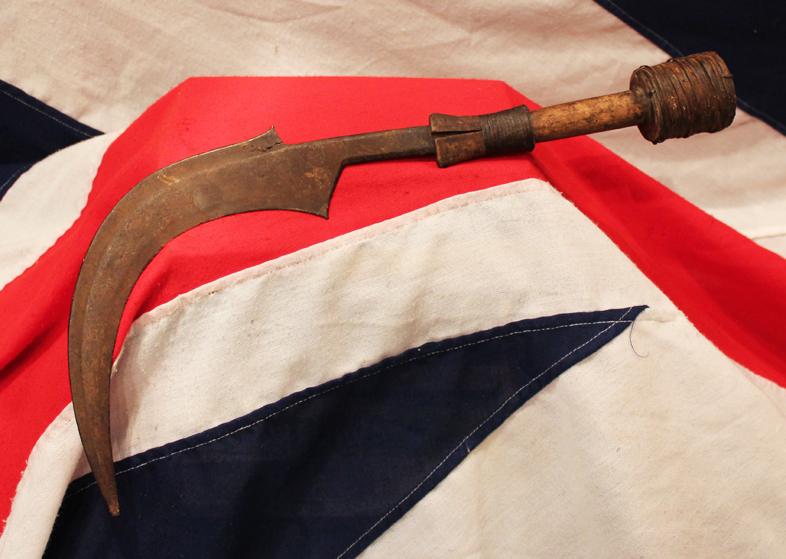
Click and use the code >19166 to search for this item on the dealer website Rare & Amazingly Intriguing, 19th Century King´s ´Status´ Knife of the Zande or the Mengbetu People, A Trombash Power Authority Knife or Short Sword
  • Nation : British
  • Local Price : £395
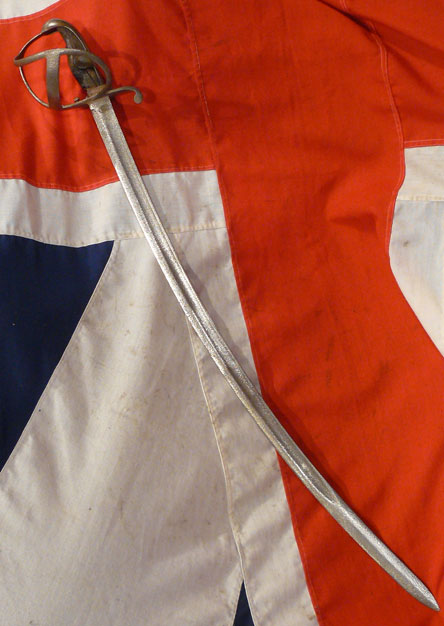
Click and use the code >14569 to search for this item on the dealer website Rare, Victorian, British Royal Engineer´s Sword, Prussian Designed, British Army Issue, Experimental Sword of The Royal Engineers, The Driver´s Sword, Model of 1850
  • Nation : Canada
  • Local Price : $750.00  CAD
(JOHN) BRASHER FLINTLOCK POCKET PISTOL. (JOHN) BRASHER FLINTLOCK POCKET PISTOL: .49 Cal. Circa 1807-1831. With pop-out trigger and turn-off 1 3/4 inch barrel. The left side of the frame is engraved “BRASHER”. It is very faint and hard to read; the right side “LONDON”. Very nice walnut grip with silver escutcheon and Sterling Silver Hallmarked butt-cap. Sliding frizzen safety; missing locking pin. Tight crisp action. VG $750.00 SOLD
  • Nation : British
  • Local Price : $750.00 CAD
BRITISH P.1857 PIQUET WEIGHT ENGINEER’S OFFICER’S SWORD. BRITISH P.1857 PIQUET WEIGHT ENGINEER’S OFFICER’S SWORD: SILVER PLATED HILT with excellent wire-bound fish-skin grips. Plain 32 ½ inch blade is excellent with a few very small patches of minor pitting. Robson #211. $750.00
  • Nation : German
  • Local Price : $750.00 CAD
IMPERIAL GERMAN CAVALRY TROOPER’S SWORD M.1889. IMPERIAL GERMAN CAVALRY TROOPER’S SWORD M.1889: Dated 1897 “ERFURT”. Maker: OTTO MERTENS, Solingen (1893-1918). Prussian Eagle in the hilt cartouche. Excellent grip, hilt and blade. The scabbard has some dents on the right side. VG+ $750.00
  • Nation : German
  • Local Price : 545.00 USD
IMPERIAL GERMAN ARTILLERY OFFICER’S SWORD. Iron hilt with P form guard, shows remnants of plating. Wire wrapped composition grip (flake at the heel and base crack left side). 35 ¼” broad fullered blade in good original polish with WKC maker's mark at the forte. Black japanned scabbard with nearly all finish intact.
  • Nation : American
  • Local Price : 545.00 USD
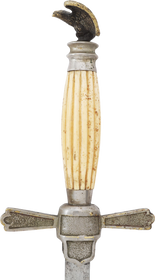
WESTWARD EXPANSION PERIOD AMERICAN STATE MILITIA SWORD. 27 ½” double-edged blade of fighting form. The ricasso marked C A HART & CO PHILADELPHIA. That maker is identified by one source as active 1870-88 producing swords for militias and secret societies. This example is made to the standard militia NCO specifications and likely was the sword of a state militia Non-Commissioned Officer. Plated hilt with excellent reeded bone grip and pommel surmounted by an eagle. Original plated scabbard with no dents and the plating is complete and bright. NCO's purchased their own swords from sword dealers and owned them after retirement. They chose from the various type available were allowed, so long as they met the basic specifications of the pattern.  
  • Nation : American
  • Local Price : 545.00 USD
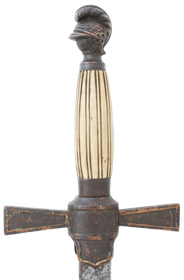
CIVIL WAR MILITIA SWORD POSSIBLY CONFEDERATE, C.1840-50. C.1840-50. As carried by Non Commissioned Officers in both the North and South. See The American Sword, Peterson, #11. 25 1/2” double edged blade. Brass hilt, formerly gilt, with reeded bone grip. State militias comprised the majority of combatants at the outbreak of the Civil War. As this sword survived the war and later, it can surely be assumed to have served. The absence of the stars and bars logo as found on the langets of many of these including this one, may indicate Southern use, as the prospect of war was festering by the 1830's. The doctrine of nullification was made law in South Carolina and resulted in 1832, in which President Andrew Johnson threatened to send Federal troops to enforce the tariff laws. South Carolina's militias were called up and the state prepared for war. From the famous Frank Barnyak collection. 
  • Nation : -
  • Local Price : 545.00 USD
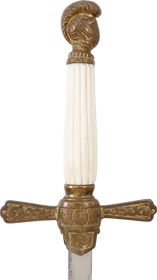
CIVIL WAR MILITIA SWORD. Antebellum period, C. 1840-60. Type carried by Non Commissioned Officers in both the North and South. See The American Sword, Peterson, #11. 27 3/4” double edged blade. Brass hilt (considerable remnants of gold overlay) with plumed helmet pommel and reeded bone grip (no chips). Gilt brass mounted iron scabbard single small dent). State militias comprised the majority of combatants at the outbreak of the Civil War. As this sword survived the war and later, it can surely be assumed to have served. The absence of the stars and bars logo as found on the languets of many of these including this one, may indicate Southern use, as the prospect of war was festering by the 1830's. The doctrine of nullification was made law in South Carolina and in 1832, resulted in President Andrew Johnson threatening to send Federal troops to enforce the tariff laws. South Carolina's militias were called up and the state prepared for war. From the famous Frank Barnyak collection. 
Page 25 of 41

The following items match your search but are currently listed on Ebay. We take no responsibility for any aspect of the listings or their accuracy.


Sorry, there is not any matching items.