
(You must register and have a linked account first)
View Privacy Policy


OR

Show


Forgot your password?

Error message here!

Error message here!

Error message here!

Error message here!

Show Error message here!

Show Error message here!


Lost your password? Please enter your email address. You will receive a link to create a new password.

Error message here!

Back to log-in

Close

For Sale

The following items are listed by for sale by users of the site and dealers. They are in no way endorsed or guaranteed by www.oldswords.com

Add a Classified Item
to

Clicking on the sword will take you through to the relevant classified item or dealer site.
Don't miss out! - Do you want to be kept informed weekly of new aditions? Just join our weekly update list.

You can also receive regular email notifcations when items match your keywords. To recieve them just register or logon at the top right of this page.
Page 32 of 40
  • Nation : German
  • Local Price : 3,000 kr
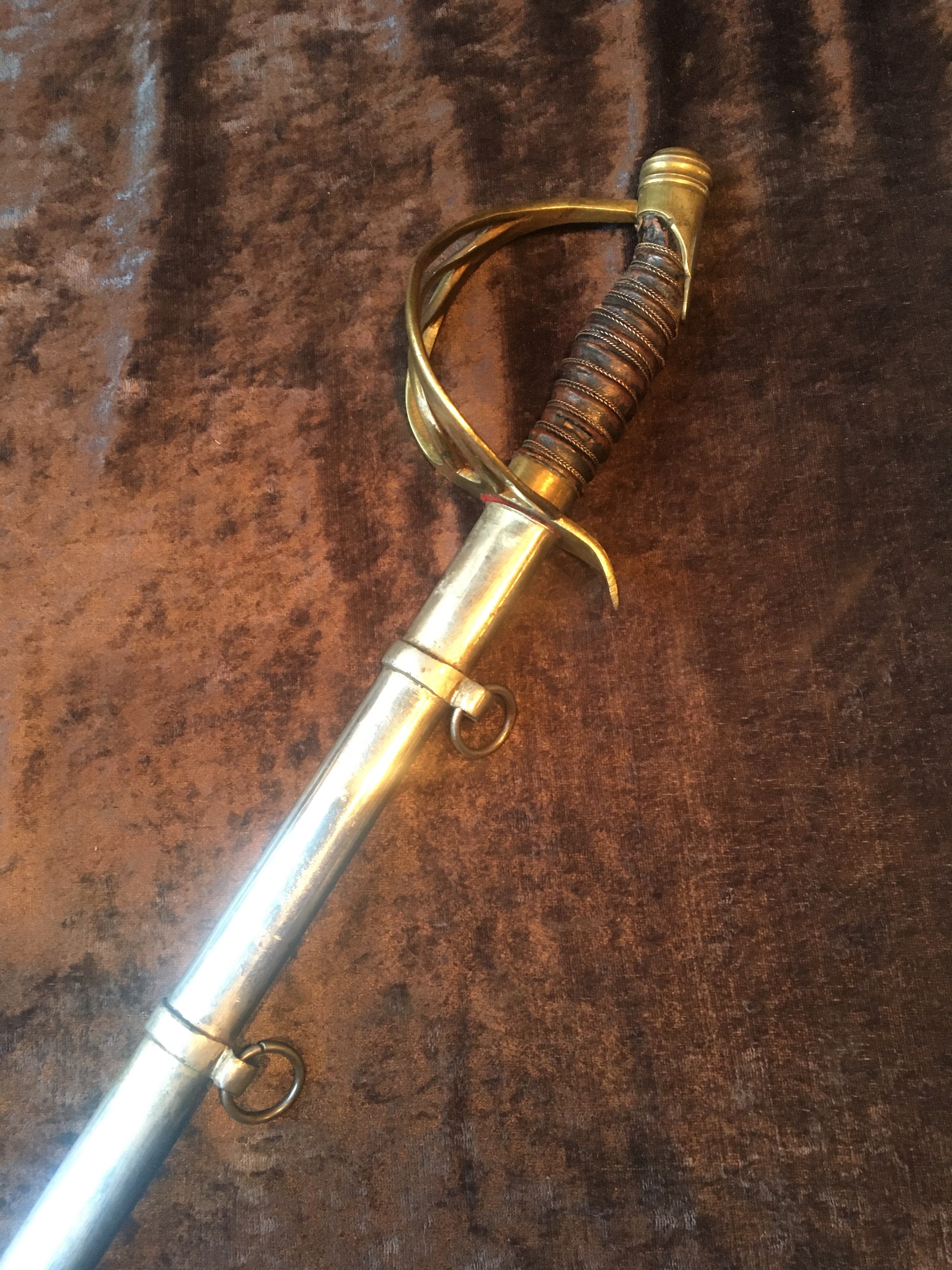
German cuirassier pallasch w/1853? For children.
  • Nation : Danish
  • Local Price : 2,980 kr
Danish artillery saber w/1802.
  • Nation : -
  • Local Price : 2,950 kr
Sv infantry officer's sword 1830-40.
  • Nation : British
  • Local Price : £230.00
British Lee Enfield No. 7 Mk 1 Land Service Bayonet, Dated 1946 by Poole. Description Single-fullered bowie knife blade with clipped point, blued for 5mm at the ricasso. Red-brown grips made of Paxolin (resin-impregnated paper, similar to Micarta, and widely used today in circuit boards). Steel scabbard with brass throat piece and circular frog stud. Blue canvas 1937 Pattern Royal Air Force frog with retaining loop. Hilt and pommel lacquered. The blade is stamped on one side at the ricasso with &#acute;No 7 MK 1/L&#acute; and on the other side with a &#acute;P&#acute; within a circle indicating the manufacturer Poole, as well as the manufacture date &#acute;1946&#acute;. The pommel is stamped on one side with a broad arrow War Department mark and on its base with some faint numbering, possibly &#acute;114&#acute;. The exposed track for the sliding button is stamped with a broad arrow War Department mark and faint lettering. The frog stud of the scabbard is stamped with a mark indicating manufacture at the Royal Small Arms Factory at Enfield: a superimposed letter E and D, resembling a D with a horizontal strikethrough. The reverse of the frog is faintly inked with some lettering (illegible). The rear side of the scabbard has been daubed with a patch of yellow paint, almost all hidden by the frog when it is fitted. The penultimate model of bayonet designed for the Lee-Enfield No. 4 rifle and Sten Mk 5 submachine gun, the No. 7 was an attempt to produce a bayonet that was equally useful as a utility/fighting knife and a mounted bayonet, by way of an innovative rotating pommel which contains the locking mechanism. 330,000 were produced between 1944 and 1948, but doubts about the rigidity of the mechanism under stress and its high cost of manufacture meant that the No. 7 was largely passed over for the simpler No. 9. The bayonet designed for the ill-fated EM series of experimental bullpup service rifles was essentially a strengthened No. 7.
  • Nation : French
  • Local Price : £230.00
French Model 1831 Artillery Sidearm, Dated 1833 by Pihet Freres, Chatellerault. Description Straight double-edged blade, unfullered with diamond profile and spear point. One-piece cast brass hilt, grip and pommel, the hilt with circular finials, the grip ribbed, the pommel oval with a domed circular tang button. Brown leather washer. Black leather scabbard with brass throat and chape pieces, the throat piece with a frog loop, the leather section with two debossed lines lengthwise on the front face, similar on the reverse face but with one line being the stitching. Blade 48.7cm in length (just over 19 1/8 inches), the sword 63.7cm (just over 25 inches) overall. The blade is stamped on one side at the forte with &#acute;Pihet Frères&#acute; and a five-lobed flowerhead stamp, and on the other side with &#acute;Chatellerault 1833.&#acute; The hilt is stamped on one side with the serial number &#acute;689&#acute;. The throat piece of the scabbard is stamped on the reverse side with a matching serial number &#acute;689&#acute; indicating that blade and scabbard are an original pair. The leather of the scabbard is stamped with the maker&#acute;s mark &#acute;GIRARD LOUIS A CHÃ
  • Nation : British
  • Local Price : £225.00
British Lee Enfield No. 7 Mk 1 Land Service Bayonet with Black Grips, by B.S.A.. Description Single-fullered bowie knife blade with clipped point, blued for 5mm at the ricasso. Black grips made of Paxolin (resin-impregnated paper, similar to Micarta, and widely used today in circuit boards). Steel Mk I scabbard with steel throat piece and circular frog stud. Hilt and pommel blued. The blade is stamped on one side at the ricasso with &#acute;No 7 MK 1/L&#acute;. The pommel is stamped on one side with a broad arrow War Department mark and &#acute;M47A&#acute;, indicating manufacture by the Birmingham Small Arms Company (B.S.A.), specifically their plant at Small Heath, Birmingham, which was assigned the dispersal code M47A during WW2. The flat of the hilt on the blade side and the frog stud of the scabbard are both stamped with a broad arrow. The penultimate model of bayonet designed for the Lee-Enfield No. 4 rifle and Sten Mk 5 submachine gun, the No. 7 was an attempt to produce a bayonet that was equally useful as a utility/fighting knife and a mounted bayonet, by way of an innovative rotating pommel which contains the locking mechanism. 330,000 were produced between 1944 and 1948, but doubts about the rigidity of the mechanism under stress and its high cost of manufacture meant that the No. 7 was largely passed over for the simpler No. 9. The bayonet designed for the ill-fated EM series of experimental bullpup service rifles was essentially a strengthened No. 7. The grips of these bayonets vary in colour due to different materials and formulations used to produce these early composite materials, but are generally red, shading towards brown in some examples. Black grips are a known variation and I have so far seen them predominantly on examples by B.S.A., and occasionally by Elkington “ they are interchangeable parts however, so could readily have been swapped between bayonets of whatever make. Some claim the black grips were intended for parade use or were for specific units e.g. the Guards, and I have indeed seen examples chromed and with parade frog, but former British Army armourer, collector and author Peter Laidler attests that both &#acute;black and brown paxolin grips were issued under the same part number and it really was just pot luck as to whatever colour came through the Ordnance system. It was nothing to do with whatever unit they were issued to&#acute;. This would seem to confirm that there was no differentiated role intended for the black version, it was simply a variation of the same product. Perhaps those found in parade order were selected at the unit level for that role for purely aesthetic reasons, not as a matter of policy. Laidler also notes that black grips seem to be scarcer in civilian collecting today than they were in military service at the time, so there may be survivorship bias at work.
  • Nation : British
  • Local Price : £225.00
British 1888 Mk 1 Type II Lee-Metford Bayonet. Royal Navy Issue. #2507001. British Pattern 1888 Mk I Type II Lee-Metford rifle Bayonet made in 1896 at the Royal Small Arms Factory at Enfield, London.This bayonet is in excellent condition for its 129 years of age and is highly collectable.The 304mm double-edged blade is marked on the ricasso with a flat crown above VR (Victoria Regina) and the production date, 2 ‘96 (February, 1896). The obverse ricasso is marked with the British War Department WD and broad arrow, a bend test stamp and an Enfield factory inspection stamp. The spine of the ricasso bears an Enfield inspection stamp. The stamps have cleaning wear.The wooden grip scales are in good condition. The left-hand scale has a stabilised crack. Two large brass rivets positioned close together hold the scales securely in place. The wooden hilt scales are drilled with an oil hole above the top rivet. The steel crosspiece and pommel are bright and free from rust. The press-stud locking mechanism is in good, crisp working order. The pommel is stamped with the weapon/issue number 161 and the letter, N, indicating that the bayonet saw service in the Royal Navy.The bayonet is complete with its black leather scabbard with steel mounts. The steel locket and chape are stamped with Enfield inspection marks. The leather is strong and the stitching intact. The bayonet sheathes and draws smoothly and is held firmly within the scabbard.This is an great example of the iconic British Lee-Metford rifle bayonet with scarce Royal Navy issue markings.
  • Nation : British
  • Local Price : £225.00
British No.7 Land Service Bayonet. Elkington 1945. #2512006. British No.7 Mk1/L, Land Service Bayonet.These scarce bayonets were made for use with the Sten Mk V sub machine gun. Originally, they were also intended for the Lee Enfield No.4 rifle but were only issued with this rifle for parade purposes due to incidents involving rounds hitting the muzzle ring.This bayonet was made during WW2 by Elkington & Co. of Birmingham and is one of only 20,000 made by them.The bayonet’s innovative design with its unique swiveling pommel allowed it to be both bayonet and fighting knife with deep finger grooves in the hilt which is made of resin impregnated cloth called Paxolin.The 207mm clip point blade has a deep single fuller on both sides and is in good condition with some almost imperceptible pin-prick pitting. The ricasso retains its original blued finish and is stamped No.7 Mk1/7 with an over-stamped Broad Arrow. The "MK1/7" is a rare factory mis-stamp, it should read Mk1/L. The obverse ricasso is marked with The Elkington wartime dispersal code, M78 and a Broad Arrow.The swivel pommel retains its original black finish and bears a War Department broad arrow stamp. The Elkington Factory’s wartime dispersal code, M78 is stamped on the block. The front of the socket and the catch are also stamped with broad arrows.The Paxolin grips are in good condition with some age and use-related wear.The bayonet is complete with its No.5 scabbard in great condition. The scabbard bears a War Department Broad Arrow.This is a scarce and highly collectable wartime production No.7 bayonet. One of only 20,000 produced by Elkington.
  • Nation : German
  • Local Price : £225.00
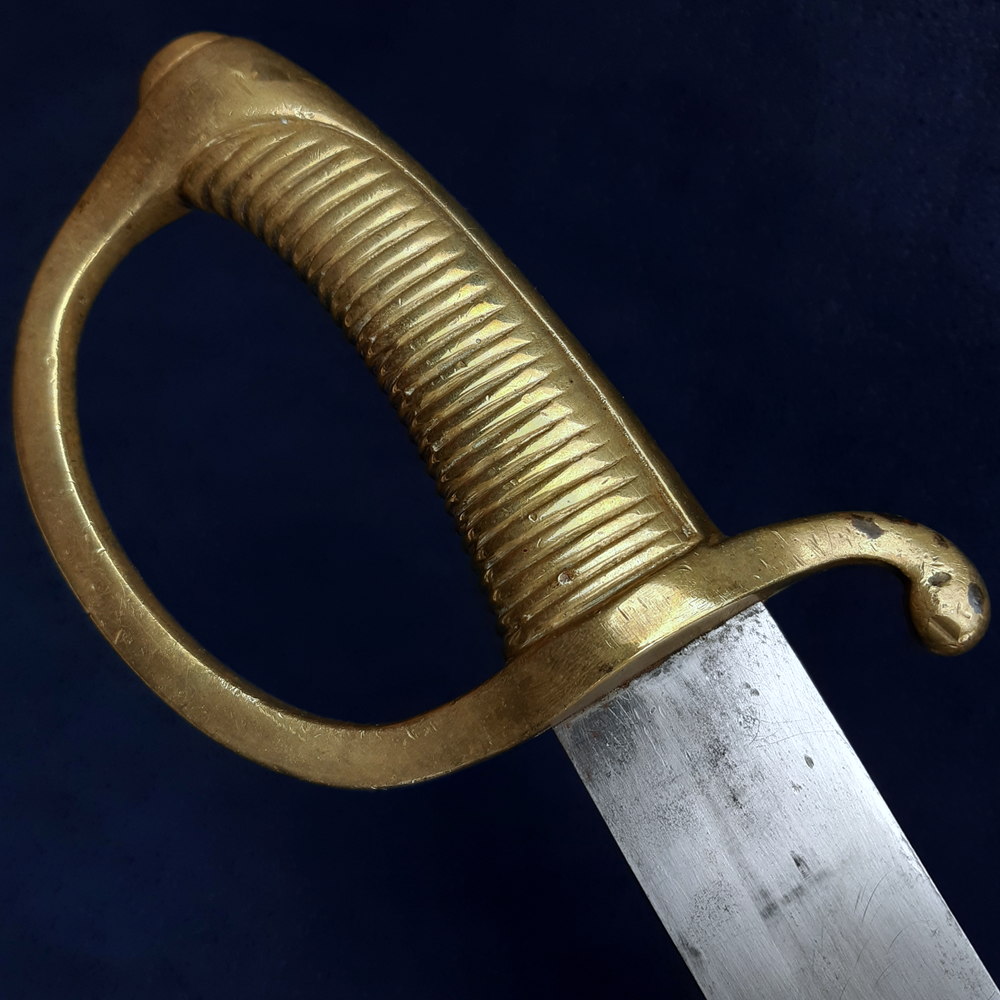
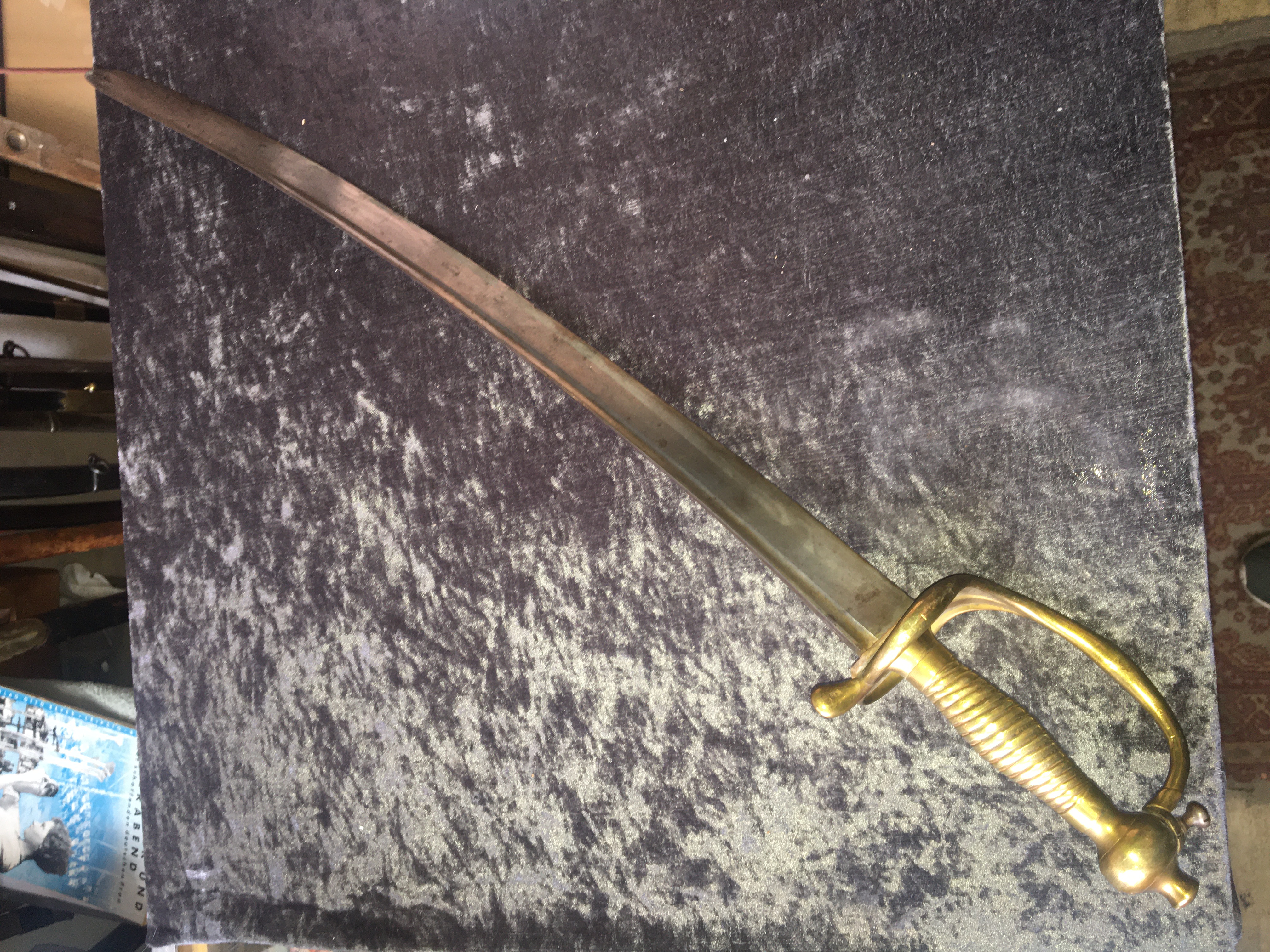
German 19th Century Infantry Briquet Sabre. Description Slightly curved spear pointed blade, unfullered with false edge. One-piece cast brass hilt with ribbed grip, forward curving quillon with comma-shaped finial and simple knucklebow, domed pommel. Black leather scabbard with brass locket and chape, the locket with oval frog stud, the chape piece partly internal with leather covering, with ball finial on the exposed lower section. Blade 65.5cm in length, the sword 78.4cm overall. The blade is bright with a polished finish, only a few tiny spots of patination and old polishing marks. Its edge is sharp with a number of nicks, its tip is undamaged. The brass hilt is likewise bright with a few spots of patination and a few small dents. The scabbard fittings have a midtone patina with some darker spots and a couple of tiny dents - one slightly larger dent to the chape piece which does not interfere with sheathing and drawing. The leather of the scabbard has a few dents and some cracking on the front face but remains sound overall. Its stitching has opened slightly in the section covering the internal chape, perhaps due to shrinkage, but there are paired brass rivets on either side which help secure the leather so it is unlikely to open any further.
  • Nation : Indian
  • Local Price : £225.00
Afghan 19th Century Khyber Knife. Afridi Sword. #2603002. This is a large 19th Century example of the famous Afghan Khyber knife or Charay used so effectively against the British on the Northwest frontier during the 19th Century. Its size, shape and incredible sharpness struck fear into the British troops defending the Khyber Pass, the area from which this knife earned its popular name. It is the traditional side arm of the Afridis, Ghilzais, Khyberies and other tribes living in and near the Khyber Pass, a mountain pass connecting Afghanistan and what was then India (now modern-day Pakistan). The 580mm heavy, single-edged blade has a T-shaped spine above a narrow fuller and tapers to a needle-sharp point. The steel blade is very sharp and is perfectly suited to both slashing and thrusting. The blade is 55mm wide at the shoulder with a spine thickness of 10mm. A narrow fuller runs below the spine. The blade is in good condition. The full tang is hilted with a steel bolster and contoured horn scales held firmly in place with iron rivets. The brass backstrap is decorated with dots within circles. The Khyber knife is complete with its later, leather wrapped wooden scabbard. The scabbard has a shaped throat to allow for the blade to be inserted until part-way up the hilt. The scabbard is in good condition. This is a good example of a 19th Century Afghan Khyber knife.
  • Nation : -
  • Local Price : 2,850 kr
Sv cutlass m / 1747.
  • Nation : Swedish
  • Local Price : 2,850 kr
Swedish cutlass m/1747.
  • Nation : -
  • Local Price : 2,850 kr
Sv cutlass m/1747.
  • Nation : British
  • Local Price : £220
Click and use the code >17601 to search for this item on the dealer website Rare 1840 Constabulary Carbine Bayonet with Deep Defensive Sword Cut
  • Nation : British
  • Local Price : £220.00
British / South African Lee Enfield 1907 Pattern Bayonet, Dated 1917 by Wilkinson. Description Straight single-fullered knife blade, steel hilt with muzzle ring, wood slab grips secured by two screws, steel beaked pommel with oil hole and locking button. Black leather No. 1 Mk 2 scabbard with steel locket & teardrop-shaped frog stud and steel chape piece. Brown leather belt frog with buckled scabbard retaining strap. The ricasso is stamped on one side with a crown over 1907 (the pattern) &#acute;8 &#acute;17&#acute;, indicating the manufacture date of August 1917, and the maker&#acute;s mark &#acute;Wilkinson&#acute;. On the other side it is stamped with a &#acute;broad arrow&#acute; War Department stores mark, three crown inspection marks with &#acute;E&#acute; from Enfield, a reissue date stamp &#acute;27 for 1927 and an &#acute;X&#acute; indicating that it passed a manufacturer&#acute;s bending test. The front of the belt frog is stamped with &#acute;42&#acute; and a &#acute;U&#acute; containing a broad arrow, the government ownership mark of the Union of South Africa. The leather of the scabbard is faintly stamped with the manufacture date &#acute;15. The scabbard&#acute;s chape is stamped beside the staple with &#acute;RE&#acute; within a circle, suggesting manufacture by Remington. On the rear of the frog&#acute;s belt loop is written &#acute;C T Overbeck 70438296&#acute;, which seems to be a name and perhaps service number. Above this is a crossed-out name in a different hand, harder to read. The blade has a matte grey parkerised finish other than a blued band at the ricasso, with no edge damage. The wood grips have no damage or noticeable dents. The hilt, pommel and scabbard parts all have a blued finish, this has worn in places but a dark patina matches it. Likewise the scabbard fittings, blued with some patinated wear, one very shallow dent to the chape piece. The scabbard leather is undamaged with a few minor impressions, the frog is flexible with no damage to the stitching.
  • Nation : German
  • Local Price : £220.00
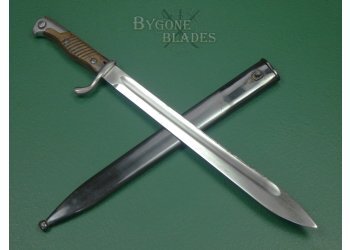
German S98/05 Bayonet. Fichtel & Sachs 1917. #2401022. This WW1 S98/05 butchers’ blade bayonet was made in 1917 by the firm of Fichtel & Sachs of Schweinfurt, Bavaria.The 364mm single-edged blade has a broad single fuller on both sides, below a flat spine with false upper edge. The blade flares before tapering to a spear point and is free of rust and tarnish, with dings to the spine and mild scratches along the blade.The ricasso is stamped with the maker mark, “Fichtel & Sachs,” over “Schweinfurt.” The blade spine is stamped with a crowned acceptance mark and manufacture date of 1917 above a second crowned acceptance stamp. The same crowned factory acceptance/inspection marks are found on all metal parts of the hilt.The wooden grip scales are in good condition and held are firmly in place with the original screws. The steel crosspiece is stamped at the front. The flash guard and pommel are bright and rust free with minimal spots of tarnish. The press stud mechanism works perfectly.The bayonet is complete with a blued steel scabbard. The scabbard is in good condition but is missing its frog stud. The bayonet sheathes and draws smoothly and is held firmly within the scabbard.This is a good example of the iconic German Great War bayonet that shows signs of service use.
  • Nation : American
  • Local Price : £220.00
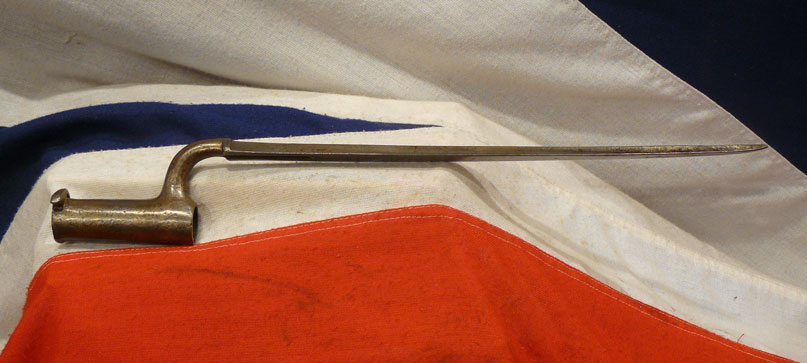
US 1873 Socket Bayonet for the Springfield Trapdoor Rifle, New Jersey National Guard. Description Socket bayonet for the Model 1873 .45-70 Springfield Trapdoor rifle, with fullered triangular blade and steel scabbard. Scabbard with drainage hole and frog hanging hook, black leather frog with rotating belt loop. The ricasso of the blade is stamped &#acute;US&#acute;. The brass swivel of the belt frog is cast with &#acute;NJ&#acute; indicating that it was made for the New Jersey National Guard. The leather inside of the scabbard loop is also roughly inscribed with &#acute;AL&#acute;, presumably a soldier&#acute;s initials. The last model of standard-issue socket bayonet, the M1873 was used with the 1873 and 1879 &#acute;Trapdoor&#acute; Springfield rifles, until 1884 when the new model introduced a rod bayonet. Both bayonet and scabbard have been deeply blued and retain a great deal of this original finish. Some rubbing and flaking to the belt loop in places, the leather is stiff but undamaged and the loop still rotates freely. A few small patches of pitting to the blade, some edge chipping towards the point. The scabbard body is free of dents with rubbing wear to the bluing towards the chape.
  • Nation : French
  • Local Price : £220.00
French Model 1831 Artillery Sidearm, Dated 1839 by Chatellerault. Description Straight double-edged blade, unfullered with diamond profile and spear point. One-piece cast brass hilt, grip and pommel, the hilt with circular finials, the grip ribbed, the pommel oval with a domed circular tang button. Black leather scabbard with brass throat and chape pieces, the throat piece with a frog loop, the leather section with two debossed lines lengthwise on the front face, similar on the reverse face but with one line being the stitching. Blade 48.8cm in length (just over 19 1/8 inches), the sword 63.9cm (just over 25 inches) overall. The blade is engraved on one side at the forte with the maker&#acute;s mark &#acute;Manufre Rale de Chatellerault&#acute; (Manufacture Royale) and on the other side with &#acute;Fbre 1839&#acute; next to which it is stamped with two French &#acute;poincon&#acute; inspection stamps at the shoulder. The hilt is stamped on one side with the serial number &#acute;165&#acute;. The chape piece of the scabbard is faintly stamped with two poincons. The leather of the scabbard is stamped with the maker&#acute;s mark &#acute;GIRARD LOUIS A CHÃ
  • Nation : French
  • Local Price : £220.00
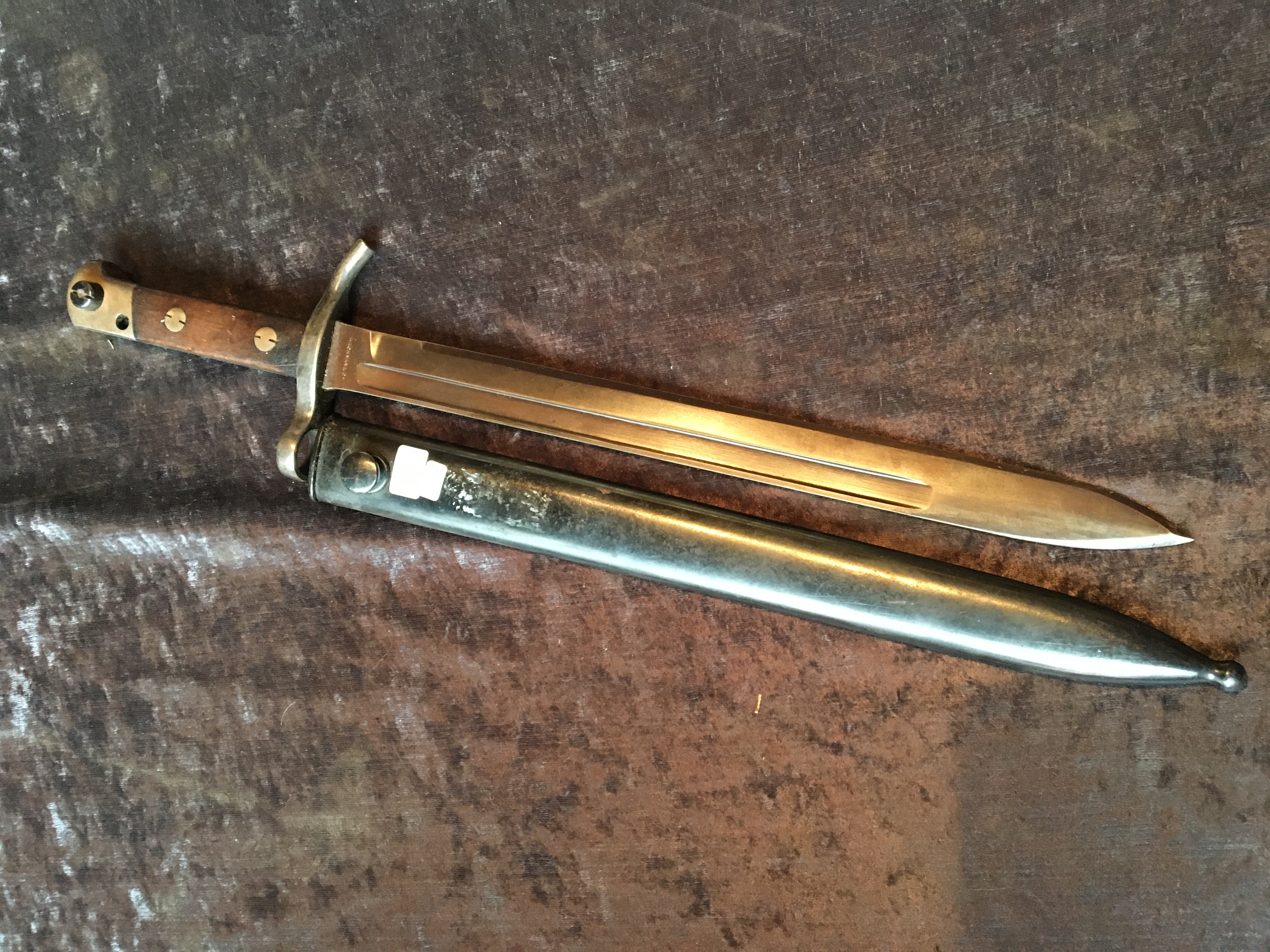
French M1892 Mannlicher Berthier 2nd Pattern Bayonet. Description Single-fullered straight blade, wood grips (meaning that this is the 2nd pattern, the 1st having composite grips) secured with two rivets. The blade has notches near the hilt which engage with a mechanism locking the blade into the scabbard. Steel scabbard, brown leather frog. Hilt with muzzle ring and quillon. The quillon has been reduced in size, a modification carried out during WW1. The quillon of the bayonet and the scabbard are both stamped with the serial number &#acute;8279&#acute;, indicating an original matching pair. Some light patination to the blade, hilt and pommel. The wood grips are undamaged. The scabbard has numerous small dents to its lower section. The leather frog is in good condition, with all stitching intact.
  • Nation : -
  • Local Price : 2,800 kr
Finsk bajonett m/1927.
  • Nation : British
  • Local Price : 2,800 kr
English infantry off saber m / 1897.
  • Nation : -
  • Local Price : 2,800 kr
Sv marinhuggare m/1851.
  • Nation : French
  • Local Price : £215.00
French M1892 Mannlicher Berthier 1st Pattern Bayonet. Description Straight blade with spear point, single fuller on each face as well as short fuller on the spine running to the tip. Black slab composition grips (meaning that this is the 1st pattern, the 2nd pattern having wood grips) secured to the exposed tang by two steel rivets. Hilt with muzzle ring overlapping the grip and a hooked lower quillon. Many M1892 bayonets had the quillon removed during WW1 “ this example remains intact and original. Steel pommel with locking button. Steel scabbard with frog loop, brown leather frog of the correct type for the M1892, with strap and brass buckle. The bayonet&#acute;s quillon is stamped with a cursive F and the serial number &#acute;38157&#acute;. The scabbard is also numbered on the frog loop band but because of the black paint that has been applied to it this number is illegible, so I cannot tell if the bayonet and scabbard are a matching pair or not. The scabbard has a small &#acute;S&#acute; inspection mark next to the rivet hole on one side. The blade is bright with some light frosting and a few small spots of patination in the fullers. The edge of the blade has been sharpened with visible grinding marks “ the tip has also been ground but is not particularly sharp, probably because of its thick point intended to pierce without breaking. The hilt, tang and pommel have areas of patination, the pommel some speckled cleaned light pitting. Some small indentations to the grip slabs. The scabbard has been painted gloss black “ this is mostly intact with just a few small chips revealing steel. The rivet near the throat of the scabbard is missing. The leather frog has some surface rubbing and loss of stitching in places.
  • Nation : -
  • Local Price : 295.00 USD
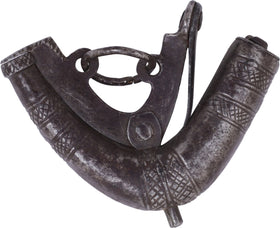
18th CENTURY OTTOMAN PRIMING FLASK FOR FLINTLOCK PISTOL. All iron of small size to hold about three pan charges, likely the most expected to be used in a battle where the opportunity for reloading was rare. Just over 2 3/4" width with curved chamber engraved hatched bands and pivoting spring cut off. Excellent with uniform light to medium surface patina.
  • Nation : British
  • Local Price : £210.00
British 1855 Pattern Land Transport Corps Sword by Kirschbaum. Description Straight unfullered single-edged blade. Ribbed solid brass hilt with cross guard, symmetrical round finials and oval pommel. No scabbard. The ricasso of the blade is stamped on one side with a knight&#acute;s helm, this mark signifies the maker as C F Kirschbaum of Solingen. Imported German blades are not uncommon on British swords of the period, even those produced for the government. English firms would often buy in German blades then hilt and finish them. On the other side it is stamped with a crown inspection mark. Sidearms with the form of a neoclassical &#acute;gladius&#acute; appear to have originated with Napoleon&#acute;s love for all things Roman, and the French 1771 &#acute;Eagle Head&#acute; Artillery sword. A series of very similar-looking short swords were subsequently designed, including the French 1816 & 1831 Artillery, the US Model 1832 Foot Artillery, the Swiss 1842 Pioneer&#acute;s, the Russian 1848 Pioneer&#acute;s and the British 1855 Land Transport. They were not particularly useful for combat (the gladius having become obsolete for good reasons) so remained either ceremonial items or in the role of a machete for various field tasks such as clearing brush. The Land Transport Corps was formed in great haste in 1855, in the midst of the Crimean War: the British Army&#acute;s disorganized transport had resulted in disastrous supply breakdowns during the harsh winter of 1854, and a rapid response was required. Officers of the new unit carried the 1822 Light Cavalry sword while other ranks were armed with the 1855: a near replica of the French 1831 Artillery sidearm, making this the only British sword to follow the Continental gladius trend. A few dents to the brass hilt as expected for its age. The blade has speckled pitting overall and some areas of more significant pitting.
  • Nation : -
  • Local Price : £210.00
Norwegian M1894 Krag Jorgensen Bayonet by Kongsberg, Matching Numbers. Description Unfullered spear-pointed blade, wood slab grips secured by a single screw, steel one-piece hilt, backstrap and pommel with integral sprung locking mechanism in the hilt, that both locks the bayonet to its scabbard and locks it onto a rifle. Steel scabbard with projecting hook on the throat piece to engage with the locking mechanism. Blade 8¼ inches in length, the bayonet 13 inches overall. The blade is stamped at the ricasso with a crowned &#acute;K&#acute;, the maker&#acute;s mark of the Kongsberg Våpenfabrikk (Kongsberg Weapons Factory) in Norway. Most M1894 bayonets were produced there, their production totalling 101,750 between 1912 and 1926. A new production run was ordered from Kongsberg during WW2 while Norway was under German occupation, but these have a different maker&#acute;s mark and distinctive Waffenamt stamps. A depot fire in 1941 destroyed 4,693 M1894 and M1916 bayonets, and 31,000 M1894s were converted to fit the M1 Carbine in 1956-57. The hilt is stamped with the serial number &#acute;42847&#acute;. This number is also stamped on the throat piece of the scabbard, indicating an original pair. The body of the scabbard is also stamped with &#acute;847&#acute; “ this may have been matching too and the initial digits were omitted or have been lost. The ricasso on the edge side is stamped with a crown mark. The blade and hilt have a bright finish. The blade is sharp with visible sharpening marks “ some tiny nicks to the edge, which have been mostly sharpened out. The wood grips have a few small dents and chips. A few small, very shallow dents to the scabbard body, which has some small areas of black paint remaining.
  • Nation : British
  • Local Price : £210.00
British Lee Enfield 1907 Pattern Bayonet, Chromed with Unusual Reverse Seam Scabbard. Description Straight single-fullered knife blade, steel hilt with muzzle ring, wood slab grips secured by two screws, steel beaked pommel with oil hole and locking button. Black leather No. 1 Mk 2 scabbard with reversed seam, steel locket & teardrop frog stud and steel chape piece. White leather parade frog. The ricasso is stamped on one side with a crown over G.R., 1907 (the pattern), a very faint manufacture date stamp which I believe reads 12 &#acute;16, which would indicate December 1916, and the maker&#acute;s mark &#acute;Wilkinson Pall Mall&#acute;. On the other side it is stamped with a &#acute;broad arrow&#acute; War Department stores mark, four crown inspection marks with &#acute;E&#acute; from Enfield, the reissue date &#acute;18 and an &#acute;X&#acute; indicating that it passed a manufacturer&#acute;s bending test. The leather section of the scabbard is stamped with a diamond-shaped manufacturer&#acute;s mark. The reverse of the frog is stencilled with the serial number &#acute;593&#acute; and inked with the name &#acute;Connolly&#acute; and some indistinct numbers, probably a soldier&#acute;s name. The stand-out feature on this bayonet is its unusually constructed scabbard, which has its seam running down the front panel on the same side as the frog stud, the reverse of the usual arrangement. &#acute;Double-stitched&#acute; scabbards with seams on both the front and back sides were produced in Australia in the 1920s, which allowed smaller pieces of leather to be used in their construction, but why one would be produced anywhere with this single reversed seam is unclear. All metal parts of the blade and scabbard have been chrome plated. This plating has worn in places, particularly the pommel and along the edge of the blade. Some small nicks to the blade&#acute;s edge, particularly towards the point. The wood grips are undamaged with only a few tiny dents. Some light rubbing to the scabbard leather on its flat face (the inside as worn). No dents to the scabbard fittings.
  • Nation : German
  • Local Price : £210
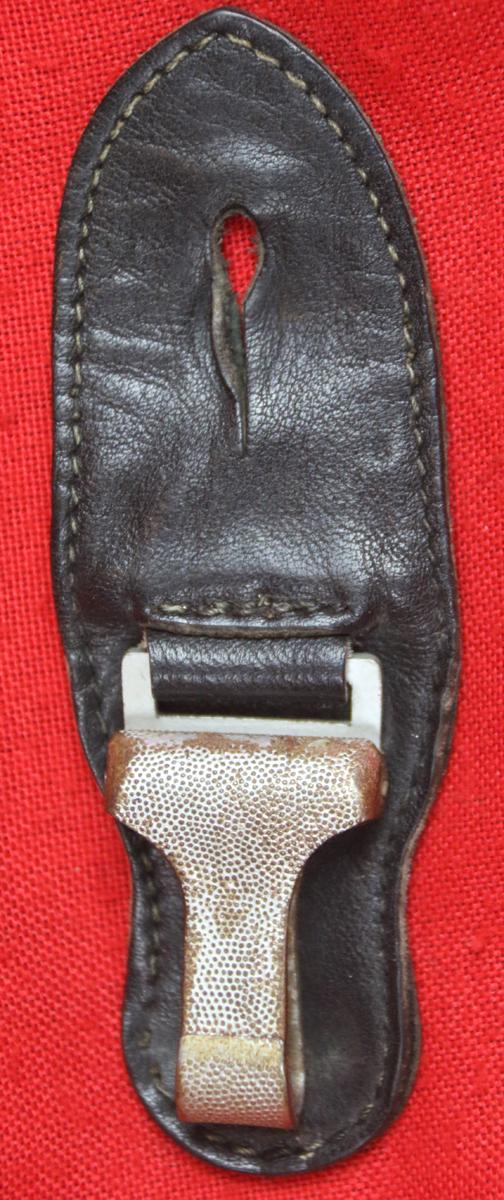
Click and use the code >24480 to search for this item on the dealer website Scarce German WW2, Luftwaffe officer´s or Possibly SS Officer´s Sword or Dagger Belt Hanger Mount
  • Nation : American
  • Local Price : £210.00
US M1873 Socket Bayonet for the Springfield Trapdoor Rifle, Pennsylvania National Guard. Description Socket bayonet for the Model 1873 .45-70 Springfield Trapdoor rifle, with fullered triangular blade and steel scabbard. Scabbard with drainage hole and frog hanging hook, black leather frog with rotating belt loop. The brass swivel of the belt frog is also cast with &#acute;N.G.P.&#acute; indicating that it was made for the Pennsylvania National Guard. The leather inside of the scabbard loop is also roughly inscribed with &#acute;WM&#acute;, presumably a soldier&#acute;s initials. The last model of standard-issue socket bayonet, the M1873 was used with the 1873 and 1879 &#acute;Trapdoor&#acute; Springfield rifles, until 1884 when the new model introduced a rod bayonet. The blade is bright with some patination, likewise the socket apart from the shank, which has bluing. The scabbard body is free of dents, it has been painted black with substantial flaking to the paint revealing patinated steel, particularly along edges. The leather frog is partly cracked along the seam attaching the semicircular &#acute;ear&#acute; piece to the scabbard loop “ it can support its own weight but should be handled with care. Some rubbing to the leather frog, surface flaking to the belt loop in places. The loop still rotates freely. One small dent to the flat side of the scabbard body.
  • Nation : British
  • Local Price : £210.00
British 1887 Pattern MkIII Martini Henry Sword Bayonet by Wilkinson. Description Straight unfullered spear-pointed blade. Steel hilt with comma-shaped quillon and stepped muzzle ring. Chequered leather grips (technically, knurled) secured by two steel rivets with washers. Black leather scabbard with steel mounts at the throat and chape, with frog hook. The blade is stamped at the ricasso on one side with a crown over &#acute;V.R.&#acute; for Queen Victoria, an issue stamp 4 &#acute;98 for April 1898, and the maker&#acute;s mark &#acute;WILKINSON SWORD COMPANY LONDON&#acute;. It is stamped on the other side with a War Department mark of a broad arrow over &#acute;WD&#acute;, a crown inspection mark with &#acute;W&#acute; for Wilkinson and an &#acute;X&#acute; indicating the blade passed a manufacturer&#acute;s bending test. The spine of the blade is stamped with two further crown inspection stamps for Wilkinson. The scabbard is stamped at the throat with the serial number &#acute;6843&#acute;. The throat piece of the scabbard is stamped under the staple on the front side with a crown inspection mark. The reverse of the scabbard is stamped next to the seam with further marks - these usually consist of another broad arrow over &#acute;WD&#acute; and another crown inspection mark but are illegible on this example due to rubbing. The 1887 Pattern bayonet was introduced into service in the face of the &#acute;British Bayonet Scandal&#acute; “ a controversy (eagerly whipped up by the media) that British Army bayonets were made of inferior metal and/or badly heat-treated, and the Army was outsourcing blade manufacture overseas to the detriment of British industry. The Government responded by centralising bayonet manufacture as much as possible at the RSAF in Enfield. However, Enfield was already overstretched and would not be able to manufacture the new pattern for some time. A tender was put out for private manufacturers to fill the gap “ German manufacturers made the cheapest offers but politics moved the government to choose the British firm Wilkinson of Pall Mall. This contract was instrumental in the rise of Wilkinson as a company and they manufactured around 42,000 1887 Pattern MkIIIs in 1888 and 1889, which made up 83% of the total supplied. The blade has a light patina with some old polishing marks “ it appears to have been refinished during its service life as the issue stamp is fresher and less rubbed than the maker&#acute;s mark next to it. Only a couple of very tiny nicks to the edge, not readily visible. The hilt and pommel have light patination in their recesses. The leather grips have some moderate handling wear that has somewhat smoothed the knurling, some small spots of losses to the leather on one side. The chape piece of the scabbard has some light dents, these do not interfere with sheathing and drawing. The leather of the scabbard has surface rubbing and some spots of abrasion near the throat and beside the seam. All its stitching remains intact.
  • Nation : Indian
  • Local Price : £200.00
Indian 19th Century Baker-Style Bayonet. Description Straight, spear-pointed blade. Steel hilt with semioval langet on one side only and D-shaped knucklebow. Steel grip with beading and ribbing to its surface, formed of two halves brazed together, with mortise slot and inset steel leaf spring locking mechanism attached with a single screw. Blade 21 5/8 inches in length, 1.2 inches wide at the shoulder, with false edge for the last 5¾ inches, the bayonet 26 1/8 inches overall. The langet bears a chiselled design of a lion rampant with its paws on a staff with pennant or a flagpole “ this resembles the badge of the East India Company, which was a lion rampant holding a crown between its forepaws, and it even more closely resembles the supporters of the Company&#acute;s coat of arms, which were lions rampant holding flags of St George on flagpoles. These bayonets are thought to have been manufactured in India, probably to fit to locally-made percussion rifles made in the style of the British P1837 Brunswick rifle, this being cheaper than importing &#acute;official&#acute; Brunswick bayonets. The design clearly harks back to the bayonet for the Baker rifle which preceded the Brunswick, that had been very popular among Indian troopers. Being local crafts purchased outside the Army procurement structure they carry no production markings. Some were found in the huge cache of surplus arms kept at the Royal Palace in Kathmandu, Nepal, and sold off in 2008. See page 346 of British Commonwealth Bayonets by Skennerton & Labudda, or page 318 of British & Commonwealth Bayonets by Skennerton & Richardson, for an example of this model (referred to as I3) and discussion of several variations of the type. Skennerton notes that the higher quality versions are those with steel hilts “ this would make sense given the cost of steel hilts over brass. The locking mechanism functions, although I have not tested whether it will fit to a Brunswick. The blade has some forging imperfections, light scratching and some small spots of patination and light cleaned pitting in places, particularly towards the tip, which is rounded by ~3mm. A number of tiny nicks to both edges, one small notch to the true edge. The hilt has a dark forged finish with light rubbing wear to raised edges showing bright steel. The blade is solidly peened to the grip, slight movement to the knucklebow & langet.
  • Nation : British
  • Local Price : £200.00
British L1A3 Bayonet, Converted L1A1, Dated 1957 by Enfield. Description Straight single fullered blade with clipped Bowie point. Black finished steel hilt, black painted sheet steel slab grips secured by two rivets around concealed tang. Steel pommel with locking button, black finished steel scabbard with circular frog stud, frog of white woven plastic. The blade is stamped at the ricasso on one side with a broad arrow War Office ownership stamp and &#acute;57D&#acute;, the &#acute;D&#acute; having a horizontal stroke extending from the vertical. The &#acute;D&#acute; with a stroke extending from the vertical is a mark of the Royal Small Arms Factory at Enfield, while 57 is the date of manufacture. The grip slabs are each stamped with another &#acute;D&#acute; with a stroke Enfield stamp and another broad arrow. The pommel is stamped on its base with the model &#acute;L1A3&#acute;, as well as with &#acute;0&#acute; and &#acute;257&#acute;, the latter probably a serial or weapon number. The L1A1 bayonet for the SLR rifle was sealed as a pattern in 1957, and the L1A3 bayonet in 1958. Most of the newly made L1A1s were converted to L1A3s (which only involved milling a recess into the pommel allowing the press stud to be replaced) and later more L1A3s were newly manufactured. Being dated 1957 this example is most likely one such conversion of an L1A1. Its markings also show signs of conversion: the grips of either an L1A1 or L1A3 would normally be stamped with their model and NATO item number, but these would be incorrect after conversion and I think they have been deliberately removed on this example by grinding, and only new Enfield &#acute;D&#acute; stamps were applied before the grips were refinished. The new model mark &#acute;L1A3&#acute; was then applied by manual stamping on the pommel rather than trying to replace the factory stamping on the grips. The blade retains its black parkerised finish with only tiny bright spots of wear on raised edges. Some dimpled forging imperfections to the blade which have been parkerised over. Likewise some spots of wear to the finish on raised edges of the hilt, grips and pommel, a couple of very small chips to the scabbard with light rubbing at its chape end.
Page 32 of 40

The following items match your search but are currently listed on Ebay. We take no responsibility for any aspect of the listings or their accuracy.


Sorry, there is not any matching items.