
(You must register and have a linked account first)
View Privacy Policy


OR

Show


Forgot your password?

Error message here!

Error message here!

Error message here!

Error message here!

Show Error message here!

Show Error message here!


Lost your password? Please enter your email address. You will receive a link to create a new password.

Error message here!

Back to log-in

Close

For Sale

The following items are listed by for sale by users of the site and dealers. They are in no way endorsed or guaranteed by www.oldswords.com

Add a Classified Item
to

Clicking on the sword will take you through to the relevant classified item or dealer site.
Don't miss out! - Do you want to be kept informed weekly of new aditions? Just join our weekly update list.

You can also receive regular email notifcations when items match your keywords. To recieve them just register or logon at the top right of this page.

Page 43 of 54
  • Nation : British
  • Local Price : £265.00
British Shortened Martini Henry Yataghan Sword Bayonet and Scabbard. BAYO 573. -. BAYO 573 This is a shortened Martini-Henry bayonet and scabbard for use by cadets. The blade has been converted from the longer yataghan style blade by shortening it and re-shaping the point which means the fuller runs through to the point. The only marking is the blade carrying the initials A.S. The mortice slot has been chamfered for Martini-Henry rifles and the muzzle ring has been bushed to 18mm. The rest of the bayonet is with original configuration with black leather grips *see images for condition of grips* and a leaf spring press stud. The scabbard is a shortened version of the original. See Skennerton, item B224 on pages 176 and 177. The price includes UK delivery. BAYO 573. (Box 2)
  • Nation : British
  • Local Price : £260.00
British WW1 1888 Pattern Bayonet, 6th Battalion The Welsh Regiment (Glamorgan Battalion). Unfullered spear pointed blade, wood scale grips with two brass rivets. Steel pommel and hilt with short quillon and muzzle ring. Black leather Land Mk II pattern scabbard with steel throat and leather chape. The blade is stamped on one side of the ricasso with a (faint) crown over ‘VR’, the production date of ‘9 ’97’, meaning September 1897, and the maker’s mark ‘Wilkinson London’. On the other side it is stamped with a broad arrow meaning War Department property, a crown inspection mark with ‘W’ for Wilkinson and an ‘X’ which indicates that the blade passed a manufacturer’s bending test. The spine of the blade is stamped with two further crown inspection marks with ‘W’. The pommel is stamped with the unit mark ‘6. WEL’, indicating the Queen’s Royal Regiment (West Surrey) and the number ‘735’. The exposed tang is stamped with ‘2’. The throat of the scabbard is stamped on each side of the mouth with a broad arrow, and with the serial number ‘160’. The scabbard leather is stamped next to the seam on one side with a broad arrow, the production date ’03 and indistinct marks, probably a crown inspection mark. The 3 rd Glamorganshire Rifle Volunteer Corps (Swansea Rifles) was formed in 1859, as part of the widespread Volunteer Movement of the period. As a Volunteer unit it went through many administrative changes but no deployment until the Second Boer War, when it contributed a detachment of volunteers to serve overseas. These men earned the unit’s first battle honour ‘South Africa 1900–1902’. In 1908 the Haldane Reforms brought Volunteer units into the new Territorial Force and linked them to regular regiments – the Swansea Rifles therefore became the 6 th (Glamorgan) Battalion of the Welsh Regiment, still headquartered at Swansea and forming part of the Territorial Force’s South Wales Brigade. The Welsh Regiment had been formed in 1881 as part of the Childers Reforms, amalgamating the 41 st (Welch) and 69th (South Lincolnshire) Regiments of Foot. On the outbreak of WW1 the battalion volunteered for overseas service and landed in France in October 1914. Territorial battalions were typically deployed still carrying the Lee Metford rifle and 1888 Pattern bayonet, supplies of the Lee Enfield being limited. The 6 th Battalion initially served on the lines of communication rather than on the front lines, but attrition caused Territorial battalions to be used in 1915 to reinforce regular brigades. The 6 th Battalion (technically the 1/6 th by this stage as a replacement 2/6 th Battalion was formed as a second line unit in December 1914) therefore joined the 84 th Brigade (28 th Division), reinforcing the 1 st Battalion Welsh Regiment, with which it fought in the Battle of Loos. In 1916 the 6 th was moved to the 1 st Division, serving as their Pioneer Battalion. In this role it would contribute working parties to assist the division’s complement of Royal Engineers with their various field tasks, but retained a supporting combat role and would take part in offensives. 1 st Division took part in many further actions until the end of the war including the Battle of the Somme, Third Battle of Ypres and the Hundred Days Offensive. The 6 th Battalion reformed after WW1 as a Territorial Army unit, absorbing the 7 th Battalion. With a growing emphasis on air warfare, the battalion became the 67th Searchlight Regiment in 1938. During WW2 it defended the industrial areas of South Wales against early small-scale Luftwaffe bombing raids, then deployed to protect Cardiff against much larger raids during the Blitz. In 1940 searchlight units were brought under the Royal Artillery, and the battalion remained with the Artillery even after the war. After several amalgamations, the lineage of the original Glamorgan Battalion is today maintained by 211 (South Wales) Battery of 104th Regiment Royal Artillery (The Welsh and Borderer Gunners), an Army Reserve light artillery unit. The blade has some light speckled patination. The tip of the blade has been shortened, possibly by breakage while in use, and has been reshaped and resharpened, with visible grinding marks. There are some minor nicks to the edge and the faint crown mark suggests that the blade may have been repolished above the shoulder. The wood grips have some light dents. The hilt and pommel have some patination and pitting. The throat piece of the scabbard has pitting and patches of dark patination. The leather of the scabbard has some rubbing and denting, one small spot of green paint, and one notch on the reverse side. The chape end of the scabbard is slightly kinked, but does not interfere with sheathing and drawing.
  • Nation : British
  • Local Price : £250.00
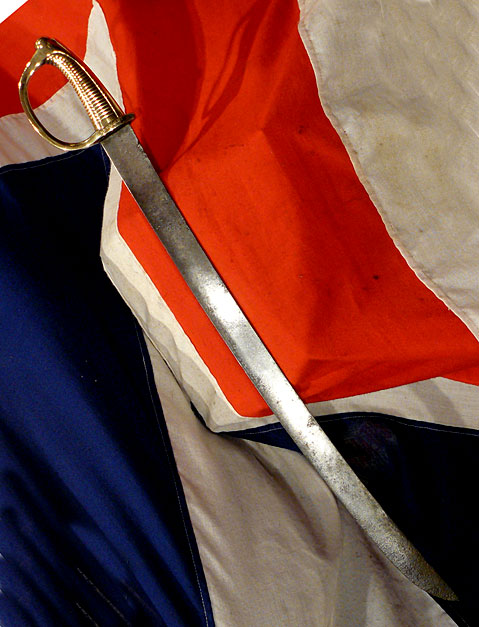
A Scarce Swiss 1842 Briquet Man's Sword of The Guard Regt's. Used in the Italian Uprising of 1848. A very rarely seen sword in the UK, The US and Europe, the Swiss briquet sidearm. It is based on the Franco-Prussian version, and similarly mostly made in Solingen Prussia, and imported to Switzerland in the early 19th century. Marked on the hilt J.P.Stacklj. As used by the Swiss regiment that fought in the streets of Naples for Ferdinand II, King of the two Kingdoms of Sicily, during the uprising of 15 May 1848. Between 1856 and 1860, around 1,200 Swiss mercenaries from the Swiss regiments in Naples continued their military careers in the Dutch colonial army. The Revolution which began in Palermo was one of a series of such events in Italy, though perhaps more violent than others. It quickly spread across the island and throughout Italy, where it prompted Charles Albert, King of Sardinia, to follow the example of Ferdinand II and issue a written constitution, the Albertine Statute {the Albertine Statute later became the constitution of the unified Kingdom of Italy and remained in force, with changes, until 1948}. In imitation of these events, riots and revolutions followed around Europe at the same time, and may be considered a taste of the socialist revolts to come. King Ferdinand II of the Two Sicilies By the recapture of Sicily in May 1849, the battle was said to be practically over. Filangieri, however, dared not let his troops enter the set of alleys that then made up the historic center of Messina: although the regular Sicilian forces had been exterminated or forced to flee, the bombardment of the Bourbons continued on the defenseless city, that is, on the part that had not yet been occupied by the regi, for another seven hours. The soldiers of the Bourbon army gave themselves up to the looting and violence against the inhabitants. Homes of foreigners living in Messina were also looted and destroyed, so much so that the English consul Barker reported the incident to his government writing that many English subjects living there were reduced to ruin and that even a diplomat, the consul of Greece and Bavaria M. G.M. Rillian, despite being in uniform, had been wounded by sabre, before his dwelling was also looted and burned down. The Bourbon troops did not spare even the religious buildings from looting. For example, the church of San Domenico, rich in works of art, was first looted of its sacred objects, then burned down and totally destroyed. Loss of life was incalculable. A Bourbon official wrote to his brother, immediately after the capture of Messina, stating that the Neapolitan departments had recaptured the city with a very intense fire and "trampling corpses in every step that progressed for the space of about two miles" and then commenting "What a horror! What a fire! British Admiral Parker also condemned the work of the Bourbons, and in particular the prolonged terrorist bombardment of the city even after the end of all resistance for eight hours: "The greatest ferocity was shown by the Neapolitans, whose fury was incessant for eight hours, after all resistance had ceased". During the siege of Messina, the last insurgents who resisted the attack of the Bourbons inside a convent, rather than hand themselves over, chose to throw themselves into a well, taking their tricolour flags with them. Messina was also troubled by the work of common criminals sent by King Ferdinand II to Sicily against the insurgents and that after tormenting the Sicilians for months with brigand actions (crimes, violence, thefts, etc.) they gave themselves at the time of the fall of the city to its looting, arriving with small boats from Calabria to make loot. Overall in very nice condition, with old traces of pitting on the blade. A very rarely seen sword. Every single item from The Lanes Armoury, Britain's famous, favourite, and oldest original Armoury Antique store, is accompanied by our unique Certificate of Authenticity. Part of our continued dedication to maintain the standards forged by us over the past 100 years of our family’s trading, and thus, it is a lifetime guarantee. No scabbard
  • Nation : British
  • Local Price : £250.00
British WW1 1913 Pattern Bayonet, Dated 1917 by Remington. Straight single-fullered knife blade, steel hilt with muzzle ring, wood slab grips with characteristic pair of cut grooves on each slab, secured by two screws. Steel beaked pommel and locking button. Brown leather scabbard with steel locket & chape piece, the locket with teardrop frog stud. Olive green 1908 Pattern canvas frog, slightly shorter than standard at 7.5 inches long rather than 8.25 (a known variant - see example 123, p31, Bayonet Belt Frogs Part I by Carter). The ricasso is stamped on one side with ‘1913 1 17’, indicating that it is the 1913 Pattern, manufactured in January 1917, and the maker’s mark ‘Remington’ within a circle. On the other side it is stamped with a ‘broad arrow’ War Department stores mark, two crown inspection marks with ‘A’ for America and an ‘X’ indicating that the blade passed a manufacturer’s bending test. The leather section of the scabbard is stamped next to the seam with another broad arrow and the manufacture date ’14. The throat piece of the scabbard is stamped at the mouth with ‘218’. The chape piece of the scabbard is stamped with a broad arrow, ‘EFD’ for the Royal Small Arms Factory at Enfield and ‘48’. Inspired by the German Mauser M98 rifle, the experimental Pattern 1913 Enfield was intended to be the next generation British infantry rifle, firing the new .276 cartridge. The outbreak of war curtailed its development and the well-established SMLE was retained in service instead. However with an urgent need for rifles the government opted to redesign the 1913 to take the existing .303 cartridge, calling this new rifle the Pattern 1914 (NB: the bayonet’s design did not require modifications, therefore it remained the ‘1913 Pattern’ bayonet). The production of these rifles and their bayonets was contracted to American manufacturers – an early handful were made by Vickers but it was clear that British plants were best left to make the SMLE. Remington was the largest manufacturer of the 1914 Pattern and its associated bayonet, producing 1,243,000 of the bayonets between 1916 and 1917. The 1914’s design was vindicated in that it proved to be more accurate than its predecessor and it was deployed principally as a sniper rifle, the Winchester-made rifles in particular thought to be of high quality, suitable for fitting with telescopic sights. It saw service again during WW2 as rear echelon equipment, e.g. with the British Home Guard, although some were again used in a sniper configuration. The 1913 Pattern should not be confused with the M1917 Enfield, also known as the ‘American Enfield’, which was essentially the same rifle design, this time adopted by the Americans and rechambered in their own .30-06 Springfield cartridge. Its bayonet was also essentially the same as the British model, but with US service marks and a ‘1917’ pattern stamp. The blade is sharp with no edge damage. It retains its original grey parkerised finish and blued area at the ricasso, with only a few small spots of patination. The hilt, exposed tang and pommel have a blued finish with some rubbing at raised edges revealing bright steel. The wood grips are very good with only a couple of small dents. The scabbard fittings are likewise blued and retain nearly all of this finish, with rubbing only at the tip of the chape and a little on the frog stud, exposing bright steel. The leather body of the scabbard has only some very small dents and spots of abrasion, all of its stitching is intact. The canvas frog has no fray and is free of staining. Its rivets, which I think are brass, have dulled. It is well fitted to the scabbard and I have not removed it to look underneath at the throat piece.
  • Nation : British
  • Local Price : £250.00
British WW1 Lee Enfield 1907 Pattern Bayonet, Royal Marines, Dated 1917. Straight single-fullered knife blade, steel hilt with muzzle ring, wood slab grips secured by two screws, steel beaked pommel with oil hole and locking button. Brown leather No. 1 Mk 2 scabbard with steel locket & circular frog stud and steel chape piece. The ricasso is stamped on one side with a crown over ‘GR’, 1907 (the pattern) ‘9 ‘17’, indicating the manufacture date of September 1917, the manufacturer’s mark ‘WILKINSON’, a crown inspection stamp and a reissue stamp dated ’21. On the other side it is stamped with a ‘broad arrow’ War Department stores mark, three crown inspection marks with ‘E’ indicating the Royal Small Arms Factory at Enfield, and an ‘X’ indicating that it passed a manufacturer’s bending test. The grip slabs are each stamped with a crown inspection mark between the screws. The pommel is stamped with ‘R M’, indicating issue to the Royal Marines. The leather of the scabbard is stamped next to the seam with another broad arrow mark, another crown inspection mark, the manufacturer’s mark ‘EFD’ for the Royal Small Arms Factory at Enfield and the manufacture date ’17. The throat piece of the scabbard is stamped next to the staple with a tiny stamp consisting of a broad arrow, ‘EFD’ again and ‘AV’. The First World War required a massive expansion of the Royal Marines, as they moved beyond their traditional role as fleet defence and naval gunners to contribute trained manpower to a land war of unprecedented scale. In September 1914, the Marines initiated short-service recruitment for the first time in their history, enlisting men only “for the duration of the war". However, there was a severe shortage of equipment to support this infantry role. The Royal Navy entered the war with a mixed inventory of British service rifles, but these were spread out across storehouses and ships. Under time pressure the 1 st Royal Naval Brigade was forced to deploy to Belgium in September 1914 armed with the Charger-Loading Lee Enfield (a modified version of the Lee-Metford and Magazine Lee Enfield rifles) rather than the up-to-date Short Magazine Lee Enfield. Even these previous-generation rifles had to be scrounged at extremely short notice, arriving days or even hours before embarkation. In November 1914 Winston Churchill, at that time First Lord of the Admiralty, ordered all SMLEs and CLLEs to be collected from ship armouries across the fleet and supplied to the Royal Naval Division (which included the Marines). This got some modern rifles into the hands of the Marines, although the bulk of this tithe was handed over to the Army, its needs being even greater. The situation began to stabilise: Marines fighting on land started to upgrade to the SMLE and its bayonet while naval vessels were left to use truly antiquated equipment like the Martini Henry rifle, or more exotic replacements: Japanese Arisaka rifles and bayonets were purchased and issued to those Royal Marines still aboard ships, later replaced with the Canadian Ross rifle. However, shortages were still so serious that the Admiralty purchased sporting rifles from BSA in March 1915, and Marines deployed to Gallipoli in April 1915 still predominantly carrying the CLLE. In 1916 the Royal Naval Division was moved from Admiralty control to that of the War Office, which improved supply of SMLE rifles – the simplified Mk III* rifle was also introduced in January 1916 and Pattern 1914 rifles made in America began to be delivered. It would appear that by 1916 all frontline Marines were finally assured of a modern rifle and bayonet like this one. Over the course of the conflict the Royal Marines grew from a pre-war strength of roughly 18,000 to over 55,000 personnel. Matching manufacture dates suggest that this bayonet and scabbard are probably an original pair. The reissue stamp suggests it remained in service with the Royal Marines beyond WW1 and into the interwar period, in which the flow of equipment reversed sending the SMLE from demobilising units back to storehouses and ships. The SMLE remained in service with the Royal Marines throughout WW2, although Commando units transitioned to the newer No. 4 rifle and the No. 5 ‘Jungle Carbine’ for their amphibious operations by 1944. The SMLE was retired in 1957, except a few held for ceremonial use and Royal Marine Cadet training rifles. The blade is bright with some light patination and grinding marks. It retains its blued band at the ricasso. No damage to its edge, which has been sharpened. The wood grips are excellent with only a couple of very light dents, a glossy finish with good colour to the wood and no apparent handling wear leaving the inspection stamps very clear. The hilt, pommel, exposed tang and scabbard fittings are blued – this finish is in good condition with wear only on the most raised edges and a few spots of light patination. A couple of short, fine scratches to the scabbard fittings which show up bright. The leather body of the scabbard has some surface abrasion giving a slightly rough texture overall, no major dents or damage. All the scabbard’s stitching remains intact.
  • Nation : German
  • Local Price : £250.00
German WW2 Army NCO’s Sword ‘Extrasäbel’ by Paul Seilheimer, Solingen. Curved, narrow single-fullered blade with spear point. P-shaped single bar hilt with quillon, shield-shaped langets, steel backstrap with riveted ears. Grip of ribbed black plastic bound with gilt wire. Brown leather washer. Steel scabbard painted black, with single fixed hanging ring and frog loop. The blade is stamped on one side with a mark of a P-hilt sabre vertically impaling a triangle that contains the word ‘SOLINGEN’. The sword’s hilt lies between the letters ‘P’ and ‘S’. This is the maker’s mark of Paul Seilheimer of Solingen. Established in 1917, the firm of Paul Seilheimer was one of many based in the city of Solingen, Germany. It manufactured swords and bayonets as well as kitchen cutlery. It was an approved government manufacturer of swords and daggers for various military and political organisations throughout WW2, although examples are relatively scarce so this may not have been at a large scale. The company ceased trading in 1970. ‘Extrasäbel’, or ‘specialty sabres’ were privately purchased from a number of retailers by German soldiers and NCOs, and were not an official pattern, although they were very similar to the Army officer’s sword. They were carried for show, ceremonial use, or as a dress sword. Not being fighting swords, the buyers often chose to ornament the blades, which could include plating, etching, bluing etc. This model is visible in product catalogues of the period produced by Waffenfabrik Paul Seilheimer, where it is listed as ‘Mannschafts-Extrasäbel’ – Mannschaft meaning ‘enlisted personnel’ which were distinct from officers (Offizier). All metal pieces of the sword itself have been nickel plated, with some light speckled wear to the plating overall, including the blade. The wire binding of the grip is all intact and tight, some fractional movement to the hilt and grip. The scabbard is free of dents and retains almost all its original paint with only a few small chips.
  • Nation : British
  • Local Price : £250.00
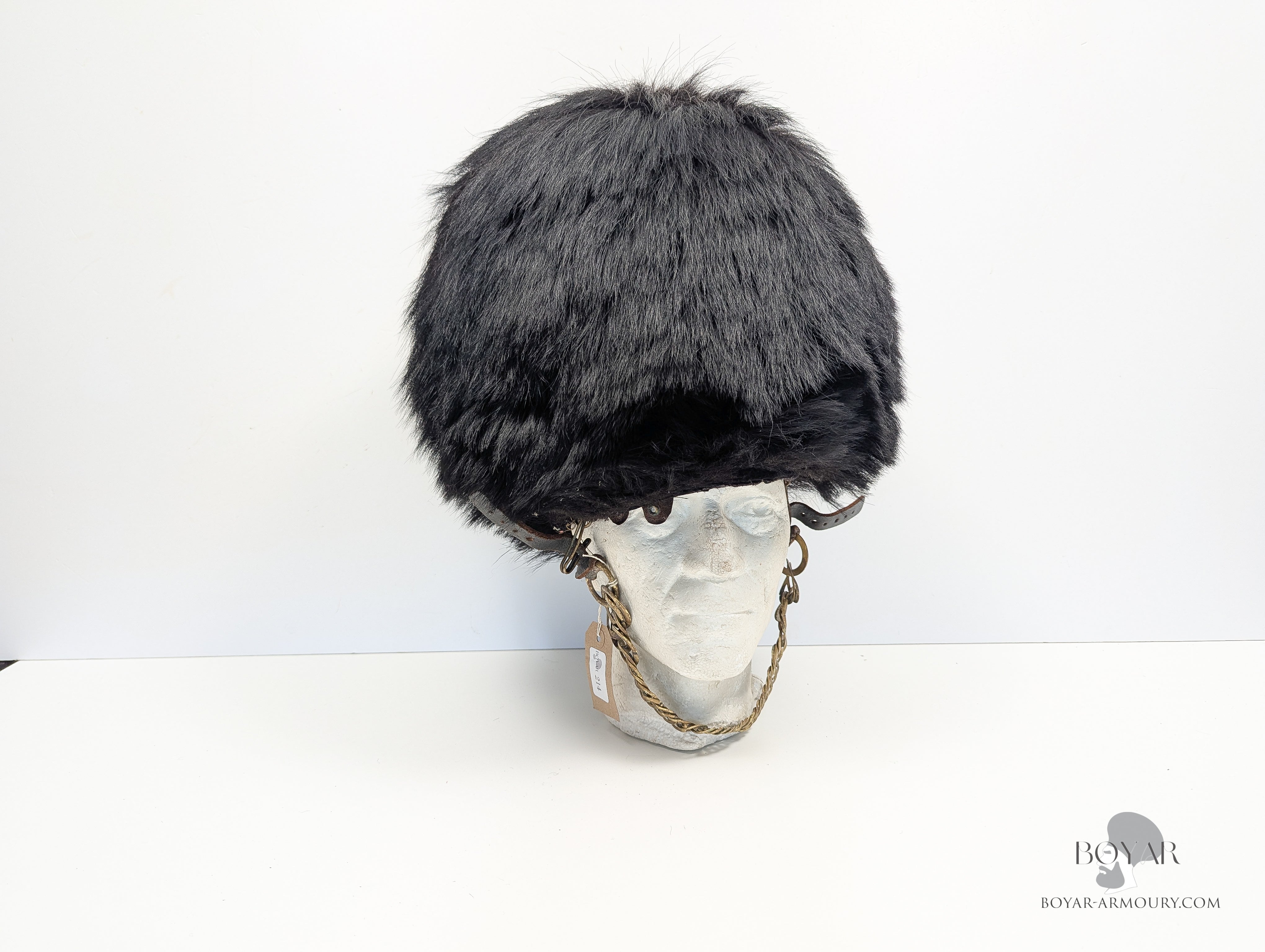
Victorian Bearskin Guards Hat Marked VR 1885. Origin: United Kingdom, Culture: British, Period: 19th Century. Victorian bearskin Guards hat marked VR and dated 1885 on the chain.
  • Nation : British
  • Local Price : £250.00
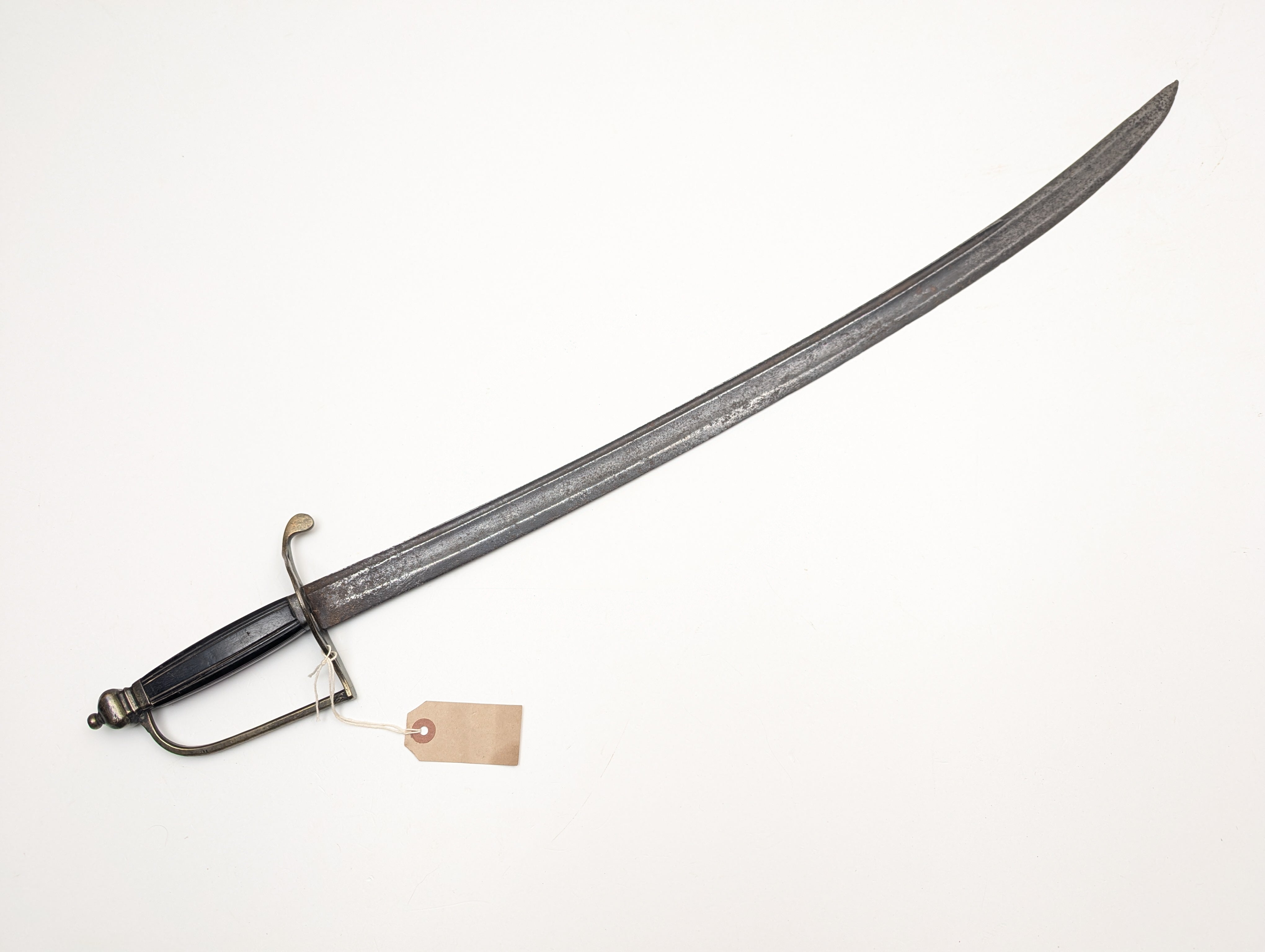
Georgian Pre-Regulation Sword (1780s). Origin: United Kingdom, Culture: British, Period: 18th Century. Georgian Pre-Regulation Hanger (1780s). The area that meets the diamond shape to the guard is not attached.
  • Nation : -
  • Local Price : £250.00
Small ‘Katana’ sized Iron ‘Tsuba’ in a rounded Square Shape. ED 2694. -. ED 2694 A nice small Iron ‘Katana Tsuba’ (A tsuba is a sword guard and part of a sword mounting. It is mounted between the sword's blade and grip to protect the user's hands) in a rounded square shape with a flat plate rounded rim (5mm) thick. There is a depiction of a Goose in flight to the surface. It has a lovely black iron look and appears to be early 19th Century age into ‘Meiji’ period, possibly ‘Nara school work’. The price includes UK delivery. ED 2694.
  • Nation : Japanese
  • Local Price : £245.00
C1936 Type 30 Japanese Bayonet Tokyo Variation A 11th Series and Scabbard. 22024. -. 22024 This is a Japanese ‘Arisaka Type 30’ bayonet with hooked quillon and made by ‘Tokyo Kokura’ arsenal (The arsenal was established in 1916 as the ‘Kojura Arms Factory’ Kokura Heiki Seizojo as one of six arsenals under control of the Government: the others were the Tokyo Arsenal, Nizo Arsenal (Second Tokyo Arsenal), Nagoya Arsenal, Osaka Arsenal and the South Manchurian Arsenal). The Arsenal manufactured various machine guns, cannons and rifles. The blade measures 15 ½ “with fullers and is clearly marked to the ricasso with the four rings trademark of the ‘Kokura’ arsenal. The grips are wooden held by two screw bolts. The pommel is serial number marked ‘1168911’ which puts it to variation A- 11th series. The scabbard is a ball tipped metal version which has an aged patina. (see page 97-99 of Bayonets of Japan by R.C.Labar for reference). The price includes UK delivery. 22024. (Other countries Box 1)
  • Nation : British
  • Local Price : £245.00
British ‘L1A3’ Bayonet, Scabbard & Frog BAYO 369. -. BAYO 369 This is a British L1A3 bayonet and scabbard (see Skennerton’s book, British & Commonwealth Bayonets Book, pages 261 – B322). The bayonet was first adopted on the 31st of December 1958. The bayonet has a blackened pommel and cross guard with muzzle ring, all of which retain most of their original paint. The 7.937” drop point steel blade is single edged and has fullers. There are no visible marks on the blade. The bayonet has its original No5 MK II metal scabbard brass mouthpiece and is fitted with an original webbing frog. The price includes UK delivery. BAYO 369. (Box 1)
  • Nation : French
  • Local Price : £245.00
French M1892 Chromed Mannlicher Berthier 1st Pattern Bayonet. Single-fullered straight blade, riveted black composition grips (meaning that this is the 1 st pattern, the 2 nd pattern having wood grips). The blade has notches near the hilt which engage with a mechanism locking the blade into the scabbard. Steel scabbard, black leather frog. Hilt with muzzle ring overlapping the grip and a hooked quillon. Many M1892 bayonets had the quillon removed during WW1 – this example remains intact and original. Bayonet and scabbard are both numbered but are non-matching, indicating a replacement or swap during its service life. No other markings. All metal parts on this example have been chromed for parade use, with black grips, scabbard and frog for a two-tone effect. The chrome finish is excellent, with a line of wear on the blade where it rubs against the scabbard retaining spring. The scabbard was painted black over its original blueing – this has worn with use with only small areas of gloss black paint remaining, some wear also to the blueing and areas of light pitting. The leather frog has only very light rubbing and no loss of stitching.
  • Nation : -
  • Local Price : £245.00
India Pattern Bayonet and Long Scabbard No1 MKII*. BAYO 779 -. BAYO 779 World War Two saw India’s largest period of bayonet production, and from 1939 until 1942 the bulk of India’s rifle and bayonet production went to Indian troops overseas and into British stores. The No1 MkII*was made with the false edge. These bayonets are special to India and bear the makers name and factory ‘R.F.I’ (Rifle Factory Ichhapore, The Rifle Factory Ichhapore also known as ‘Ichhapore Arsenal’ is an Indian state-owned arms manufacturing unit located at Ichhapur in the state of West Bengal) to the ricasso along with the date of manufacture ‘3’48’ (March 1948). The 302mm blade (422mm overall) doesn’t appear to have been re sharpened and the wooden grips are in excellent condition. The scabbard bears the ‘O.A’ (Orange Arsenal) marks and the furniture and leather are in very good condition with all the stitching in place. See Skennerton item 154, pages 347-351. The price includes UK delivery. BAYO 779. (Other Countries Box 2)
  • Nation : British
  • Local Price : £245.00
British Wilkinson 1888 Pattern Mark I, 2nd Type Lee Metford Bayonet and Scabbard. BAYO 581. -. BAYO 581 This is a Lee Metford, 1888 Mark I second type bayonet manufactured for the British .303 calibre Enfield, Lee Metford Rifle. The bayonets 12” double edged blade is unfullered with a medial ridge running from the ricasso to the blade tip. The ricasso of the blade is marked WILKINSON LONDON 2 99 (February 1899 manufacture date) ’03 and various other inspection stamps. The other side carries an arrow over W.D. and an inspection stamp. The pommel is regimentally marked 28 LD R710 2.E and 758 crossed out. There is also an inspection stamp on the spine. The grips are wood, held together with two brass rivets. There is an oil clearance hole in both grips. See Skennerton item B213 page 169 for reference. The price includes UK delivery. BAYO 581. (Box 2)
  • Nation : -
  • Local Price : £245.00
Nazi M98 Dress Bayonet By A Scarce Maker Gustav Spitzer, Solingen & Scabbard. Bayo 90 -. Bayo 90 An early Nazi M98 dress bayonet by a Scarce maker, Gustav Spitzer and scabbard. The dress sidearm for military and civilian uniformed formations was designated the M98 Dress Bayonet. This bayonet represented a stylised form of the S. 84/98 bayonet purchased by the individual for wear with the walkout dress uniform and was worn by the mainly non-commissioned officers and enlisted personnel. This dress bayonet has a rifle mortise and push button release. It retains the red felt in the mortise slot. This is the long version with a 9 3/4" blade. It has "C Gustav Spitzer Solingen" stamped into the ricasso. The polished steel blade is in excellent condition. The grips are chequered and secured with two rivets. It has a metal scabbard with lozenge shaped frog stud. (see 'German Clamshells' book pages 15-16 by Gary L. Walker & R.J. Weinand). The price includes UK delivery. Bayo 90
  • Nation : -
  • Local Price : £245.00
India Pattern No1 MK1++ Bayonet, Scabbard and Frog. BAYO 508 -. BAYO 508 This is an India pattern bayonet converted from a 1907 pattern bayonet. The original markings are still legible (crown ofer G.R. 1907 and 4 18 (April 1918 date) and SANDERSON). These bayonets were converted by India from full length to the shortened version in the 1950s. This example has Mk1++ stamped over the crowned G.R, on one side and F.R.56 on the other side of the blade. This denotes a factory repair in 1956. The blade has a false edge with the fuller running to the tip and has ben re-blued. The grips have an Indian inspection on one side. The bayonet is contained in its shortened Mk1 scabbard and the frog is a standard pattern 37 webbing version. See Skennerton item 152 on page 348 for an identical bayonet. This is a very nice condition India pattern for the serious collector. The price includes U.K. delivery. P 1907 BOX. BAYO 508
  • Nation : -
  • Local Price : £245.00
WWII 1943 Dated India Pattern No 1 MK.II* Bayonet Scabbard and Frog R.F.I. Marked (Royal Factory Ishapore). BAYO 394. -. BAYO 394 This is a nice WW2, 1943 dated Indian Pattern No. 1 MK II* bayonet and leather scabbard. This is one on the many variations of these bayonets and a large collection could be amassed of all the different patterns and variations with this pattern bayonet. This bayonet has a false edge tip to the blade and the ricasso carries 7 43 (July 1943 manufacture) over R.F.I. (Royal Factory Ishapore). And crown over ‘G.R.I.’. See Skennerton item 154 on page 349 for similar and pages 346 – 351 for full descriptions of all the variations. The rounded pommel has the correct release button which operates smoothly, and it has a clearance hole. The scabbard is a cut down No1 with steel mounts and a black leather body dated ‘1942’. The green webbing frog is in good order *see images* The price includes UK Delivery. BAYO 394. (British Box 1)
  • Nation : Canadian
  • Local Price : £245.00
WW1 Scarce Canadian Marked Wilkinson 1907 Pattern Bayonet & Scabbard. BAYO 580 -. BAYO 582 This is a scarce Canadian marked marked WW1 production P1907 bayonet by Wilkinson. The blade carries the crown over G.R. and 1907 followed by 8 18 (August 1918) and Wilkinson. The other side of the blade carries the broad arrow. The pommel carries the Canadian acceptance stamp of a broad arrow within a C. The wooden grips are wood held by 2 screw bolts. The Canadians used the Ross rifle at the start of the war bt due to accidents and failures under battlefield conditions it was withdrawn and replaced by the S.M.L.E rifle. This is a P1907 bayonet used by the Canadians towards the end of the war. Canadian bayonets are scarce and do not turn up often of the collectors market. The price includes U.K. delivery. BAYO 580
  • Nation : -
  • Local Price : £245.00
Nazi M98 Dress Bayonet By A Scarce Maker Gustav Spitzer, Solingen & Scabbard. BAYO 80 -. BAYO 80 An early Nazi M98 dress bayonet by a Scarce maker, Gustav Spitzer and scabbard. The dress sidearm for military and civilian uniformed formations was designated the M98 Dress Bayonet. This bayonet represented a stylised form of the S. 84/98 bayonet purchased by the individual for wear with the walkout dress uniform and was worn by the mainly non-commissioned officers and enlisted personnel. This dress bayonet has a rifle mortise and push button release. It retains the red felt in the mortise slot. This is the long version with a 9 ¾“ blade. It has "C Gustav Spitzer Solingen" stamped into the ricasso. The polished steel blade is in excellent condition. The grips are chequered and secured with two rivets. It has a metal scabbard with lozenge shaped frog stud. (see 'German Clamshells' book pages 15-16 by Gary L. Walker & R.J. Weinand). The price includes UK delivery. BAYO 80. (Box 2)
  • Nation : Italian
  • Local Price : £245.00
Italian WW2 Era, RARE, Model Italian Tropical Model 1870 Sword Bayonet Webbing and Leather Bayonet Frog. -. L 263 This is a rare Italian leather and canvas bayonet frog for the Model 1870 sword bayonet. The leather part of the frog is a mid-tan in colour and is in excellent condition with no rips or tears. The stitching is complete and in good order. The leather frog is attached to a buff webbing strap by stitching and forms a belt loop. The frog measures 10 inches in length. At the rear of the frog is marked in old worn ink REGALBUTO SICILY 1943. The battle of Regalbuto was part of Operation Hardgate and began on the 29th of July. This was a pincer manoeuvre to capture Adrano and was in full swing on August 1, 1943. On one pincer was the 1st Canadian Division at Regalbuto and the other was the 78th Division, supplemented with the 3rd Canadian Brigade. The Germans, particularly the Panzer-Division Hermann Göring, were told to hold the line, but had been bombed continually by the RCAF flying out of Tunisia. Once again, the Panzer-Division Hermann Göring were matched against the Canadians in Regalbuto. Regalbuto was captured on August 2, 1943. See item 343, Carter, Bayonet Belt Frogs Part II.The price for this bayonet frog with its history includes UK delivery. (Belts Box). L 263
  • Nation : -
  • Local Price : £245.00
Belgian M1924 Mauser Sword Bayonet & Scabbard. BAYO 419. -. BAYO 419 The Sword bayonet for use with M1924 and M1930 Short Rifles produced by FN for export. These were made for use with Mauser rifles manufactured for export. The M1924 Mauser rifle was widely exported and made with two bayonets with identical hilts but different blade lengths they were made to be exported with this highly successful rifle. These rifles were sold worldwide to Argentina to Yugoslavia with scores of countries in between. See pages 26 & 41 No 99 of Watts & White ‘The Bayonet Book’. The polished blade length; 38 ¾ cm (51 ½ cm overall) The wooden grips are solid with only minor service wear. The metalwork is polished and retains the overall majority of its colour with No 15056 to the top of the pommel. The polished blade is in very good condition. The all steel blackened scabbard has a teardrop frog and ball end cap. It has aged well and has only minor service wear. The price includes UK delivery. BAYO 419. (Box 3)
  • Nation : British
  • Local Price : £245.00
British ‘1907’ Pattern Bayonet and Scabbard. BAYO 907. -. BAYO 907 This is a nice ‘1907’ bayonet that has had its quillon removed on re-furbishment. The blade is stamped ‘Crown over G.R. 1907 10’11 (dating it October 1911) and ‘E.F.D. (Enfield). The production figures for 1911 were only 32,706 at ‘Enfield’, but the bayonet was also made in large quantities by ‘Wilkinsons’ and others. In ‘1913’ it was decided to remove the quillon and all further bayonets were made without the quillon and those that came in for refurbishment had it removed, (see Skennerton item B234 & B235 PAGES 186-195). The other side of the blade has a broad arrow and several inspection stamps. The grips are wood, held on by two screwbolts, and are in near mint condition. The scabbard is the ‘No1 MkII’ which is showing signs of service related wear with a round frog stud. The price includes U.K. delivery. BAYO 907.
  • Nation : -
  • Local Price : £245.00
U.S. Rare M1 Bayonet and Scabbard for the Garand Rifle By A.F.H. BAYO 719 -. BAYO 719 This is a rare M1 bayonet and not a cut M1905 or M1942 blade. The grips are plastic and are held to the bayonet by one screw bolt. The fullers on the blade do not go down to the tip, stopping 2 ¾ inches from the tip. The blade is in very good order and is showing signs of service wear.The bayonet is stamped on the ricasso with A.F.H. (Union Fork and Hoe) U.S. and has the Flaming Grenade (Frankford Arsenal). The crossguard is stamped ‘5058’. The bayonet is carried in its correct composite olive green plastic scabbard *unfortunately showing some etching/damage* with a steel mouthpiece on which is stamped the U.S. flaming grenade. The bayonet is virtually identical to the one shown as in item 930 on pages 412 and 437 in The Bayonet Book by White and Watts. The price includes UK delivery. BAYO 719.
  • Nation : -
  • Local Price : £245.00
India Pattern No 1 - MK1 ** Bayonet With The Fuller Running to the Tip, Scabbard & Frog. Sn 12829. -. 12829 An Indian Pattern No.1- MK I** bayonet and leather scabbard. This is a shortened conversion of an earlier bayonet with the fuller running to the tip and with an addition of a false edge. This is a conversion in the India pattern range of a 1907 Wilkinson made bayonet. According to Skennerton's many of these conversions with a false edge were done during the 1950's. This example was done in 1956 and carries the stamp "F.R. 56" denoting 'Factory repair 1956'. The other side of the ricasso has a faint stamp of Wilkinson's, Crown over "G.R." but now over stamped with "MK **". The bayonet is in excellent condition. It has a blued 12" blade. It has slab wood grips which are secured with two screw bolts and one is stamped with Indian inspection marks. The pommel has a release button which operates smoothly and it has a clearance hole. The leather scabbard has a metal locket and chape. (See page 348-351, item 152 in Skennerton's 'British & Commonwealth Bayonets book). The price includes UK Delivery. Sn 12829. (Box 1)
  • Nation : -
  • Local Price : £245.00
U.S. ‘M1’ Garand Bayonet and Scabbard. BAYO 733. -. BAYO 733 This a lovely dated blade ‘M1’ bayonet that has been cut down from an ‘M1905’ long bayonet, denoted by the fact that the tip. The blade is marked with ‘S.A.’ (Springfield Arsenal) over a flaming grenade and ‘1918’. The other side carries ‘U.S. over 856482’.This bayonet was converted by ‘A.F.H’ (Allied Fork & Hoe Co) and is stamped to the top of the hilt with ‘A.F.H’. The grips are black plastic held by a single screwbolt. The scabbard is an olive drab camouflaged early example with ‘U.S. M7’ stamped to the topmount and not the later flaming grenade with ‘U.S.’. See ‘An Illustrated History of Bayonets’ by J.Brayley, pages 231-241. This is a very good Garand variant worthy of any collection. The price includes U.K. delivery. BAYO 733.
  • Nation : -
  • Local Price : £245.00
*U.S. ‘M1 Garand’ Bayonet and Scabbard. BAYO 731. -. BAYO 731 This is a nice ‘M1 Garand’ bayonet with an original blade and not a cut down ‘M1905’ or ‘M1942’. The fullers do not run through to the tip as with the cut down bayonets, but stop 2 ¾ “from the tip. It is marked to the blade with ‘R.I.A.’ (Rock Island Arsenal) a feint 1918 date and a flaming grenade with the other side carrying ‘U.S. over a feint 355805?’ The bayonet metal parts appear to have been chromed, possibly for ceremonial use. The unmarked grips are black ribbed plastic held by a single screwbolt. The near mint scabbard is an olive drab, again freshly made and not a cut down version. It is marked to the top mount with a flaming grenade and U.S. the rear of the scabbard carries ‘VP 29’ denoting manufacture by ‘Victory Plastics’ , see ‘An Illustrated History of Bayonets’ by Martin.J.Brayley, pages 231-241. A good collectors piece with maker marked scabbard. The price includes U.K. delivery. BAYO 731.
  • Nation : British
  • Local Price : £245.00
British Martini Henry ‘1876’ Socket Bayonet with Nepalese Script to the Blade. BAYO 717 -. BAYO 717 The 22"Common socket bayonet was named the "Lunger" by the soldiers. Approved on the 7th June 1876 it is triangular in shape, the bayonet was purely a stabbing weapon, with no sharp edges. Known today as the Pattern 76', this is actually incorrect; the official name was the "Bayonet Common Long". Bayonets were marked with the War Department stamp, and the Enfield Viewing marks. From July 21st 1882 socket bayonets were marked with the date of manufacture. This example is dated ‘9/82’ (September 1882), There is some ‘Nepalese’ script to the blade which renders itself to further investigation, as shown in the images. The War Department acceptance mark is also on the blade. The blade has some age related marks to its 54 ½ cm length. See ‘British and Commonwealth Bayonets’ by Skennerton& Richardson page 145-6 item B187. The price includes UK postage. BAYO 717.
  • Nation : British
  • Local Price : £245.00
British ‘1876’ Socket Bayonet with Nepalese Script to the Blade. BAYO 711 -. BAYO 711 The 22"Common socket bayonet was named the "Lunger" by the soldiers. Triangular in shape, the bayonet was purely a stabbing weapon, with no sharp edges. Known today as the Pattern 76', this is actually incorrect; the official name was the "Bayonet Common Long". Bayonets were marked with the War Department stamp, and the Enfield Viewing marks. From July 21st 1882 socket bayonets were marked with the date of manufacture. This example is dated ‘4/88’ (April 1888), There is some ‘Nepalese’ script to the blade which renders itself to further investigation, as shown in the images. The War Department acceptance mark is also on the blade. The blade has some age related marks to its 21 ¾ “length. See ‘British and Commonwealth Bayonets’ by Skennerton& Richardson page 145-6. The price includes UK postage. BAYO 711
  • Nation : British
  • Local Price : £245.00
British ‘1907’ Sword Bayonet and Scabbard. BAYO 735. -. BAYO 735 The 1907 bayonet was designed to be used with the Short Magazine Lee Enfield (SMLE) rifle. The pattern 1907 bayonet with hooked quillon removed, the important change was decided for the removal was in 1913, the official approval date was 29/10/13. This bayonet comes with a leather scabbard, all with stitching intact and furniture painted olive drab. The ripasso has the name of the maker ‘Wilkinson’ who produced 25,575 of the 1907 bayonet. The date of manufacture is obscured, possibly ‘18’ (1918). The other side has Government acceptance marks etc. The wooden grips *in good condition* are held with two pins above the cross guard and muzzle ring. Blade length: 43 cm, overall length: 55 cm and does not appear to have been re sharpened. See ‘British and Commonwealth Bayonets’ by Ian Skennerton and Robert Richardson, page 187 item B235. The price includes UK postage. BAYO 735. (Box 1)
  • Nation : German
  • Local Price : £245.00
Desk Top German Miniature K98 Bayonet and Scabbard. BAYO 2615 -. BAYO 2615 This is a miniature version of the K98 Dress Bayonet and has a 12 ¼ cm (18 ¾ cm overall) fullered polished steel blade. A rear facing quillon, wooden chequered grips and a stylised Birds head pommel. The scabbard is black painted steel but with no frog stud which would suggest use as a desk paper knife. These have not survived in as great numbers as the full size bayonets of this type. The price includes UK delivery. BAYO 2615. (German Daggers Drawer)
  • Nation : -
  • Local Price : £245.00
India Pattern Bayonet and Long Scabbard No1 MKII. BAYO 783 -. BAYO 783 World War Two saw India’s largest period of bayonet production, and from 1939 until 1942 the bulk of India’s rifle and bayonet production went to Indian troops overseas and into British stores. The No1 MkII was made with the shorter unfullered blade (not conversion). These bayonets are special to India and bear the makers name and factory ‘M.I.L.’ (Metal Industries Lahore), M.I.L. had produced No I Mk and Mk. III bayonets during the second world war, when Lahore was still under Indian jurisdiction) to the ricasso. The 300mm blade (425mm overall) doesn’t appear to have been re sharpened and the wooden grips are in good condition held by two screws. The long scabbard bears the ‘O.A’ (Orange Arsenal) marks and ‘Mangrovite 43’ (Mangrovite Arsenal), the furniture and leather are in very good condition with all the stitching in place. See Skennerton item 153, pages 347-351. The price includes UK delivery. BAYO 783. (Box 3 all countries)
  • Nation : German
  • Local Price : £245.00
Desk Top German Miniature K98 Bayonet and Scabbard. BAYO 2611. -. BAYO 2611 This is a miniature version of the K98 Dress Bayonet and has a 5 1/2" fullered polished steel blade. A rear facing quillon, wooden chequered grips held with two pins and a stylised Birds head pommel. The steel is showing a nice aged patina. The scabbard is black painted steel but with no frog stud which would suggest use as a desk paper knife. These have not survived in as great numbers as the full size bayonets of this type. A collector’s item worthy of further investigation. The price includes UK delivery. BAYO 2611. (German Daggers Drawer)
Page 43 of 54

The following items match your search but are currently listed on Ebay. We take no responsibility for any aspect of the listings or their accuracy.


Sorry, there is not any matching items.