
(You must register and have a linked account first)
View Privacy Policy


OR

Show


Forgot your password?

Error message here!

Error message here!

Error message here!

Error message here!

Show Error message here!

Show Error message here!


Lost your password? Please enter your email address. You will receive a link to create a new password.

Error message here!

Back to log-in

Close

For Sale

The following items are listed by for sale by users of the site and dealers. They are in no way endorsed or guaranteed by www.oldswords.com

Add a Classified Item
to

Clicking on the sword will take you through to the relevant classified item or dealer site.
Don't miss out! - Do you want to be kept informed weekly of new aditions? Just join our weekly update list.

You can also receive regular email notifcations when items match your keywords. To recieve them just register or logon at the top right of this page.
Page 9 of 40
  • Nation : French
  • Local Price : $1995.00
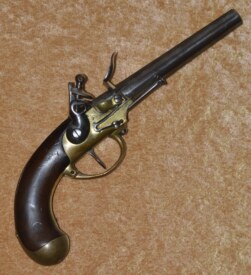
French M1777 Flintlock Cavalry Pistol. The French Model 1777 pistol was introduced to replace the earlier Model 1763/1766 and was manufactured between 1779 and 1792. During the American Revolution thousands of French M1777 flintlock cavalry pistols were supplied to the American military by the French. The M1777 proved so popular in America that it was copied in 1799 by North & Cheney, becoming the very first official US military pistol. The French models were produced primarily at the Charleville, Maubeuge, and St. Etienne arsenals, and so marked on the brass frame, but some were produced by smaller arsenals and not marked with the arsenal name. This is one of those examples, with no visible arsenal marking. It features 7 1/2” (19 cm) tapering round smoothbore barrel of .69 caliber, becoming octagonal at the breech and bearing two inspection stamps on the breech. Brass frame with stamped inspection mark. Brass trigger guard and butt cap, the latter stamped with star over “C”. Walnut grip with inspector stamp. Original ramrod with star over “C”? stamp. Made without belt hook. Near excellent condition, the steel parts having been cleaned bright; brass with pleasing patina. Overall length 13” (33 cm).
  • Nation : Spanish
  • Local Price : $1995.00
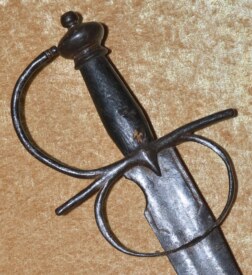
Unusual Spanish Broadsword, 17th C. Iron hilt consisting of short, straight, undecorated quillons, knuckle bow with simple decoration at its finial, unusually large pas d’ane, small integrally forged pierced and faceted guard with painted inventory number; bun-shaped pommel with turned baluster base and large button. Original wood grip, having long ago lost its wrap. Broad 33 1/2” (85 cm) blade with mid-length central fuller marked with undecipherable maker’s mark; the ricasso notched later for a forefinger rest. We believe this was period modified from a cup-hilted broadsword, with cup removed, quillons shortened, and the original guardopolvo serving as the current guard. Probably a captured or battlefield pickup piece period altered for actual use, and possibly with piracy association. Overall length 38 1/4” (97.1 cm). Formerly in the War Museum Collection.
  • Nation : Spanish
  • Local Price : £1995
Click and use the code >22501 to search for this item on the dealer website Very Rare and Historical 1822 Presentation Sword to Ensign Alexander Samson of the Caribbean, 1st West India Regt. In 1855, From Col. Lockyer Freestun &#acute;Great Officer&#acute; of the Knights Hospitallers of Jerusalem. Two Men Of The Regt. Were V.C.
  • Nation : Russian
  • Local Price : £1995
Click and use the code >20830 to search for this item on the dealer website Very Good, Original, Napoleonic Wars Period, Imperial Russian Romanov Cavalry Sabre Engraved With The Russian Double Eagle Crest. French Invasion and Retreat From Moscow Period of 1812
  • Nation : French
  • Local Price : £1,995.00
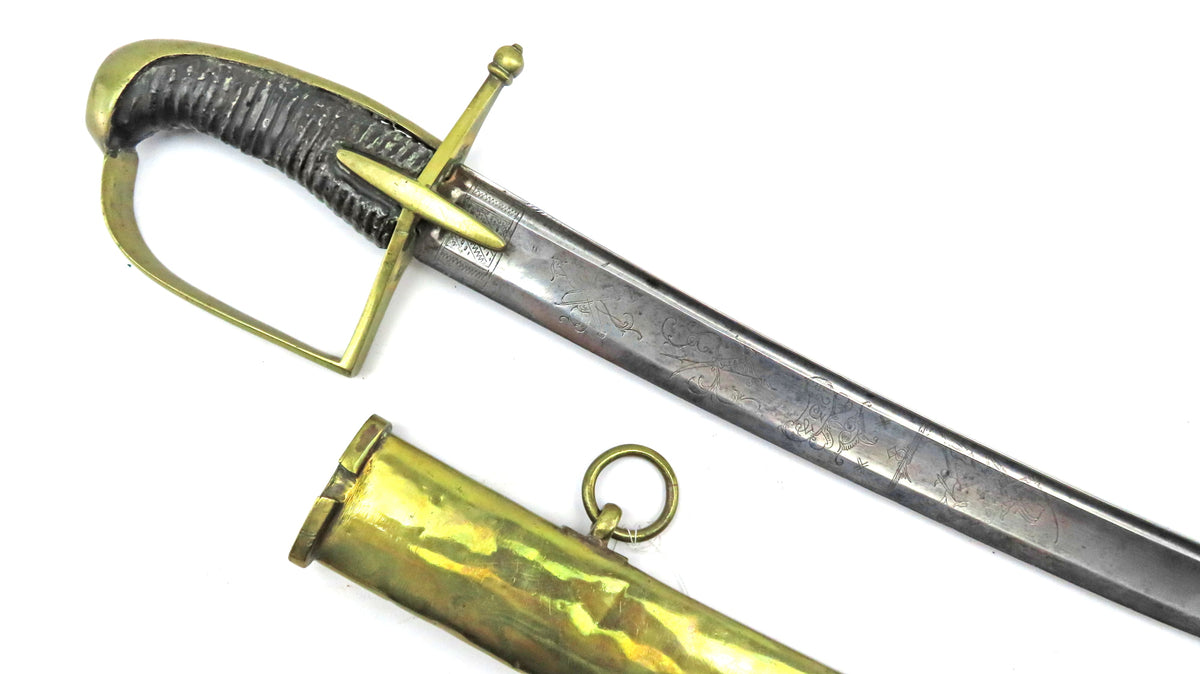
French 1786 Hussar Officer´s Sabre. Ref X3413. A Scarce French 1786 Hussar Officer´s Sabre. 40&157; overall, 34 &194;&190;&157; broad curved&194;&160;&194;&160;blade with one narrow & one broad fuller, engraved on both sides with Hussars, Turks head and mythical symbols. Brass hilt with&194;&160;´D´ shaped chamfered knuckle bow, flat pommel, double bar langets, ribbed wooden grip. In its original brass scabbard with twin hanging rings & steel chape shoe. Rare sword in good condition. Circa 1780 -1810. &194;&160; Images courtesy of West Street Antiques (https://antiquearmsandarmour.com/)
  • Nation : Italian
  • Local Price : £1980
Italian Schiavona dating to circa 1740. A Venetian Schiavona dating to the early 18th century. The hilt is a typical representation of the distinctive design of the Schiavona guard, consisting of a complex trellis of delicately formed flattened bars swollen in the middle with rounded and well finished edges. This style of basket hilted sword is unique to northern Italy and particularly the territories held by the Venetian Republic throughout the early modern period which was also a powerful naval force in the eastern Mediterranean. The angled rear quillon terminates in a globular finial. The brass pommel is fashioned in the typical cat's head shape with integral button and waisted collar beneath and is finished with a grotesque mask on each side. The knuckle bow terminates at the top with a knopped loop secured to the forward pommel ear. The wooden grip is covered with an attractive brass wire binding and mounted with brass ferrules top and bottom. Typically, the hilt is asymmetrical and is made for a right-handed user indicated by the position of the thumb loop inside the basket guard. The guard is most complex and decorative on the outside where it protects the upper hand of the user, whereas the inner face, less visible and less important for defence, consists of fewer bars which creates a lightweight but strong structure for the hilt. The single edged blade has a single broad fuller extending from the end of a short ricasso near the hilt to the tip. The blade is just over 31.25 inches (79.5 cm) long and in total the sword is just under 37 inches (94 cm) long. The sword is in good russet condition covered with an attractive and consistent brown patina with minor patches of light pitting on some parts of the hilt.
  • Nation : British
  • Local Price : £1975
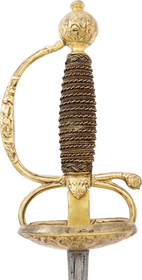
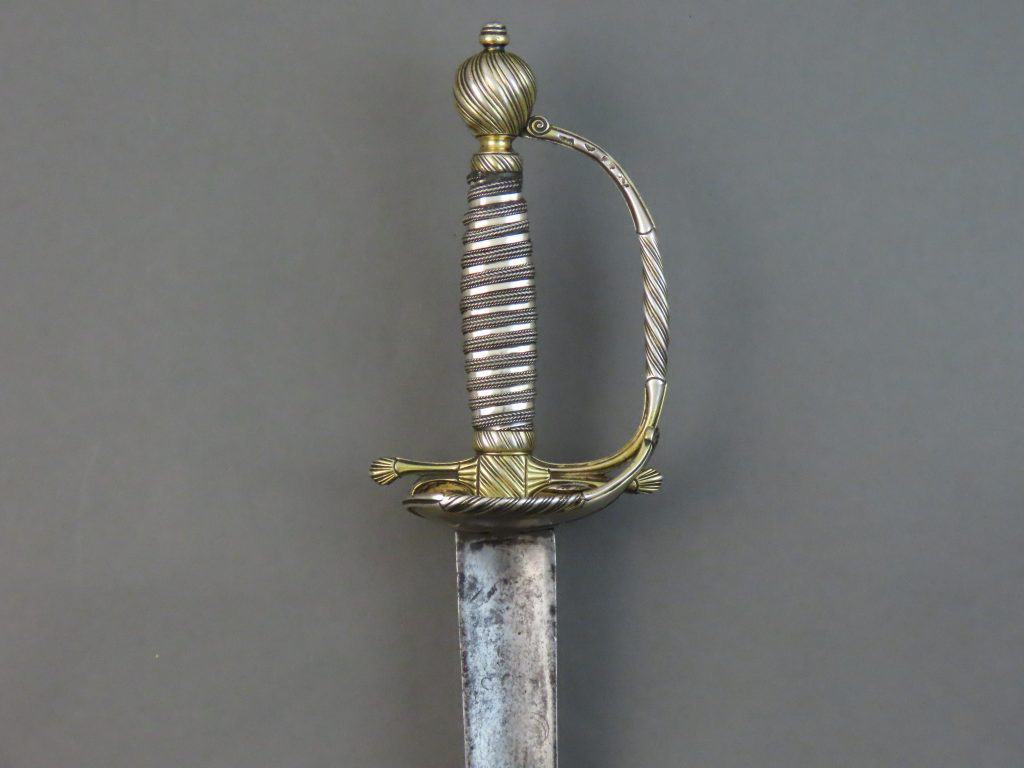
English Silver Hilted Small Sword by John Radborn of London Hallmarked for 1767 / 1768. An English silver hilted small sword by John Radborn of London with hallmarks for 1767 / 1768.  The hilt is mounted with a dish guard which is exquisitely pierced and chased with rococo foliate scrolls between curling tendrils on both sides of filigree delicacy. The design is the common theme on the other major silver components of the hilt which attests to the homogeneity of the parts. The sword is well-balanced in  hand and the silver hilt is, unusually, in excellent condition having experienced almost no wear, and has maintained its shape without damage or repair.  The sword is mounted with a tapering hollow ground triangular section blade. The hilt is an example of the high standards of design and execution required of the 18th century London silver hilt maker, as well as an example of one of the most effective weapons of the 17th and 18th centuries, which at this time was at the pinnacle of its evolution. Silver hilted small swords were fashionable attire for gentlemen. Mostly worn for effect, someone wearing such a sword was also announcing to the world that he was able to use it. Despite the stylish and often delicate appearance of these swords they were formidable dueling weapons. The sword hilt is in excellent crisp condition without losses or repairs and has maintained its original pleasing profile. The shallow dish guard has a strengthened rim shaped as four crescents on the outside which supports the  chased foliate designs within. The ricasso, pas d' ane rings, knuckle bow, quillon and pommel are pierced and chased in the same decorative style as the dish guard. The stamped maker's mark of “I R” is present on one side of the knucklebow near the pommel in raised relief inside a depressed rectangle, accompanied by the crowned leopard's head assay mark, the royal lion passant purity and date marks. The baluster shaped rounded rectangular section grip is covered with spirally wrapped bevelled silver strip, separated by wrapped silver twisted wire, flanked by thinner ropes on either side. Silver cap terminals are present top and bottom of the grip engraved with scallops on each side. The tapering, hollow ground, stiff, triangular section blade is in good mottled condition and retains evidence of its original engraved foliate panels near the hilt. John Radborn was one of the most gifted silver hilt makers and sword cutlers of his time.  He worked in the New Street precinct of the City of London for all of his professional life. He is first recorded when he was indentured to the cutler Nathaniel Young in 1737.  On the death of Young in 1742 he was turned over to John Smith for the remainder of his term and was sworn free of the Cutlers' Company by servitude in 1745 when he probably entered his first mark at Goldsmiths Hall which is now lost. His first surviving mark was entered in 1762. On moving address in 1769 Radborn entered another mark which was very similar to the last to confirm the move. He was admitted as a pensioner of the Cutlers' Company in 1776 and died in 1780. For further information on John Radborn see Leslie Southwick “London Silver-Hilted Swords”, their makers, suppliers and allied traders, with directory, 2001, Royal Armouries, and particularly page 206 for the biography and examples of his work in plates 46, 66, 72-3, 74 and colour plate 3. The blade is just under 33.25 inches (just over 84.5 cm) long and the overall length of the sword is just under 40 inches (101.5 cm).
  • Nation : Japanese
  • Local Price : £1,975.00
**RARE**SURRENDER PRESENTATION**WW2 1942 Dated Japanese Officer’s Seki Arsenal Type 98 Sword Smith Signed ‘Noshu Seki Ju Kiyo Nobu Saku’ With Presentation Plaque To Captain D.S. Young By HQBMA Malaya 1945, Japanese Officer’s Name Tag &. This sword has been assessed by a UK based Japanese sword expert Bill Tagg. His assessment accompanies this piece. In exerts from the assessment he states “ A surrendered army officer’s type 98 shin gunto with wood scabbard & leather active service cover, with a surrender presentation plaque fixed to it from British military administration headquarters Malaya 1945. In good condition & rare to find. Tsuba is good quality casting gunto pattern in brass no gilding left. Tsuka hilt is gunto pattern in used but clean condition some finish left on mounts, complete with knot loop possible re-bind ? Blade has seki arsenal inspectors stamp, so is a showa to oil tempered arsenal product. It is signed with makers name ‘Noshu (province), Seki (city), Ju (living in), Kiyo Nobu (art name), Saku (made this)’. He made showa to blades medium to high grade & gendaito medium grade. Blade is in dirty condition with old black staining and light rust needs re-polishing / restoration to see work. A genuine trophy of the second war hard to find today. His family name was ‘naga mura’. See john slough book on swordsmiths page 85 for oshigata & see fuller & gregory books of oshigata on swordsmiths pages 188/192/255”. In his illustrations he describes the cutting edge length as 64.5 cms and the overall length as 86.5 cms. He also translates the date markings on the blade (1942), Smith signature & describes other blade characteristics and measurements which can be read in the images. Also accompanying the sword is the original leather tab label with ink kanji attached to the scabbard which Bill describes as a hard to translate Japanese Officer’s name (illustrated) and another typed descriptive label found on the sword which can be read in the images". The price for this rare piece with expert assessment includes UK delivery. Sn 23228
  • Nation : British
  • Local Price : £1975
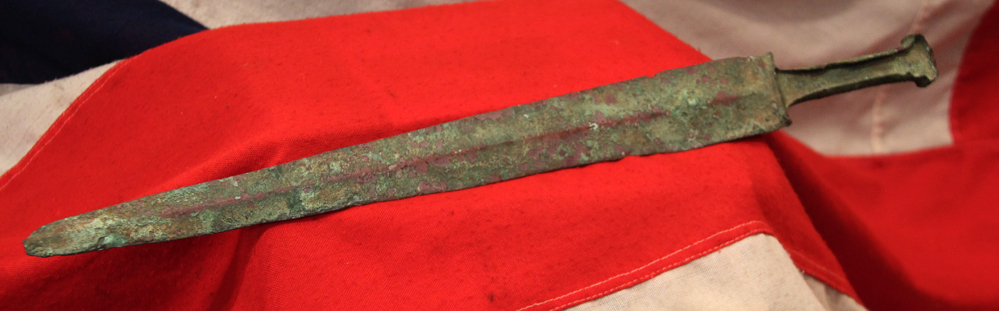
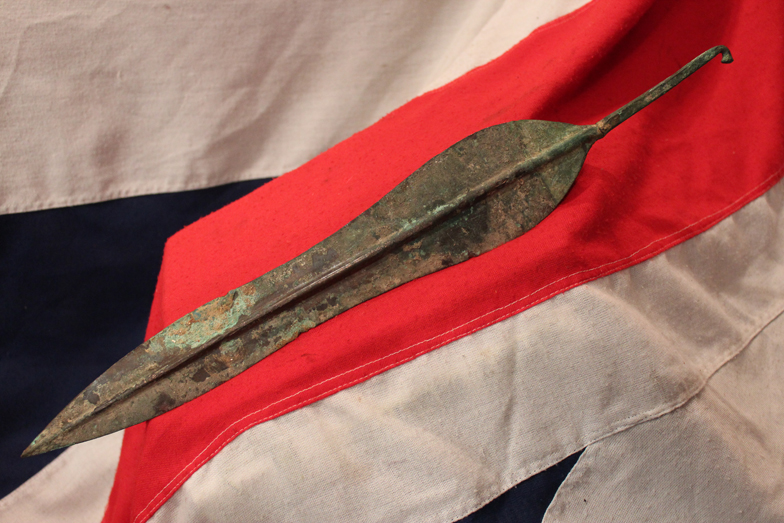
Click and use the code >22086 to search for this item on the dealer website Wonderful Circa 3000 Year Old Original Sword From the Time of the Ancient Greek ´Heroic Age´ Such as The Era of The Seige of Troy and The Trojan War
  • Nation : -
  • Local Price : 2,750.00 USD
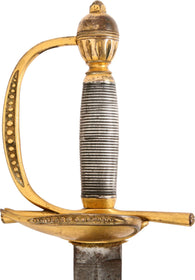
US M.1832 GENERAL OFFICER’S SWORD. An exceptional example of a rare pattern is Peterson #113. Gilt hilt with boat-shaped guard. The guard edge and knuckle bow with the beaded motif. Olive-shaped pommel secured with a nut. Silver sheet simulating wire wrap to the grip. 30 ½” broad d.e. blade decorated with naturalistic foliage, potted foliate display, Eagle with motto ribbon, arms display with crossed cannons, draped vignette, and Indian headdress with star band. Exceptional condition throughout. The decoration is uniform and complete. Hilt with near-all heavy gold overlay, the left edge of the guard, and the pommel top are only weak/worn from being worn and resting the hand on the pommel. Just the second example we have ever offered and the best we have seen.
  • Nation : British
  • Local Price : £1950
Mid 17th century Civil War Period English Hanger. An impressively decorated early English Hanger dating to the middle of the 17th century and the English Civil War period. These hangers were used by civilians during this period and by members of the military particularly pikemen. The iron  hilt consists of an upwardly convex shell guard attached to a robust quillon block which has a flattened lobed downward facing rear quillon and curved knuckle bow which is attached to the pommel front with a hook. The domed pommel cap has an integral ribbed button on top. The grip is formed from natural roe buck antler and has a pronounced collar at the base. The hilt is impressively chiselled in relief in typical English 17th century style. The convex surface of the shell has a profile portrait of a male wearing a wig and robe presumably indicating a judicial connection. The bust is flanked by intricate scrolling tendrils. The bust is repeated on the front of the base collar of the grip. The quillon and knucklebow are deeply chiselled with foliate designs. The flattened hook at the top of the knucklebow is fashioned as a beast’s head. The pommel top is cut with a flower head of six petals which radiate from the pommel button to the edge. The sides of the collar are chiselled with conjoined arches. The curved single edged blade becomes double edged towards the tip. It has a short ricasso from which on the reverse side a single broad fuller extends underneath the spine almost to the tip. Interestingly, on the front side, a fuller commences from the hilt in the same manner for a short distance after which it bifurcates into two fullers running underneath the spine. The bottom fuller terminates near the tip and the top fuller terminates where the blade becomes double edged. At the forte the short broader fuller is inscribed with ‘Louis Oldfieldt, Dundlek ont”. The meaning of which is unknown. The hanger is in good original condition with a light consistent “salt and pepper” russet surface all over. The blade length is 19.25 inches (49 cm) and overall the hanger is 24.75 inches (just over 62 cm) long. Provenance: The Professor David Weaver Collection.
  • Nation : British
  • Local Price : £1950
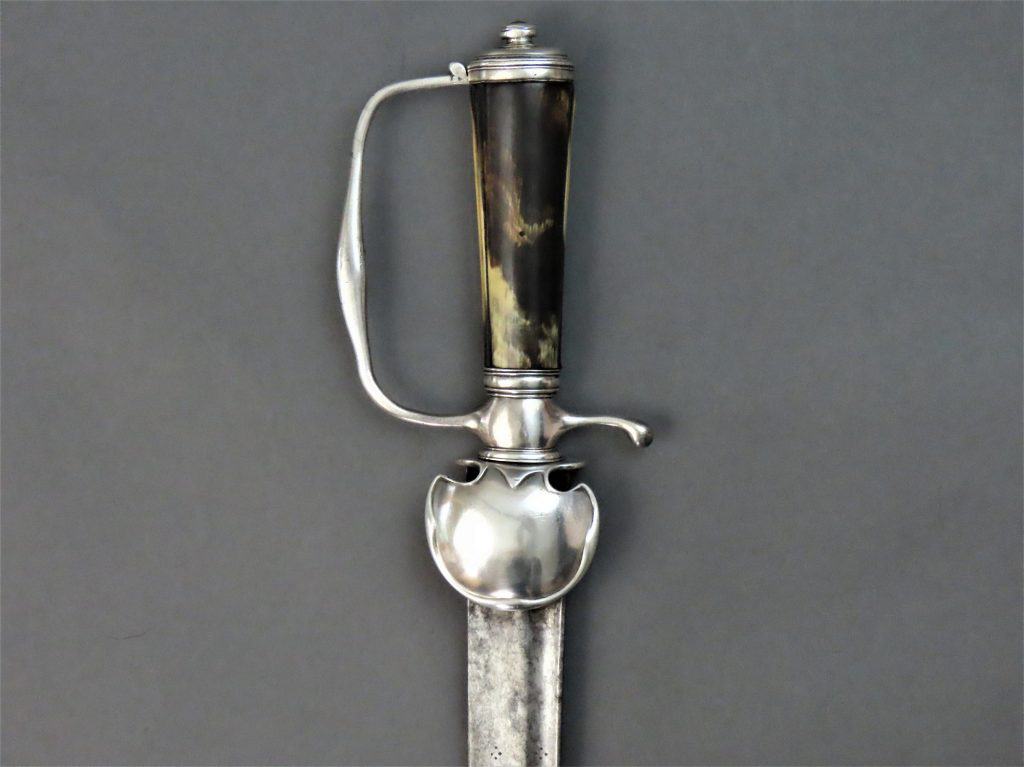
English Silver Hilted Hunting Hanger by John Carman (I) Hallmarked for 1740 / 1741. An English Silver Hilted Hunting Hanger with London Hallmarks for the year 1740 / 1741, made by the silver smith and cutler, John Carman (I) of The City of London. This plain but elegant hanger was a gentleman's weapon. The most distinctive feature of the hilt is the large convex scallop-shaped shell guard with its moulded edge which emanates from the cross guard at the front and extends parallel to the blade towards its point. The knuckle bow is clearly marked midway along one side with incuse stamps for the date, the royal lion passant, the crowned leopard’s head assay mark and the makers mark of “J C”.  The leopard’s head and lion stamps are repeated underneath the hilt. This maker’s mark is most certainly that of the London cutler and silver hilted sword maker John Carman (I). The top of the knuckle bow is secured into the pommel cap with a terminal hook of usual form. The pommel cap has an integral ribbed button on top and is grooved at the side in similar style to the base ferrule of the grip. The attractive grip is formed from four plates of natural horn. The curved, single edged blade broadens slightly at the tip and is 25 inches (63.5 cm) long. It has a short ricasso and a single fuller which extends from the hilt underneath the spine of the blade and terminates almost at the tip. The blade on each side is marked with the talismanic date 1555. The  numbers are separated in the middle by an orb mark with a cross attached either side. The word “S A H A G V M” appears inside the fuller on each side. This mark appears with variants on a number of blades in the 17th and 18th centuries mounted on Dutch and English swords and were probably made in Solingen. During the 17th and 18th centuries, when swords were a popular weapon for gentlemen, hunting swords and hangers were a robust, shorter, secondary side arm used for self defence when walking about town and travelling in general. Although referred to as “hunting” weapons, they probably had minimal use in hunting. Self defence in crowded areas, and in the tight confines of dangerous alleyways in cities, required a weapon which was shorter than a full length sword for close-in use in these confined spaces. The blade of this weapon is a fighting blade which would probably have been impractical to use in a hunting environment and further outlines the misnomer of the term “hunting” when  generally applied to these swords. The date of this hanger shows that John Carman (I) made it shortly before his death in 1741. Unfortunately the signature mark is no longer available to us in the records at Goldsmiths’ Hall. The Smallworkers’ Book of 1739 – 1757 which might have recorded this mark, plus many others struck between these dates, is now lost. John Carman (I) had a son who was also a silver hilted sword maker and cutler.  He is recorded from 1721 when he was born until 1664 when he died. He was indentured to his father, and sworn free by servitude of the Cutlers’ Company in 1743. It is likely that he registered a mark then, or shortly after, possibly prompted by the death of his father and the resulting need for stability in the business.  Given these circumstances John Carman (II) could not have had his own name mark registered at Goldsmiths’ Hall and be making swords in his own right before 1743. Hence the mark is of Carman (I) given the absence of any other recorded makers with names that may have marked in this manner at this date. The above reference work borrows from Leslie Southwick, “London Silver – Hilted Swords, Their makers, suppliers & allied traders, with directory”,  2001, Royal Armouries. The sword overall is in good condition. The total length is 30.25 inches (79.5 cm).
  • Nation : ?
  • Local Price : 1,950.00
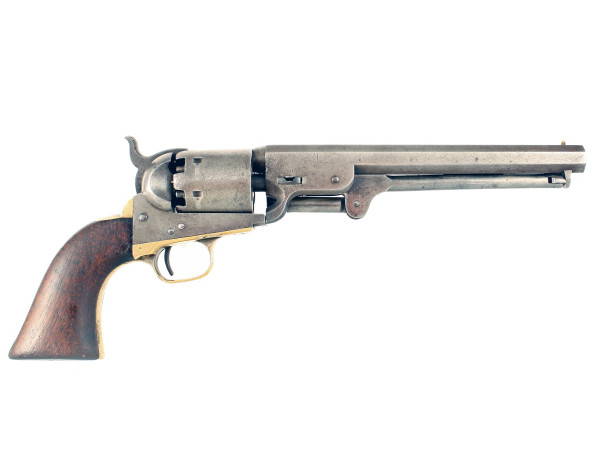
. A Scarce Martially Marked Colt Revolver, No. 69249. With sighted octagonal barrel, stamped ‘ADDRESS SAM L COLT NEW YORK CITY' the cylinder decorated with the Naval Engagement scene, serial numbered '69249' throughout, frame stamped ‘COLTS PATENT U.S.' brass trigger guard, rounded grips. Dimensions: Bore: .36 Calibre Barrel Length: 7.5 Inches (19 cm) Overall Length: 13 Inches (33 cm)
  • Nation : ?
  • Local Price : 1,950.00
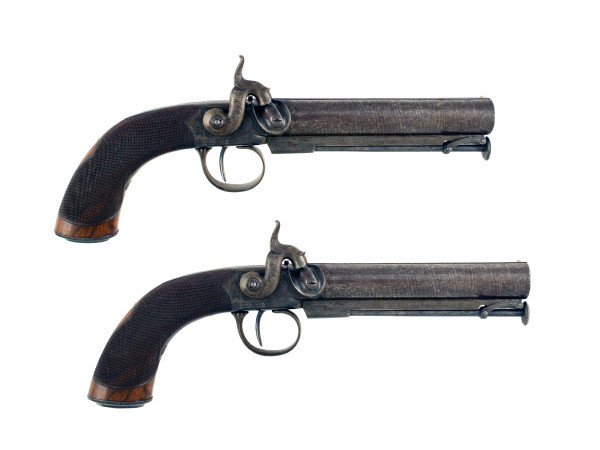
. A Superb Pair of Percussion Belt Pistols by Dooley. With round sighted barrels cut with a sighting groove running the entire length and stamped ‘DOOLEY LIVERPOOL' case colour hardened breeches, profusely engraved box-lock actions fitted with rear sights and blued belt clips, finely chequered walnut grips with vacant rectangular escutcheons, folate engraved butt caps with concealed traps, trigger guards engraved with scrolling foliage, fitted with captive ramrods and stamped with London proofs. Notes: In fine untouched condition. Retaining nearly all of their original finish. DOOLEY, W. [1840-1872]
 Shop at 11 Ranelagh Street,Liverpool. Made percussion pepperboxes, cased percussion travelling pistols and cased percussion duelling pistols, with loading equipment, also made percussion revolvers of Kerr Patent. A. Merwyn Carey (1954) English, Irish and Scottish Firearms Makers, Acro Publishing Company, New York. Dimensions:
Bore: 16 Bore
Barrel Length: 14.5 cm
Overall Length: 27 cm
  • Nation : British
  • Local Price : £1,950.00
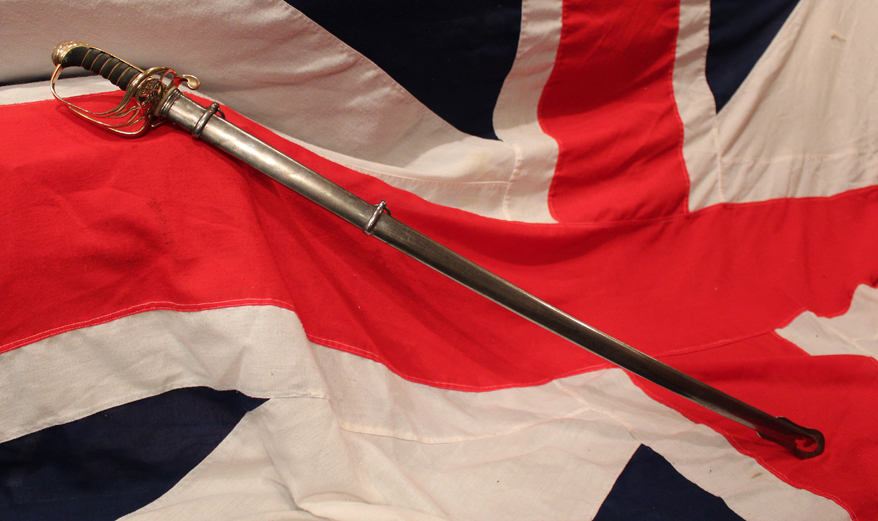
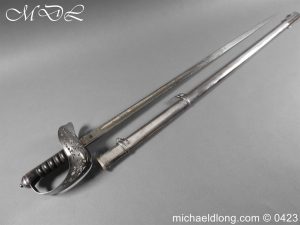
Wilkinson Sword VC Officer&#acute;s Sword – Thomas Colclough Watson. Wilkinson Sword VC winners Officer&#acute;s Sword belonging to Thomas Colclough Watson Victorian Engineers officer&#acute;s sword number 35643 regulation sword with steel guard with VR and crown and fisk skin grip. The blade with owner&#acute;s initials J C W Royal Engineers regimental badge and maker marked. It is complete with steel scabbard and is sold with a copy of the Wilkinson Sword register. Notes: Watson was 30 years old, and a lieutenant in the Corps of Royal Engineers, British Army, attached to the Bengal Engineers, British Indian Army during the First Mohmand Campaign in British India when, on the night of 16/17 September 1897 in the Mamund Valley, North-West India, Lieutenant Watson and James Morris Colquhoun Colvin collected a party of volunteers (including James Smith) and led them into the dark and burning village of Bilot, to try to dislodge the enemy who were inflicting losses on British troops. After being wounded and driven back by very heavy fire at close quarters, Lieutenant Watson made a second attempt to clear the village and only gave up after a second repulse and being again severely wounded. An account mentioning him is given in Winston Churchill’s “The Story of the Malakand Field Campaign”.
  • Nation : British
  • Local Price : £1,950.00
English Military Small Sword by John Hillman c 1764. English Small Sword by John Hillman c 1764 Pierced steel hilt with stunning detail including trophies of arms indicating this was produced for a military officer and floral designs please see detailed images. The silver wrapped hilt is complete with no damage and the whole sword is tight no loose parts, the etched colichemarde blade hollow ground 29.75 inch long. John Hillman is recorded to have worked in New Bond Street London 1764 and the sword is complete with top and middle scabbard mounts which is engraved with Hillman Bond Street although faint.
  • Nation : -
  • Local Price : £1,950.00
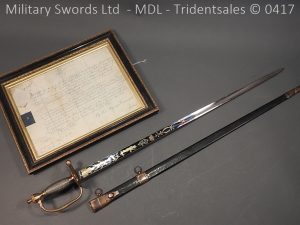
1796 Midlothian Vol Infantry Officers sword – Major G Young. Engraved blued and gilt blade, standing Officer, Royal Arms and GR cypher, engraved Bedington & Co and Warranted regulation folding gilt hilt engraved Major G Young Midlothian Volt Infy with silver wire bound grip, in its brass mounted leather scabbard, the locket engraved within oval cartouche G.Hunter Army Contractor 96 S. Bridge together with commission document dated August 1803 and inscribed to George Young Major to the Midlothian Volunteer Infantry.
  • Nation : Italian
  • Local Price : 2,650.00 USD
GENOESE (ITALIAN) ASSASSIN’S SHORT SWORD C.1760. 18th century Genoa was a hotbed of violence and intrigue. It was a city-state republic controlled by several powerful families who fought for control after the failed Austrian siege of 1747 which led to the loss of Corsica in 1768. Power was traded through secret agreements and alliances and preserved through fear, brutality, and assassinations. As assassinations stemmed from power struggles, an element of brutality to instill fear in surviving opposition was utilized. This is the sword of a henchman whose job it was to deliver those elements and carry out assassinations. It has a 22 3/4” cutlass from the blade which derives from Genoa's maritime culture. In fact, short swords were favored throughout the Italian peninsula. The horn grip is carved as a Moor, with the head fully modeled and decorated in bone and brass piques. The guard is shaped to embrace the first two fingers for better purchase, like a thumb ring, and only partially defensive. See il coltello Genovese storie de lame di armi proibite di caruggi, (the Genoese knife stories of blades of forbidden weapons of “alleyways”), Andrea Buti, p.363 for another example. 
  • Nation : Spanish
  • Local Price : 2,650.00 USD
SPANISH TRANSITIONAL RAPIER C.1690-1720. Gilt hilt with symmetrical thickened edge shell guards and large supporting rings. Copper and brass wire wrapped grip. 33” diamond section blade with deep fuller to the forte, inscribed S A G U M xx E L xx V I E G O. The tang within the guard encased in a gilt sheath. The gold strong and bright with slight rubbing as expected. The blade excellent. Period of the War of Spanish Succession (1701-1714) and probably the sword of a Spanish military officer.
  • Nation : British
  • Local Price : £1895
Click and use the code >26195 to search for this item on the dealer website Absolutely Superb & Stunning, Fully Provenanced, Victorian, British Generals Wilkinson Sword Of The Commander of the Grenadier Guards In The Crimean War At Alma, Sevastopol, and The Battle of Inkerman, In the Guards Brigade
  • Nation : American
  • Local Price : $1895.00
Remington 1857 Maynard-Primed Rifled Musket. 21,952 M1816 flintlock muskets were altered at the Frankfort Arsenal between 1856 and 1859. The locks and chambered breech pieces were made by Remington of Ilion, NY, but they did not perform any work on the guns themselves. These guns were also rifled, though only 14,989 were fitted with rear sights. About 1,300 of these muskets were altered for New Jersey, of which only 200 had rear sights. This example with lockplate stamped vertically “REMINGTON’S/ILION.N.Y./1857/U.S.” behind the hammer; serpentine side plate. Rifled 42” .69 caliber barrel stamped with eagle head and “P” at the breech, secured by three barrel bands to the walnut full stock. This example one of the approximately 7,000 made without rear sight. Sling swivels at front of trigger guard and on middle band; iron ramrod. Overall length 57 3/4”. Metal parts with light pitting and age staining; heavier pitting on the butt plate. Bore with only faint traces of rifling; stock with wear and handling marks and a few deeper dents on the left side. Mechanically very good. These muskets were the best of the percussion-altered muskets available at the onset of the Civil War and were widely used by both sides. While a novel idea that could shorten the time to prime a musket, the Maynard tape primer proved unreliable, especially in wet conditions, and was often disabled in favor of conventional percussion caps.
  • Nation : ?
  • Local Price : 1,895.00
. A Solid Silver Hilted Sword, hallmarked for 1790-91. With straight singled edged tapering blade, cut with a long deep fuller running the entire length, engraved on both sides with stands of arms and ‘GR', solid silver stirrup hilt, with silver wire bound ebony grip, in its original tooled leather scabbard with solid silver mounts all hallmarked and stamped with makers initials IF, the locket signed ‘NEILD St. James St. SWORD CUTLER to his royal highness the PRINCE OF WALES'. Notes: The scabbard is complete but rather flimsy, there is a small tear towards the bottom. Dimensions: Blade Length: 32.5 Inches (82.55 cm) Overall Length: 38 Inches (96.52 cm)
  • Nation : British
  • Local Price : £1,895.00
**NAPOLEONIC WARS ERA**British 1796 Pattern Yeomanry Officer’s Light Cavalry Sabre With Quality Gilt & Blued Etched Blade & Scabbard. Sn 22733 -. These Sabres were primarily used by British Light Dragoons and Hussars during the Napoleonic Wars (see page 78 of World Swords by Withers). The blade is remembered today as one of the best of its time and has been described as the finest cutting sword ever manufactured in quantity. Officers of the famous 95th Rifles, Light Infantry Regiments and the "flank" Companies of Line Regiments adopted these Swords (The Hit Napoleonic War, Book & TV series Sharpe’s Rifles featured this pattern of Sword). Pattern 1796 Sabres were used at The Battle of Waterloo 1815. This original Officer’s quality 1796 Sabre is in very good condition. It has a single edged, 30 ½” slim sabre blade (35” overall). The slim blade indicates that this sword was most likely a Yeomanry cavalry Officer’s privately commissioned piece. The blade has some staining consistent with age but no rust and the cutting edge has a few small nicks consistent with age and service use. The nicks are only visible on close inspection. Both sides of the blade have decorative Gilt & Blued panels with Banners & Arms, Crown & Royal Cypher ‘GR’ (George Rex). There are no visible maker marks on the blade. It has a steel cross guard with rounded langets, knuckle guard, grip frame and fish skin covered ribbed grip with wire binding. The covering is worn in areas exposing the wood grip underneath and some of the grips original wire binding is present. The Sabre is complete with its original steel scabbard with 2 hanging rings. The scabbard has even patina. There are no maker marks visible on the scabbard. The price for this attractive Napoleonic Wars Era Sword & Scabbard includes UK delivery. Sn 22733
  • Nation : British
  • Local Price : £1875
Late 17th century English Silver Mounted Hanger with the Maker’s Mark “WL” for William Lutwich of London. An English silver mounted hanger comprehensively stamped with the maker’s mark “WL” most likely for the silversmith William Lutwich of London. This is a fine example in unusually good condition.  The small mark consists of the letters in raised relief inside a shield with a pellet above and below. In the 17th and 18th centuries when swords were a popular weapon for gentlemen, hangers were a robust secondary side arm used for self defense when hunting and travelling. They were also used in parts of the British Army and Navy. Hangers appear in some military portraits of the time. Towards the end of their popular use, they were slimmed down and refined for wear as a gentleman’s fashion accessory. The high quality and expensive hanger described here, with its robust blade, was most likely a gentleman’s weapon made for use rather than decoration. The hanger dates to between 1691, when Lutwich was “made free” of his guild and able to practice in his own right, and 1697, which is the date of the advent of the Higher, or “Britannia”, Standard for silver, when smiths were required to use a new stamp bearing the first two initials of their surnames. When the requirements for punch marks changed again in 1720 with the arrival of the Sterling Silver Standard, many makers reverted to recording their initials but in bolder type accompanied by date and hallmark stamps. By this date the styles adopted for hangers had changed so there no doubt that this hanger is a late  17th century example. On this hilt the quillon terminals are stamped as are the base ferrule to the grip and the pommel. This comprehensive marking was also a historic practice by the turn of the century. The cross guard of this sword is comprised of a bold faceted block with horizontal quillons swollen at the vertically counter curved terminals. The grip is of stag antler with a plain ribbed ferrule at its base and scalloped edge. The pommel cap has a ribbed neck beneath with scalloped edge formed in the same manner as the basal ferrule. The plain dome formed on top has a pronounced tang button in the centre. The slightly curved robust single edged blade is just over 16 inches long (40.5 cm).  It becomes double edged from just over two thirds of the way along to the tip. The blade is deeply struck on both sides at the forte with a moustachioed King’s head mark on each side. The full length of the hanger is just over 21.5 inches (54.5 cm) long. The hanger is in fine condition. A stamp recorded by William Lutwich at Goldsmiths’ Hall is shown in Grimwade number 1967 page 144. This mark has the same shaped depressed shield and letters WL incuse as do the marks on our hanger. However, the stamp in Grimwade has a crown above the letters whereas the marks on our  hanger have a pellet above and below. It is not known when the mark in Grimwade was recorded but smiths did use and record variants of their marks over time many of which are now lost. For further information on English silver hilted swords and hangers see Leslie Southwick, “London Silver – Hilted Swords, Their makers, suppliers & allied traders, with directory”,  2001, Royal Armouries. For a very similar example with the maker’s mark of Richard Fuller, circa 1690, see the same publication page 277, plate 18.
  • Nation : Japanese
  • Local Price : £1,875.00
**SCARCE**MAN TETSU SWORD COMPANY DOUBLE SIGNED KOA ISSHIN MANTETSU (Respectfully Made) BLADE*WW2 Japanese Officer’s Gendaito Katana Sword Officer’s Rank Tassel, Scabbard With Leather Combat Cover & Expert Assessment. ED 3018 -. A scarce original WW2 Japanese Officer’s Company made Sword with signed tang and scabbard. The sword has been assessed by UK Japanese sword expert Bill Tagg. A copy of his hand written notes and illustrations accompany the sword. In extracts from his notes he states “A scarce example of a company produced sword not signed by a swordsmith. A Koa Isshin Man Tetsu (Respectfully Made) see John Slough’s book Modern Japanese Swordsmiths 1868-1945 page Numbers 94,95,96, 3 pages of information on these swords. 2 types were made Medium to Superior Grade Show-To and Medium to High grade Gendaito. This is bright with old rust at point. You can see vague nioi hamon. I class them as basic Gendaito, lots of handwork. The best ones were made in Japan 1st produced for the Manchurian army in occupied China in 1937. Originally made in the Diaren Railway factory after 1937 for the Canton Army. Well balanced & very good nakago tang, lovely well cut kanji. Saya gunto parade steel with green army paint covered with very good condition & good quality leather combat cover. Copper blade collar habaki with big heavy pierced brass tsuba & one seppa. Tsuka hilt all original, locking catch & sarute knot loop with ¾ of original Lieutenant To Captain rank tassel (worn). Binding & Ray skin intact but dirty. A good example of a Koa Isshin Man Tetsu sword. In his illustrations Bill translates the tang Kanji. One side War slogan ‘Develop Asia By One Mind’ and ‘Man Tetsu Company Made This’. The reverse Junish & Zodiac dates? And Autmn (date not translated). The spine of the blade marks are translated as ‘2744 Showa’. He measures the cutting edge as just under 67 cms, total length 88 cms and describes other blade and tang measurements & characteristics which can be seen in image 2. The price includes UK delivery. This sword is worthy of further research. ED 3018
  • Nation : Italian
  • Local Price : £1875
Click and use the code >20468 to search for this item on the dealer website Very Fine, Original, Ancient, Punic War Period Early Roman Republic Era Short Sword, A Gladius Hispaniensis Double Leaf Shaped Blade Circa 2,400 Years Old
  • Nation : British
  • Local Price : £1850
English Silver Hilted Small Sword Hallmarked for 1748 / 1749. An English silver hilted small sword mounted with a “Boat Shell” hilt and colichemarde blade. The guard is of plain solid form with boldly and finely executed gadrooning to the shell brim, knuckle bow, pommel, quillon terminals and ricasso. The exquisite workmanship is typical of the London silver hilt makers of the mid-18th century. In this respect the sword is not only an attractive weapon but also a fine example of the London silversmiths' work at its best. The hallmarks are on the knuckle bow and consist of the leopard's head standard mark, lion passant assay mark and date stamp for 1748 / 1749. A fourth mark, the hilt maker's mark, is present but illegible. The hilt retains much of its original gilt finish especially intact on the inside of the guard. The hollow ground triangular section colichemarde blade is in fine condition with mild blemishes originally with engraved foliate designs in panels at the forte now worn. The blade just over 31.75 inches long or 81 cm. The overall length is 38.25 inches or 96.5 cm. The grip consists of a baluster-shaped wooden core wrapped with alternate thicknesses of contra-twisted roped and ribbon silver wire with silver cap terminals top and bottom engraved with floral designs. Silver hilted small swords were fashionable attire for 18th century gentlemen. Although mostly worn for effect a gentleman carrying such a sword was also announcing to the world that he was capable of defending himself with it and was trained to do so. The stylish and delicate appearance of these swords was an expression of confidence, social standing and competence in their use as formidable duelling weapons.
  • Nation : British
  • Local Price : £1,850.00
Scottish 71st Highland Light Infantry officers Sword. Scottish 71st Highland Light Infantry officers Sword by Wilkinson sword number 5659 dating it to 1855. This sword is one of 28 made for 71st Highland Light Infantry numbers 5645 to 5680 “ 5 had defective blades, in 1854 the 71st had 28 officers. The sword is regulation P1821 Light Cavalry, 3 bar hilt with fish skin grip and chequered pommel. The blade with a small amount of engraving towards the hilt and makers details Henry Wilkinson the spine and throat of the scabbard both number 5659. The sword is complete with steel scabbard, dress knot and a copy of a photograph of Viscount Kirkwall Capt 71st Highlanders Crimean War wearing this pattern of sword.
  • Nation : German
  • Local Price : £1,850.00 GBP
Walloon Hilted Broadsword. An 18th century Walloon hilted sword featuring the "eyelash" mark on the blade, usually associated with North Italian cities such as Venice or Genoa. Each side of the guard features a stylised sun. The hilt also bears a set of maker's hallmarks, probably German."
  • Nation : French
  • Local Price : £1850
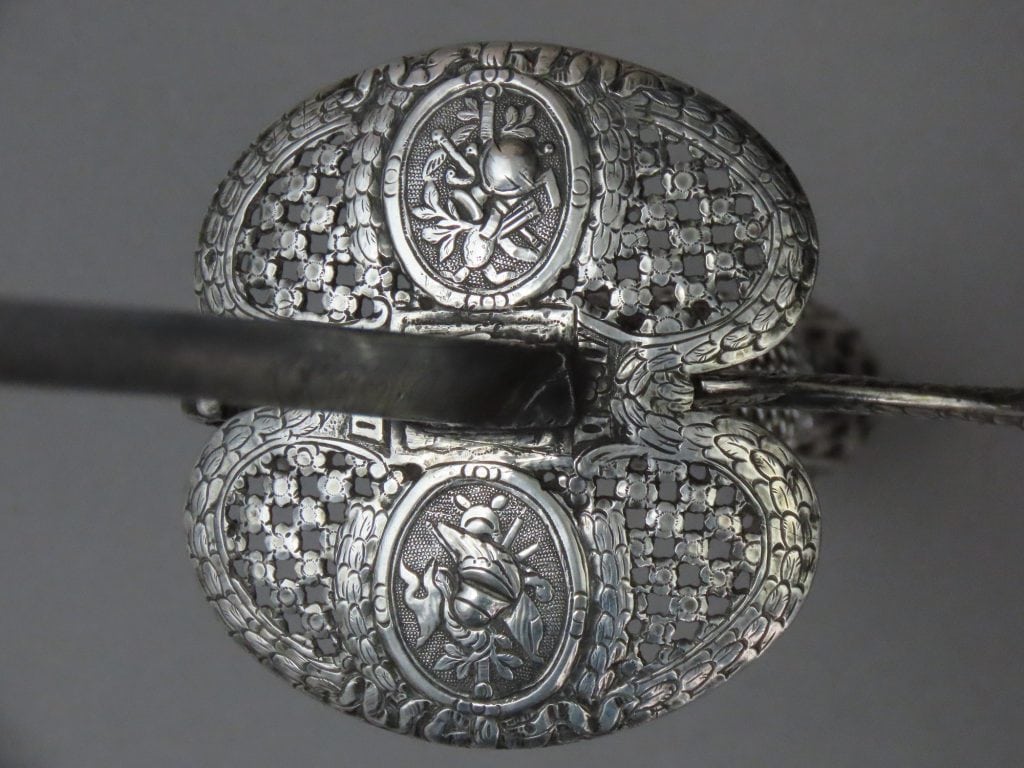
Fine French Silver Hilted Small Sword date stamped for Paris 1769. A very nice aristocratic French silver hilted small sword dating to the years preceding the French Revolution. It is a nicely balanced example mounted with a double shell guard hilt and a fine hollow ground triangular section blade engraved with foliate panels at the hilt. The sword is an example of the high standards of design and execution required of the 18th century Parisian silversmith as well as an example of one of the most effective duelling weapons of the late 17th and 18th centuries in France. The shell guard is skillfully chiselled with flowing designs in raised relief comprised of floral sprays, foliage, tendrils and pierced panels of intricate latticework. Each shell both on the convex and concave sides is engraved with a leafy foliate border. Each is centred with an oval panel containing stands of arms in raised relief on the outer convex sides and sprays of flowers  on the inner concave sides. Both sides of the panels are pierced with a lattice of flower heads. The ecusson, pas d'ane rings, knuckle bow, quillon and pommel are decorated in the same sumptuous manner with leafy foliate designs, stands of arms and musical instruments. The designs attest to the martial stature of the owner, most likely a member of the military, whilst simultaneously announcing his cultural and artistic merits. This balance of qualities was important to achieve success and standing at the French court of pre-Revolutionary France. The date stamp is represented by  a letter “F” with an open crown above in raised relief inside a shield on the forward pas d'ane ring. The grip consists of a wooden rectangular section baluster-shaped core spirally wrapped with bands of flat silver strip separated by contra twisted roped silver wire and mounted with silver woven “Turk's Heads” top and bottom. The stiff blade tapers acutely to its point and is enhanced with engraved panels of foliate scrolls near the hilt on both sides. Condition: the sword is in fine condition overall. The hilt and grip show little wear and no noticeable damage. The hilt retains its original pleasing shape,  there are no repairs or damage and the engraving is generally crisp. There is slight blackened age staining to a few small parts of the blade, which is straight and undamaged.  The sword is well balanced in hand. The blade is just over 33 inches (84 cm) long and overall the sword is 40 inches (101.5 cm) long.
  • Nation : French
  • Local Price : £1,850.00
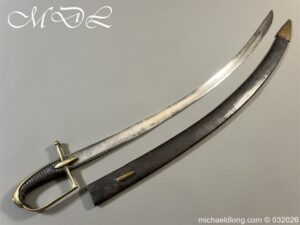
French Hussar sabre – model ANIV – 1795/6. French Hussar sabre – model ANIV – 1795/6. The stamps indicate it was made between 1795-1803 so Consular period. This sword was originally part of the Geoff Worrall&#acute;s collection and due to the leather scabbard could have possibly been supplied by the French to America for the War of Independence. Regulation pattern sword with brass hilt and ribbed leather grip, curved single edged blade with wide fuller. The scabbard leather stitched with brass frog and drag note drag is a period replacement and a hairline crack in cross guard please see images. Overall length 92cm the blade 94cm
  • Nation : ?
  • Local Price : $3500.00 CAD
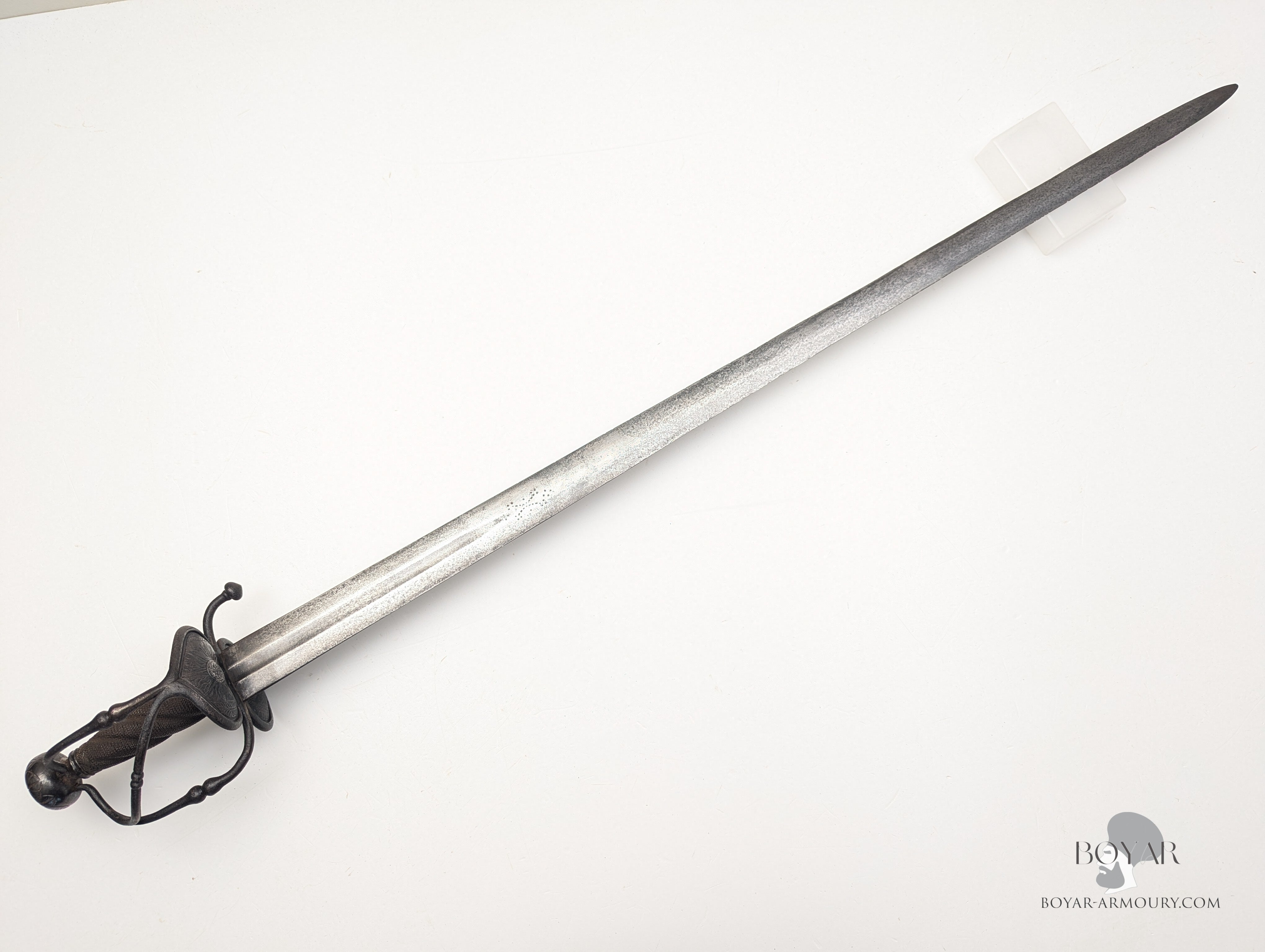
NORTHERN EUROPEAN RAPIER. NORTHERN EUROPEAN RAPIER: Circa 1600. Transition from the long rapier to the shorter blade, as dictated by fashion of the 17th century. Original horsehair grip wrapping. Note the early “PAS D’ANE” 32 inch blade, 38 inches overall. This is a very unique and unusual style of rapier. V.G. $3500.00
Page 9 of 40

The following items match your search but are currently listed on Ebay. We take no responsibility for any aspect of the listings or their accuracy.


Sorry, there is not any matching items.