
(You must register and have a linked account first)
View Privacy Policy


OR

Show


Forgot your password?

Error message here!

Error message here!

Error message here!

Error message here!

Show Error message here!

Show Error message here!


Lost your password? Please enter your email address. You will receive a link to create a new password.

Error message here!

Back to log-in

Close

For Sale

The following items are listed by for sale by users of the site and dealers. They are in no way endorsed or guaranteed by www.oldswords.com

Add a Classified Item
to

Clicking on the sword will take you through to the relevant classified item or dealer site.
Don't miss out! - Do you want to be kept informed weekly of new aditions? Just join our weekly update list.

You can also receive regular email notifcations when items match your keywords. To recieve them just register or logon at the top right of this page.
Page 8 of 40
  • Nation : British
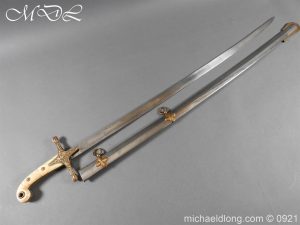
  • Local Price : £2,450.00
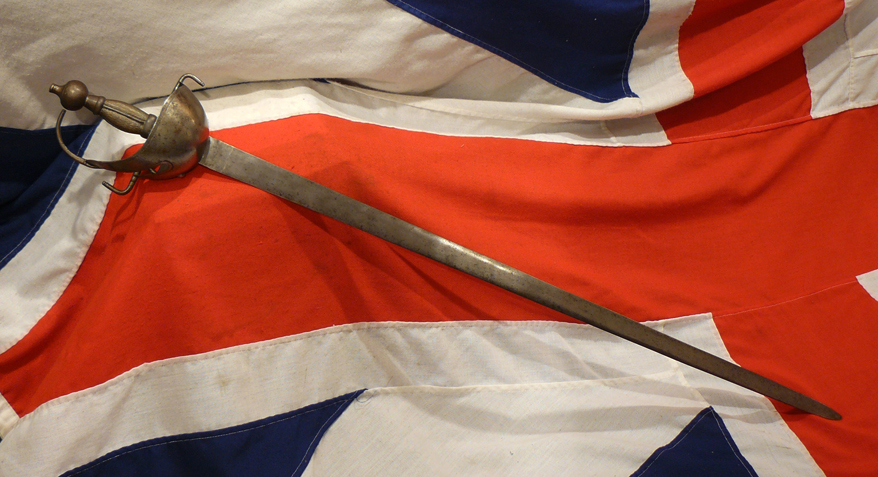
15th Hussars Officer&#acute;s Mameluke. 15th Hussars Officer&#acute;s Mameluke very nice condition regimental hilt and bone grip. The slightly curved blade with faint etching but William 4th cypher and I V visible Hilt and blade tight and complete with steel scabbard with gilt brass mounts. Reference: Swords of The British Army by Robson plate 84 – 85 Blade Length: 32.25 inch Overall Length: 38.0 Inch
  • Nation : British
  • Local Price : £2400
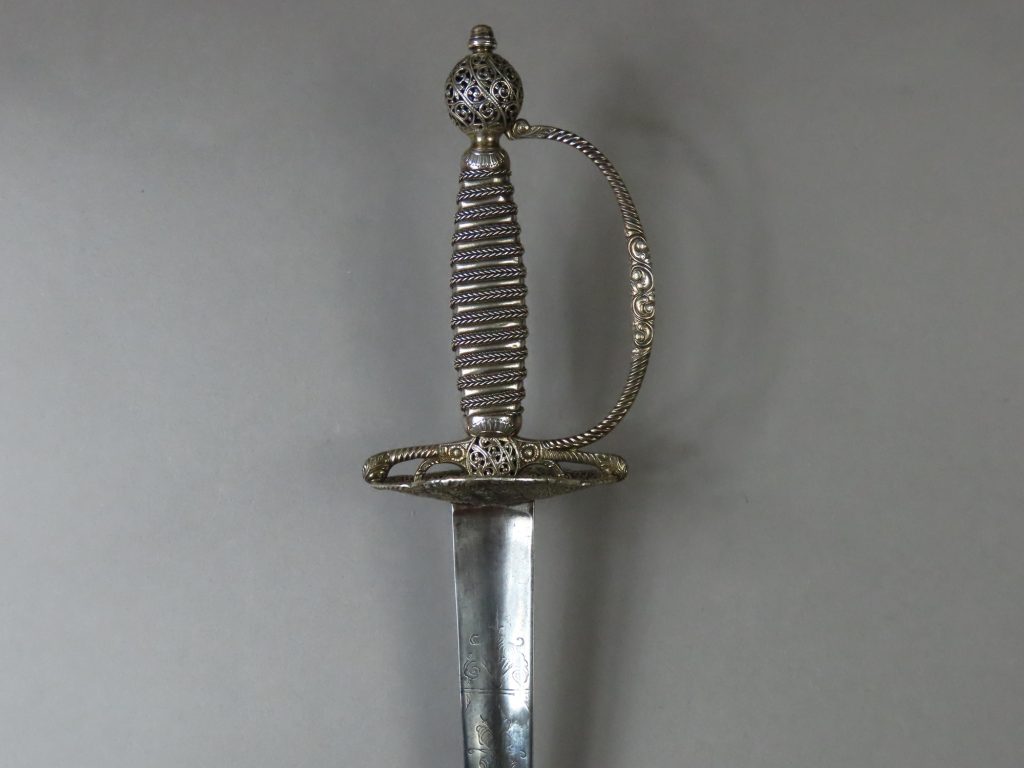
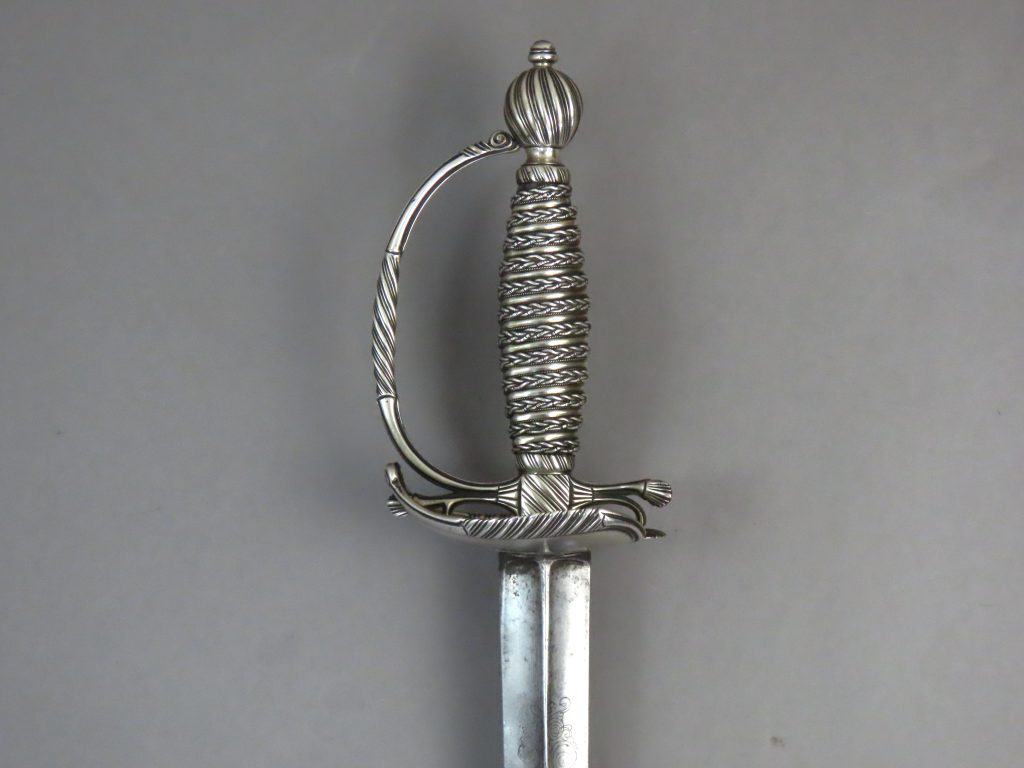
English Silver Hilted Small Sword by William Kinman of London Hallmarked for 1768 / 1769. An exceptional pierced dish hilted smallsword by the renowned 18th century London silversmith and cutler William Kinman, date-stamped for 1768 / 1769. The hallmarks are of small type stamped into the Pas D'Ane rings and consist of the maker's mark of “W K” in raised relief inside a depressed irregular panel with a pellet between the letters, the lion passant mark, crowned leopard's head assay mark and date stamp. Kinman's work, together with a few of his contemporaries, represents the highest standard of English silver craftsmanship of the time as is to be seen in the hilt of this sword. The dish guard, pommel and ricasso are pierced and engraved with exquisitely detailed foliate scrolls formed within diagonally spaced panels, the sides of which emulate waving tendrils. The delicacy of the interior of the dish guard is supported by a strengthening of the rim which is decorated with floral designs front and back with gadrooned engraving to the sides, which is repeated on the knuckle bow and quillons. The baluster shaped wooden grip is of rounded rectangular section diagonally bound with silver strip interspaced with a double length of plain wire with thinner twists on each side, mounted with silver cap terminals top and bottom engraved with floral designs. The hilt is as much an example of the high standards of design and execution required of the 18th century London silversmith as it is as an effective weapon maker. Silver hilted small swords were fashionable attire for 18th century gentlemen. Mostly worn for effect as a show of wealth and taste, someone wearing such a sword was also announcing to the world that he could use it, and was at risk of being invited to do so. Despite the stylish and delicate appearance of these swords they were formidable dueling weapons. The triangular section, stiff, robust, hollow ground bright blade retains its  engraved decoration on both sides at the forte including panels of foliage and strapwork on each side, with stands of arms inside ovals between, indicating that the sword originally belonged to a military officer. The sword is in fine condition overall. There are no losses or repairs to the hilt which has maintained its original pleasing outline. The blade is 32 inches (just over 81 cm) long and overall the sword is 38.5 inches (98 cm) long. William Kinman was one of the most influential and preeminent makers of silver hilted swords working in London in the third quarter of the 18th century. He made swords for the London social and military elites. He was a leading member of the Founders' Company of London and served in all the major offices of the guild including Master. Kinman was born in 1728 and was sworn free of the Founders' Company in 1750, when presumably he started to make silver hilted swords under his own name and was admitted to livery in 1757. Kinman entered his first mark at Goldsmiths' Hall in 1759 (Grimwade 1990 reference 3210) which is his mark on this sword. William Kinman was at his most prominent in the earlier part of his career, when this sword was made, later becoming bankrupt due to the failure of a founding business he was involved in. For contemporary silver hilted swords by William Kinman and other notable London makers see Leslie Southwick, “London Silver-Hilted Swords”, Royal Armouries, 2001. And for further information on Kinman’s life of see pages 159 and 160.
  • Nation : British
  • Local Price : £2395
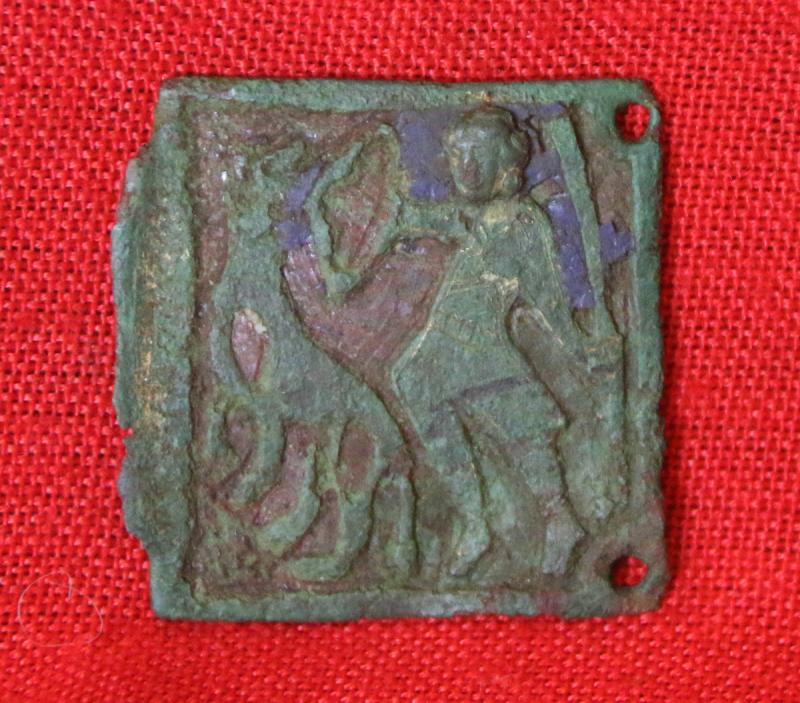
Click and use the code >25555 to search for this item on the dealer website From Limoges, a Champleve Enamel Gilt & Bronze Sword Belt Plate of a Knight of King Henry II & Queen Eleanor of Aquitaine. Decorated With A Knight Combating A Beast with Spear and Shield . 1100´s ´Opus Lemovicense´ Crafted in Limoges, Aq
  • Nation : British
  • Local Price : £2375
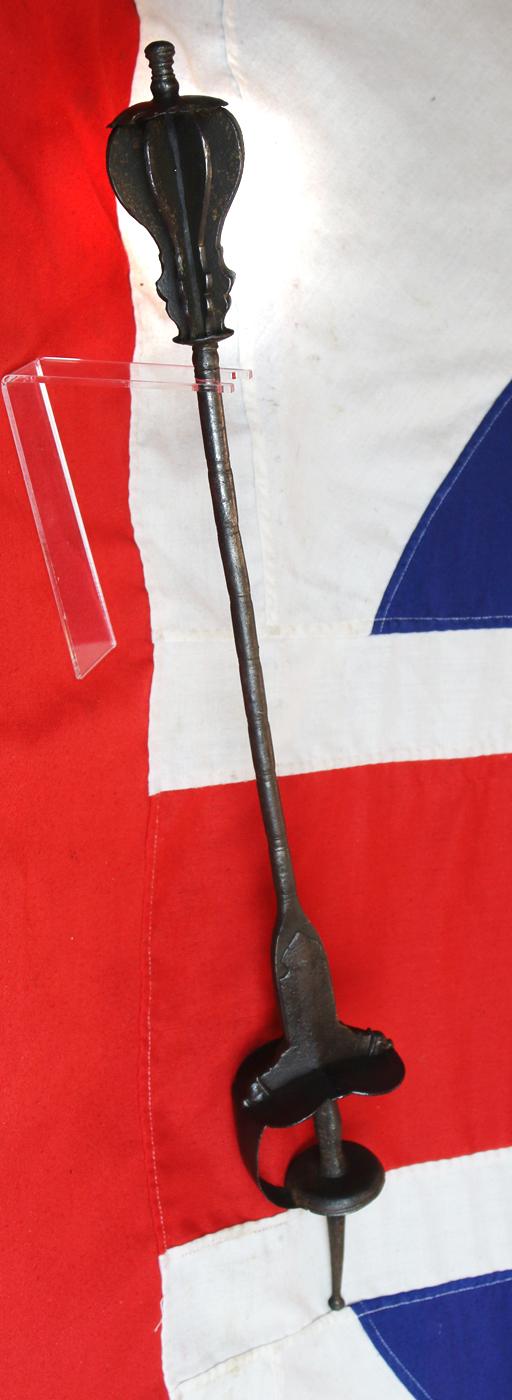
Click and use the code >24186 to search for this item on the dealer website One Of The Most Impressive, Fiersome, & Effective, Combat Weapons Ever Created. A 1600´s to Early 1700´s Mughul Period Battle Mace Shishpar With 8 Flanged Head and Khanda Sword Hilt. A Most Formidable Usually Hindu Piece Yet As Popular in Anci
  • Nation : American
  • Local Price : $3295.00
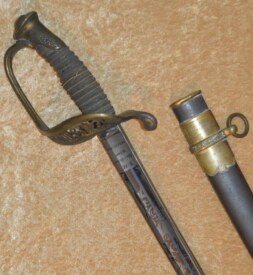
Civil War Presentation US M1850 Staff & Field Officer’s Sword. In 1850, the US Army designated two sword models for commissioned infantry officers; the M1850 Foot Officer's Sword and the M1850 Staff & Field Officer's Sword. The foot officer's sword was to be for company-level officers of the rank of Captain and below, while the staff & field sword was for officers of the rank major and above. However, in actual practice they were interchangeable and ownership apparently had little or nothing to do with rank. Both model swords followed the same basic design, with the only difference being that the staff & field sword had a cutout “US” worked into the design of the guard. This example features gilt cast brass guard of standard form, pierced and decorated with classical foliate design and “US” on the upper obverse face; integral knuckle bow joining the capstan pommel. The wood grip is covered with shagreen and wrapped with twisted brass wire (wire broken and missing a few turns). Slightly curved single-edged 30 3/4″ blade with wide and narrow fullers, profusely etched with foliage, stands of arms, and maker's name “W. H./Horstman/& Sons/PHILADELPHIA” just below the guard; “IRON PROOF” etched on the spine. Brown metal scabbard with gilt brass mounts, the upper carry band engraved “Presented to/CAPT N. L. HAWLEY/by his Democratic friends/of Lockport”. While he is not listed in the Civil War Database of soldiers, Norman L. Hawley was a captain in the Lockport Light Artillery, attached to the 4th Illinois Cavalry. Illinois records show he mustered in on July 31, 1861. The 4th Illinois Cavalry officially began service on September 26, 1861 and was consolidated into the 12th Illinois Cavalry Regiment on June 14, 1865. The regiment saw action at Fort Henry and Fort Donelson, the Battle of Shiloh, Siege of Corinth, and the battles of Coffeeville and Egypt Station. Further research would likely reveal more information about Captain Hawley, and a book was published on the history of the 4th Illinois Cavalry in 1903, now available in reprint. Except for the grip wire, the sword is in very good condition, with about 40% original gilding on the hilt; the blade is very good plus, with bright frosty finish and clear markings. Overall length 36 ½”, not including scabbard.
  • Nation : British
  • Local Price : £2350
English Silver Hilted Small Sword with Boat Shell Guard by George Fayle of London Hallmarked for 1760 / 1761. A fine English silver hilted smallsword by the London silversmith George Fayle mounted with a boat shell guard dating to the middle of 18th century. The boat shell  was one of the most robust guard designs adopted by the London small sword makers. This example is of solid form with boldly and finely executed gadrooning to the pommel, shell brim, knuckle bow, quillon terminals and ricasso. George Fayle was a prominent silver hilt maker and sword cutler in London born in 1734 in Lancashire and recorded in the City of London from 1747 until his death in 1786. The full suite of hallmark stamps are on the pas d'ane rings comprised of the leopard's head assay mark and the incomplete Royal lion passant mark of purity to the sterling standard for which only the rear end of the lion is visible. The maker’s mark is comprised of the letters “G F” with a star between in raised relief inside a depressed rectangle. The date mark is the stylised letter “E” for 1760 / 1761. The maker’s mark is repeated underneath the hilt where it is stamped near the back edge of the blade and at the other side the lion passant partly obscured by the blade shoulder. The baluster shaped wooden grip is of rounded rectangular section diagonally bound with silver strip interspaced with a twisted roped wire flanked by thinner roped wires on each side. The grip is mounted with silver cap terminals top and bottom engraved with gadrooning. The sword is as much an example of the high standards of design and execution required of the 18th century London silversmith as it is as an effective weapon. The hollow ground triangular section blade is sharply tapering and in fine condition with minor blemishes and crisp engraving of a stand of arms in an oval, plus foliage and strapwork in panels at the forte. The blade is 31.5 inches long or 80 cm. The overall length is 37.75 inches or 96 cm. Silver hilted small swords were fashionable attire for 18th century gentlemen. Mostly worn for effect as a show of wealth and taste, someone wearing such a sword was also announcing to the world that he could use it, and was at risk of being invited to do so. Despite the stylish and delicate appearance of these swords they were formidable dueling weapons. For further reading on George Fayle see Leslie Southwick, “London Silver-Hilted Swords”, Royal Armouries, 2001, pages 105 and 106. For an example of his work see Plate 68.
  • Nation : British
  • Local Price : £2350
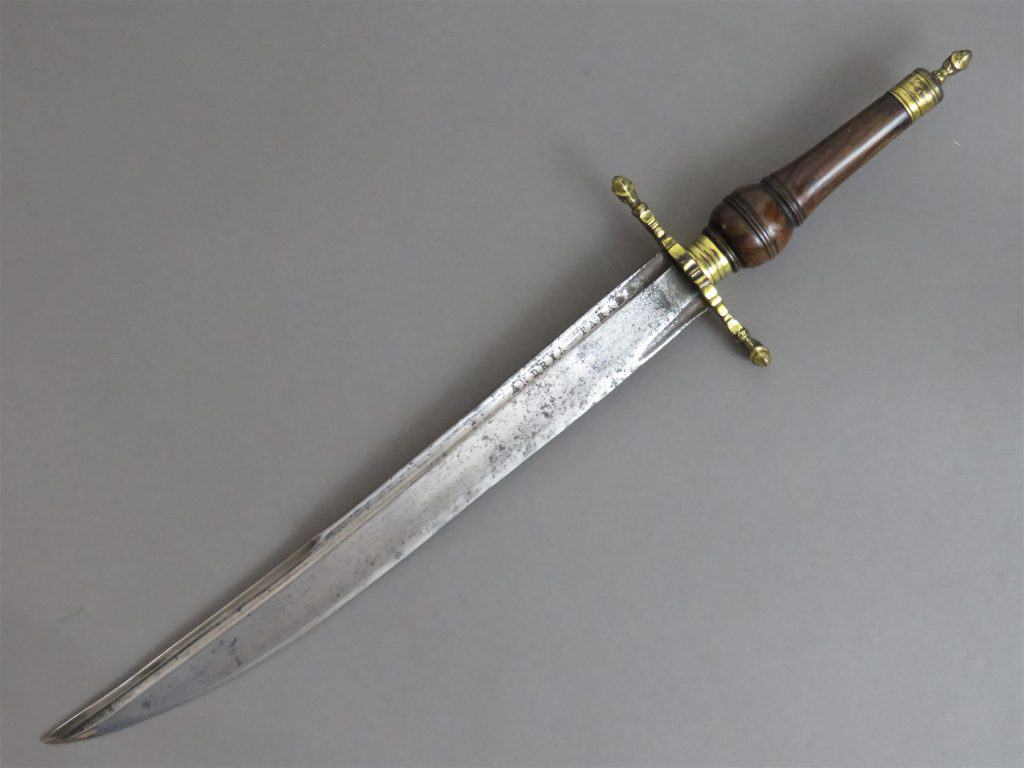
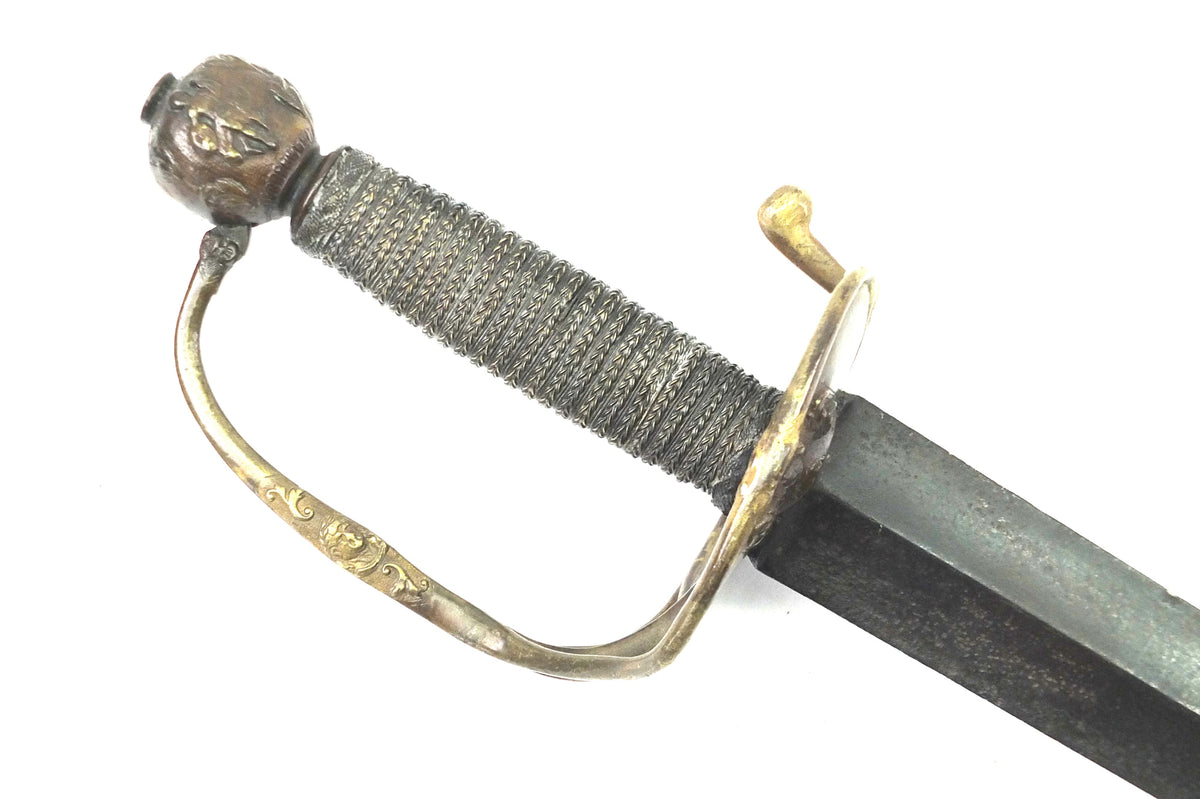
Late 17th Century English Plug Bayonet for an Officer with Fire Gilt Mounts. A fine English Plug Bayonet for an Army Officer dating to circa 1690 to 1700. Plug bayonets were used by the British military after the middle years of the 17th century until they were replaced with the socket bayonet in the early 18th century. The figured hardwood grip is of circular section tapering towards the pommel and has the characteristic swelling at the base turned with sets of decorative grooves around the circumference above, midway and below. A brass ferrule at the base separates the wooden grip from the cross guard. This is also decorated with a pattern of horizontal circular grooves. The cross has a thick oval shaped block with faceted edge and horizontal quillons. The tapering brass pommel sleeve is also decorated with horizontal grooves. Each quillon terminal and the pommel top consists of a helmeted warrior’s head. The mounts retain most of their original gilding. The particular feature of helmeted heads forming pommel caps and / or quillon tips was noted by Harold Peterson as an “English pattern that seems to have been very popular during the very late 17th century, and possibly the opening years of the next century” which “boasted pommels and quillon terminals in the form of helmeted heads”. A survey of plug bayonets by R.D.C Evans devotes a section to English plug bayonets and notes that those with helmeted heads are English and illustrates several bayonets of this type. The slightly curved single edged blade is of robust manufacture. It has a pronounced fuller which extends underneath the spine to the tip. Near the hilt the blade maker’s mark “ANDRIA FARARA” is present on both sides indicating that the blade is of German, probably Solingen, manufacture. It has been adapted from an obsolete heavy sabre blade. The blade is double edged for two fifths of its length towards the tip. The ricasso consists of a blunt edge on the cutting side near the hilt which has a short fuller running along side after which the sharp working edge commences. The blade length is just over 13.75 inches (35 cm) and overall the bayonet is 20.25 inches long (51.5 cm). Army officers wore plug bayonets. A portrait of Captain Francis Hawley of the 1st Foot Guards in 1685 shows the Captain wearing a plug bayonet which has a plain wooden hardwood hilt mounted with brass. Acknowledgements: Peter Finer Ltd, 2003 Catalogue, item 30 “A Fine English Plug Bayonet for an Army Officer circa 1690”. The bayonet is in fine condition overall. The hardwood grip exhibits a rich dark patina. The blade has mottled blackened patches in places.
  • Nation : British
  • Local Price : £2350
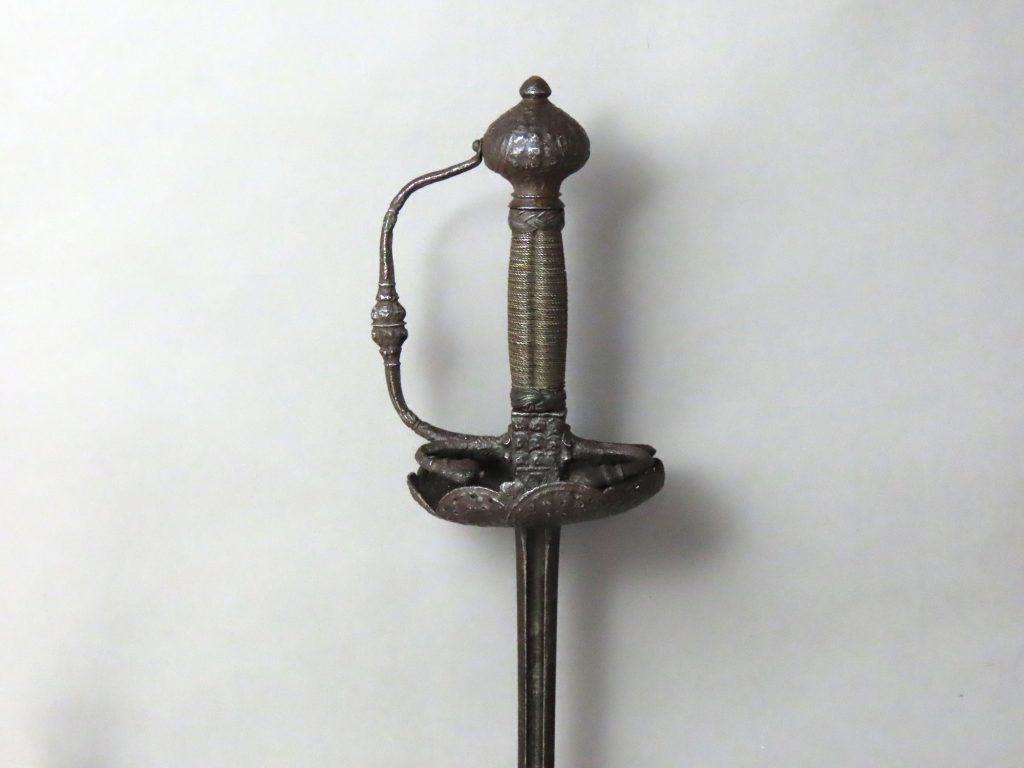
English Dish Hilted Rapier dating to the Second Quarter of the 17th century. The solid globular pommel has an integral waisted neck beneath and raised button on top. It is decorated with chiselled overlapping circles and foliate designs same as those on the dish guard. The grip is of baluster shaped rounded square cross section with a vertical groove on each side. It is spirally bound with alternating steel and brass twisted wire, two ropes of steel for each one of brass. Woven steel rope “Turks' Heads” are mounted top and bottom of the grip. The stiff blade is of tapering slightly flattened diamond section and just over 40 inches (just over 101 cm) long. It a short ricasso from which a deep fuller is cut extending for 9.5 inches (24 cm) along each side. The fuller on one side is stamped in capital letters with: SINAL  ES  EL  CAVISCO  DE BOOY and on the reverse: CLEMENTE  BONIM  EN  ALAMANIA, the words on both sides interspaced with patterns of dots. The phrases seem to be in Latin and are not yet precisely translated, but such inscriptions tend to follow a standard pattern. The first phrase would state something like “I was made by”, whilst the second would say who did make the blade, in this case Clemente Bonim, who made the blade in Germany (en Alamania). Clearly the blade is a German import into England. Blademaking in England was a small industry and not well established at this time. Most blades were imported from German blade making centres of which Solingen was the most important. The rapier retains an even blackened dense  russet patination all over. The hilt retains its pleasing original profile. The overall length of the rapier is just over 47 inches (119 cm). English rapiers of this date exhibit a common form and style, however, there are many variations under this umbrella. Many are seemingly unique like our example discussed here. For different styles of English rapiers see Stuart C Mowbray, “British Military Swords”, 2013, Andrew Mowbray Publishers, Volume One, 1600 to 1660, pages 254 to 281.
  • Nation : British
  • Local Price : £2350
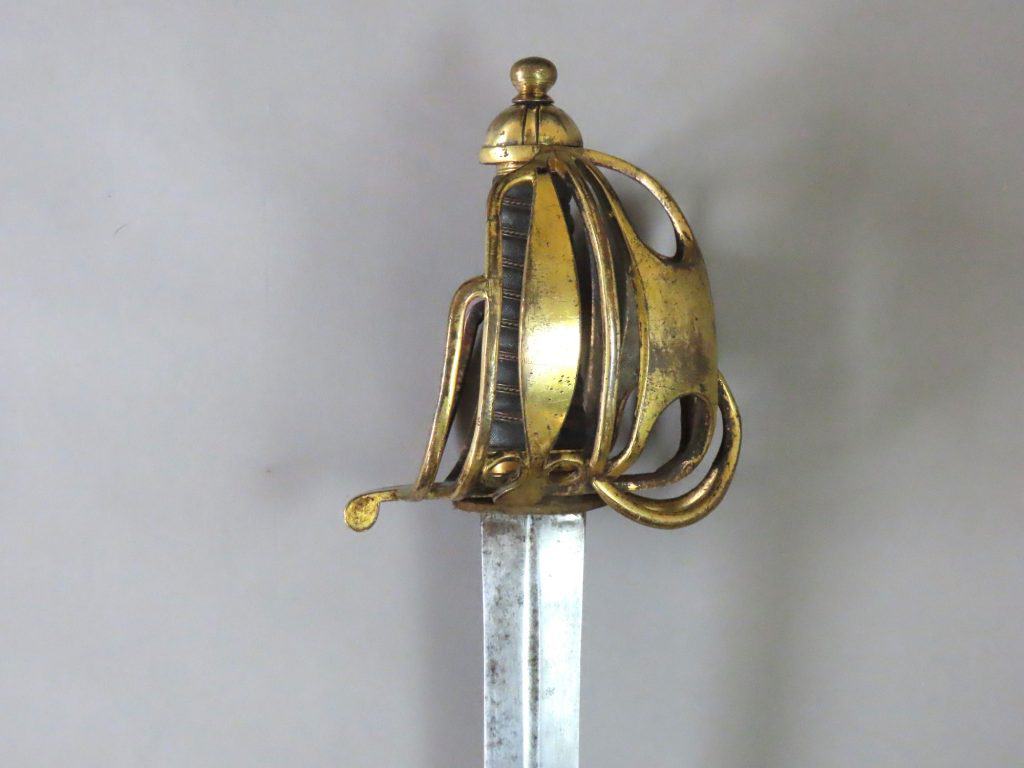
1798 Pattern Scottish Highland Infantry Officers’ Sword with Gilt Copper Hilt. An example of the distinctive basket hilted sword introduced for Scottish Infantry officers in Highland Regiments in 1798. It was replaced by the regulation steel basket hilt 1828 pattern three decades later. The sword type was used throughout the Napoleonic War period. This sword has most of its gilt covering to the bronze hilt still in place. The hilts of these swords were most usually made of gilt copper, bronze or brass. The hilt of this sword is of gilt bronze. The basket guard is made of rounded bars and flattened plates in the usual manner with forward loop guards and a swollen solid wrist guard terminal to the rear quillon. The upper terminals of the guard arms are fixed onto a ring inside which the stem of the mushroom shaped pommel is fitted. The pommel is dome-shaped with a large separate waisted and domed pommel button on top from which four sets of decorative grooves flanked by narrower lines radiate to the pommel edge. The double-edged gently tapering blade is 32.75 inches (83 cm) long. Typically it is of lenticular section with a short ricasso. A central fuller commences a short distance from the hilt on each side and is 8 inches (20 cm) long. The blade is unmarked and probably a German import which was the norm for this sword type and most probably of Solingen manufacture. The grip is of spirally grooved wood covered with shagreen held in place with thin ropes of twisted copper wire flanked with plainer thinner wire now coloured with age. It is mounted with gilt bronze ferrules top and bottom which are incised with decorative lines. The materials used for 1798 pattern hilts were less robust than iron and as a result were more susceptible to damage. Many surviving and published examples have bars missing, are out of shape and are often with repairs. This sword is a fine example without any such problems. The blade has a few small patches of blackened age-related staining in places and the hilt has kept its shape without damage or repairs as can be seen in the photos. For other examples of the 1798 type see: Harvey J S Withers, “The Scottish Sword 1600-1945”, Paladin Press, 2009, pages 13 to 151 and Cyril Mazansky, “British Basket-Hilted Swords”, Boydell Press, 2005, pages 131 to 133.
  • Nation : Spanish
  • Local Price : 3,200.00 USD
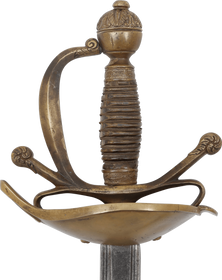
SPANISH OFFICER'S RAPIER C.1800. This sword is a good example of the individuality and stylistic expression which influenced Spanish sword design in the colonial period. It is a rapier with its roots in the European officers small swords of the period. The boat form guard was widely adapted to the Spanish taste but seldom as faithfully as here. The wire wrapped horn grip has a distinctively colonial flavor. It likely was made as part of the armament in anticipation of Spain's involvement in the Napoleonic Wars and may have served in the Peninsular War after 1808. It is as likely to have carried on its service in the colonies including North America and the Caribbean, where Spain struggled to maintain control after Napoleon's defeat. In true Spanish character, it is as functional as it is charming.
  • Nation : British
  • Local Price : £2,295.00
Williamite Walloon Hilted Officer´s Sword, very fine. SN 9114. A Very Fine Williamite Walloon Hilted Officer´s Sword. 43&157; overall, 36&157; earlier flattened diamond section hollow ground blade, characteristic gilt bronze hilt, the solid cast oval side guards decorated with scrolls & classical figures of warriors to the underside & inside, upturned quillon, D shaped knuckle guard decorated with a Roman bust at the mid point, two short supporting side bars, spherical pommel decorated to match, gilt brass wire bound grip with Turk´s heads. Sword 1685-1710, blade circa 1620.&194;&160; &194;&160; &194;&160; &194;&160; &194;&160; &194;&160; &194;&160; &194;&160; &194;&160; &194;&160; &194;&160; &194;&160; &194;&160; &194;&160; &194;&160; &194;&160; &194;&160; &194;&160; &194;&160; &194;&160; &194;&160; &194;&160; &194;&160; &194;&160; &194;&160; &194;&160; &194;&160; &194;&160; &194;&160; &194;&160; &194;&160; &194;&160; &194;&160; &194;&160; &194;&160;&194;&160; Very fine Anglo-Dutch sword in good condition, very fine hollow ground blade probably German fitted&194;&160; to later hilt. Images courtesy of West Street Antiques (https://antiquearmsandarmour.com/)
  • Nation : American
  • Local Price : $2295.00
Rare Confederate Froelich Artillery Short Sword. All Confederate-made swords are relatively rare, but perhaps one of the rarest is the foot artillery short sword made by Louis Froelich of Wilmington, NC and later Kenansville, NC. It would appear that the artillery sword was one of his earliest pieces, as the State of North Carolina contracted for 200 foot artillery swords in 1861 and it is known that the ordnance office in Raleigh paid $12 each for 151 of these between December 1861 and March, 1862. In Wilmington the company was known as the Wilmington Sword Factory or the Confederate Arms Factory, but in September, 1862 Froelich bought a 2.5 acre tract in Kenansville, NC and the new factory became known as the Confederate States Armory, where most of their wartime production occurred. They produced a wide array of products from buttons, knapsacks, and accouterments, to all types of edged weapons, including swords and surgical instruments. They are perhaps best known for their cavalry sabers, of which they provided over 11,000 to the Confederacy. The quality of their products was generally better than other Confederate-made items. The example offered here is of simple form with cast one-piece brass hilt comprising guard, scaled grip, and pommel. Double-edged 18 1/4″ blade of gladius form with unstopped fuller on each side. It is completely unmarked and identified mostly from its distinctive cross guard. Like almost all foot artillery short swords of the period it was fashioned after the French model which was a modern recreation of the ancient Roman gladius. When adopted by the French, these were originally intended to kill or maim charging cavalry horses, but such use during the Civil War was rarely practical so these stout weapons were largely used to clear brush and help with setting up the artillery batteries. As such, the blade of this example shows much use with numerous deep edge nicks and the tip is worn. The piece is uncleaned and the high copper content brass hilt show a dark patina with some lighter patches. Blade with dark rust patina. Most Confederate swords show considerable wear and use, as is the case with this very rare example. No scabbard. Overall length 23 1/2″.
  • Nation : British
  • Local Price : $2295.00
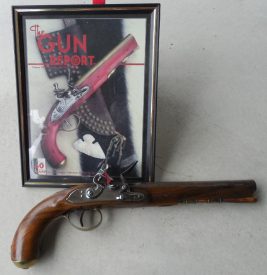
English Flintlock Trade Pistol by Sharpe, First Quarter 19th C. Flat lockplate with line border and feather cluster design behind cock; with a crown over “NR” and marked “SHARPE” (1800-1840). Flat cock with beveled edges and line border. 8″ round .58 cal. barrel with Birmingham proofs, a series of stars, and marked “EXTRA/SHARPE/PROOF at breech; tang with line border and broad arrow stamp. Brass furniture includes butt cap, ramrod thimbles, and sideplate and trigger guard with engraved snowflake design. Silver wrist escutcheon crudely engraved with letters “CF”. Walnut stock with small crack on fore end; wood ramrod. Metal parts cleaned. These early trade pistols were highly prized by the Indian tribes. This exact gun is pictured in Lar Hothem’s “Rare and Unusual Indian Artifacts”, page 386. Tom Richards Collection.
  • Nation : Chinese
  • Local Price : £2295
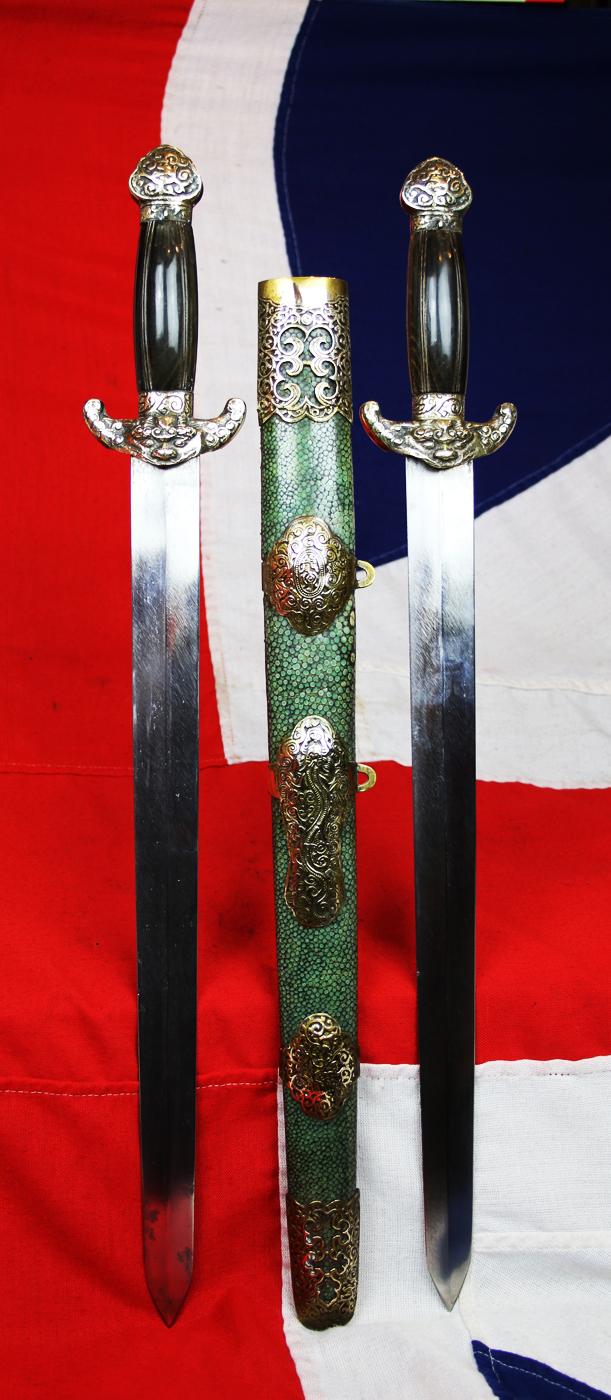
Click and use the code >26174 to search for this item on the dealer website Most Scarce Antique Ching Dynasty Chinese ShuÄ
  • Nation : German
  • Local Price : $2295.00
Fine German Transitional Rapier/Smallsword, Late 17th/early 18th C. Brass hilt featuring symmetrical bilobate shell guard, decorative pas d'ane, and squared knucklebow. Oblong pommel with flattened sides, featuring grotesque masks and human figures in relief. Fine spiral grip wrap of twisted iron and brass wire with braided turks heads top and bottom. Hexagonal-section 28 1/4″ blade with ricasso marked with gilded Prussian Eagle and “BERLIN” on both sides, probably of the 18th C. The style of the knucklebow, pommel, and grip are typical of late 17th C transitional swords, but the shorter blade with gilt markings likely from the 18th C. Very attractive and fine quality sword with a beautiful rich patina to the brass. Overall length 35″.
  • Nation : British
  • Local Price : £2295
Click and use the code >23950 to search for this item on the dealer website 18th Century 1770´s Hallmarked Silver Hilted American Revolutionary War Period Officer´s Sword Used By Both American and British Officers. Made by William Kinman of London
  • Nation : Japanese
  • Local Price : £2,250.00
**ANCIENT LATE 14th - LATE 16th CENTURY MUROMACHI ERA BLADE IN MINT FULL POLISH**Wakizashi Short Sword Suriage Cut Down From Samurai Tachi Blade, Officer’s Rank Tassel, Scabbard & Expert Assessment. ED 3033 -. This Wakizashi with ancient blade has been examined by UK Japanese sword expert Bill Tagg and a copy of his assessment notes accompany the sword. In extracts of his notes he states “Ancient blade now a wakizashi (length). I Think this has been a tachi blade originally made sometime in the muromachi period (ran from late 14th century to late 16th century). Suriage (cut down) tang shortened and cut square. Blade shoulders (machi) moved down. Shortening cutting edge to the length it is now. Any signature that may have been on it lost in the shortening process. The boshi (temper) with its strings of long nie (hakikaki) looks like yamashiro work. In practically mint polish, showing all the workmanship. Needs more research in Japan to identify It properly. Put into shin gunto pattern mounts for service in WW2. Saya is leather covered wood with brass koi-guchi (mouth) some old damage to leather (repaired) complete with rare plated suspension chain. Tsuba is good quality gunto pattern in gilt brass, in good used condition. Tsuka (hilt) is complete with all binding and mounts & brass wire sarute (loop) for blue/brown rank tassel of a Lieutenant to Captain grade. In good used condition, finish on mounts faded. A very light & well balanced Samurai blade in very good polish. A nice addition to a Japanese sword collection”. In his illustrations of the blade he describes the cutting edge of blade as just under 52cms. Total length 65.5cms. He also describes other blade characteristics and dimensions which can be seen in the images. The price includes UK delivery. ED 3033
  • Nation : Japanese
  • Local Price : £2,250.00
**HIGH GRADE SMITH**WW2 Japanese Army Gunzoku (Military Civilian Employee) Officer’s Gendaito Hand Forged Katana Long Sword Smith Signed Tang ‘NOSHU JU MORITA KANE SHIGE KIN SAKU’ Scabbard With Leather Field Combat Cover & Expert Assessment. An original WW2 Japanese Officer’s Sword and Scabbard. The sword has been assessed by UK Japanese sword expert Bill Tagg. A copy of his hand written notes and illustrations accompany the sword. In extracts from his notes he states “Gunzoku katana (army civilian employee) sword with hand forged (gendaito) blade signed by its maker, shoshin mei genuine signature NOSHU JU MORITA KANE SHIGE KIN SAKU see John Slough book of second war swordsmiths page No. 63 for oshigata and info on this man. Real name Morita Isamu born 1900 student of Mizuta Sei Jiro Kuni Shige. Won highest award in 1939 National exhibition rated 1 Million Yen, man making high grade gendaito. In very good old polish, few scratches. Saya wood with extra reinforcing brass strips under leather field service cover, in good condition for its age. Habaki brass with etched armoury storage number 282-180064 ? Tsuba is gunzoku civilian pattern mokko shape in brass (been gilt) with flower decoration complete with several seppa & o seppa. Tsuka (hilt) is gunzoku pattern (civilian) with later war shortages plastic imitation Same fish skin. Brown military ito wrap with 2 sets of menuki (rare). One standard gunto showa blossoms in gilt brass, other pair a spray of flowers & leaves in shakudo metal ? never seen this before. Finished off with rank tassel tied on hanging ring of scabbard (Lieutenant to Captain rank tassel). There is no hole to be fitted with sarute loop. Fuchi kashira are civilian (flowers) in brass, matching tsuba. A scarce pattern sword in untouched collectors condition”. In his illustrations Bill translates the signature on the tang. He describes the cutting edge as 67.5 cms & total length 88.5 cms. He also describes & measures other blade characteristics which can be seen in the images. The price includes UK delivery. Sn 23059
  • Nation : British
  • Local Price : £2,250.00
**VERY RARE**NAPOLEONIC PENINSULAR WARS ERA**British Webb 57 Piccadilly London 1803 Pattern Light Infantry Flank Officer’s Sword With Blued & Etched Warranted Sabre Blade, Remnant Of Original Officer’s Cord & Scabbard. Sn 22823 -. The development of the Pattern 1803 Flank Officer’s sword goes back to the late 18th century, when light infantry units were formed in the British Army. The Grenadiers and light companies of a battalion were considered the elite of these infantry regiments, and could be detached and deployed separately as skirmishers. Grenadiers were the senior company of any infantry battalion and would typically lead an assault. When the battalion was deployed in line, the grenadier and light companies were deployed on the right and left flanks respectively, and both companies could be could be called upon to operate in looser formations and semi-independently. The added element of risk associated with detached skirmishing in looser formations meant that officers of light infantry needed a more robust fighting sword. By 1799, sufficient numbers of officers of these regiments and companies were using sabres rather than the Pattern 1796 Infantry Officer’s sword, enough for them to be given official leave to wear sabres instead. In addition to being a more practical weapon, these sabres could be more easily hitched up, as they were suspended on slings rather than the shoulder belt and frog of the Pattern 1796 Infantry Officer’s sword. This ensured that the weapon did not inhibit movement when skirmishing over broken ground. This need for a more robust weapon was formally acknowledged by the King in 1803, when he approved ’a Pattern Sword for the Officers of Grenadiers and Light Infantry’. Despite this regulation there exists a great deal of variety in 1803 Pattern swords. most have a slotted hilt with the royal cypher (GR) on the knuckle-guard, which joins the head of the back piece at a Lion’s head pommel. It is rare to find these swords with Light Infantry ’slung bugle’ or Grenadier ’ignited grenade’ devices. The blade is commonly quite broad for an infantry sword, with a single fuller. In terms of general form, the sword is similar to the curved sabres of the light cavalry, and the blade is comparable to a slighter version of the 1796 Light Cavalry sword. This similarity was perhaps deliberate, as at this time light infantry across Europe were increasingly taking their military stylings from their light cavalry counterparts. Both light infantry and cavalry considered themselves an elite, and were keen to distinguish themselves from their comrades in the line through different uniform and equipment. The sword was approved for both flank officers of line infantry regiments as well as those few regiments in the British Army designated as light infantry. In addition to this, Regimental officers (Majors, Lieutenant-Colonels and Colonels) were permitted to carry the sword. This is an original very rare to find example of a British 1803 Pattern Light Infantry Flank Officer’s sword (see page 168 of World Swords by Withers & page 151 of Swords Of The British Army by Robson). Our excellent example has the correct pierced brass guard with King’s Crown GR (George Rex) cypher, rare to find Light Infantry ‘slung bugle’ device and Lion’s head pommel. The wire bound leather covered grip is excellent. All wire is tight and intact. The hilt is mounted with remnants of an original Officer’s cord. The sword has a 27 ¾” long fullered, single edged sabre blade with pronounced curve & leather hilt washer (32 ½” overall). The blade is correctly gold etched on both sides for approx. one third of its length. The etchings are foliate design, ‘warranted’ banner and panel signed by the maker ‘Webb Manufacturer 57 Piccadilly London’. The sword comes with its steel scabbard which has 2 steel hanging rings and shoe. The scabbard has just a few light dents only visible on close inspection which is consistent with service use. The price for this quality sword worthy of further research regarding the maker includes UK delivery. Sn 22823
  • Nation : Japanese
  • Local Price : £2250
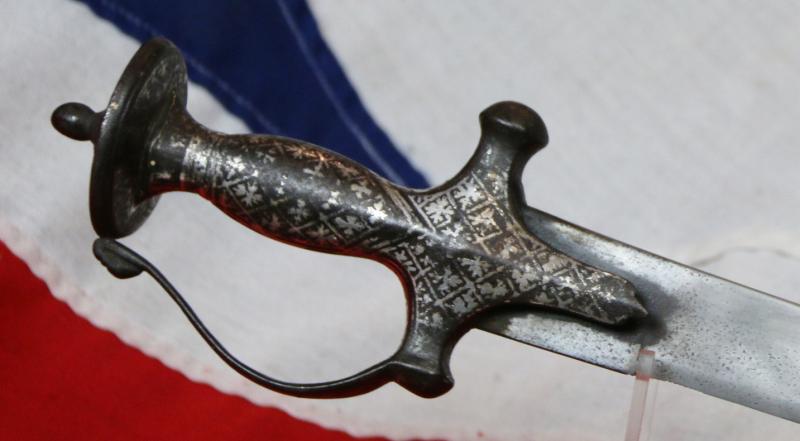
Click and use the code >22647 to search for this item on the dealer website Superb Antique Indian Tulwar 17th to 18th Century Silver Decor Hilted Sword With Hybrid Wootz Damascus Shamshir Blade. It Has Just Returned From Expert Museum Grade Conservation, Polishing & Etching of The Blade To Reveal Its Stunning Pattern
  • Nation : American
  • Local Price : £2250
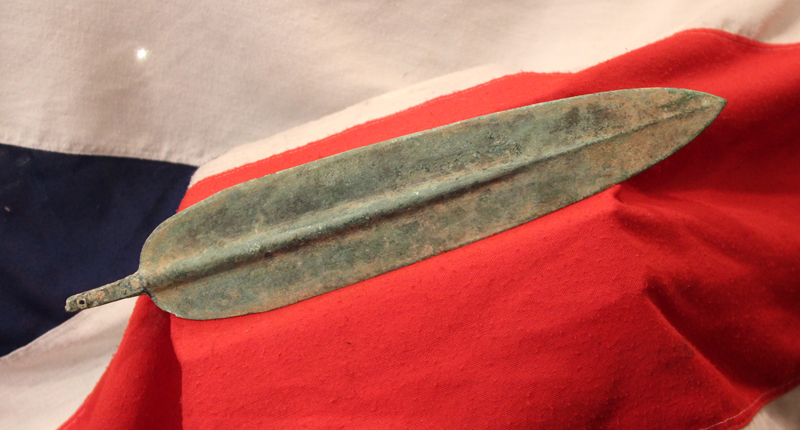
Click and use the code >22103 to search for this item on the dealer website Beautiful and Ancient Original Greek ´Leaf Shaped´ Bronze Sword, 1200 BC, Around 3200 Years Old, From the Era Known In The Days of Homer as The ´Heroic Age´
  • Nation : Japanese
  • Local Price : £2,250.00
**WW2 JANUARY 1941 LUCKY DAY**Japanese Army Officer’s Type 98 Gunto Gendaito Traditionally Hand Forged Katana Sword With Smith Signed & Dated Tang ‘KANE YOSHI’, With Rare To See Signed Tsuka Hilt, Scabbard & Expert Assessment. Sn 22732 -. This sword has been assessed by a UK based Japanese sword expert Bill Tagg. His assessment accompanies this piece. In exerts from the assessment he states “ A Type 98 Gunto with medium to high grade Gendaito blade (traditionally forged). In 80% original polish with original signature ‘Kane Yoshi’, a known Gendai maker, real name Matsubara Shozo worked as a navy Haigun Jumei Tosho, a student of Watanabe Kane Naga (see John Slough page 73 for Oshigata & info, rated 1 million Yen man good maker. Type 98 Gunto parade metal saya (been re-painted). All copper mounts in good condition. Tsuba good quality pierced with several quality seppa all matching number ‘41’. Habaki good quality copper base wrapped in silver sheet decorated with cat scratches & rain drops. Tsuka handle very good quality fish skin & brown ito wrap worn on knot. With possible replacement cord sarute loop? Locking catch there but bottom end missing (does not lock into scabbard). Good shape well balanced. Good work on nakago. A good blade by a known Gendaito swordsmith. NB Wood of hilt signed by tsuka maker under bottom fitting rare to see (not translated)”. In his illustrations of the blade he describes the cutting edge of blade as just under 66.5 cms. Total length 86.5 cms. He also translates the tang signature & date and describes other blade characteristics and dimensions (illustrated). The price for this excellent well marked Gendaito sword with expert assessment includes UK delivery. Sn 22732
  • Nation : British
  • Local Price : £2,200.00
Scottish WW1 Field Officer’s Broadsword of Brig. Gen. Norman Richard Crockatt, Royal Scots, First Director of MI9, CBE, DSO, MC, MID, Legion of Merit, Legion d&#acute;Honneur, Croix de Gu. Description Straight spear-pointed blade with double fullers 32 5/8 inches in length, 1.1 inches wide at the forte, the sword 39 inches overall. Pierced nickel-plated steel guard with foliate &#acute;honeysuckle&#acute; decoration also incorporating thistles, and the emblem of the Royal Scots: a figure of St Andrew, holding a crux decussata (a.k.a. the saltire, or St Andrew&#acute;s cross, also seen on the Scottish flag). Patron saint of Scotland, St. Andrew was said in medieval tradition to have requested to be crucified on such a cross, as he felt unworthy to be executed in the same manner as Jesus. Wire-bound shagreen grip, chequered backstrap with integral chequered oval pommel, secured by screw with eyelet. No leather washer. Fabric hilt liner with red exterior and white interior. Steel parade scabbard with two hanging rings. The blade is etched at the ricasso on one side with the royal coat of arms above the maker&#acute;s mark &#acute;Henry Wilkinson Pall Mall London&#acute;. At the ricasso on the other side is a hexagonal brass proof slug set within an etched six-pointed star - the hexagonal proof slug was used from 1905 onwards to denote Wilkinson&#acute;s best quality blades. The spine of the blade at the ricasso is stamped with the serial number &#acute;44310&#acute;, indicating production in 1913. Wilkinson Sword records confirm that sword 44310, described as a &#acute;Claymore&#acute;, was finished on the 9th October 1913 and sold to &#acute;R Crockatt, Rl Scots&#acute;. The blade is further etched with thistle motifs, the crown and cypher of King George V, &#acute;Royal Scots&#acute; enclosing a thistle and beneath another crown, and the family crest of the Crockatts: a Dog Sleeping Sable, Spotted Argent (in this instance with a variation of a five-pointed star placed on the dog) above the family motto &#acute;TAK TENT&#acute; “ a Scots phrase meaning &#acute;take heed&#acute;, &#acute;keep watch&#acute;, or &#acute;beware&#acute;. Norman Richard Crockatt was born in 1894. Educated at Rugby School, he went on to attend the Royal Military College at Sandhurst and joined the Royal Scots as a 2nd Lieutenant in 1913. He disembarked in France with the 2nd Battalion in August 1914 as part of the British Expeditionary Force and was severely wounded during the Retreat from Mons in the same month. He was promoted to temporary Lieutenant in September 1914, and to Lieutenant in November 1914. He was appointed an Adjutant serving with the Yorkshire Regiment in May 1915 which came with the Territorial rank of temporary Captain “ I believe the Adjutant position may have allowed him to first use the field officer&#acute;s hilt on his sword. He was mentioned in Dispatches in June 1916. His Adjutant appointment ended in July 1916 when he was assigned a Grade 3 General Staff Officer, still at temporary Captain. He was promoted full Captain in August 1916. He was awarded the Military Cross in the 1917 New Year Honours. He was made a temporary Major in February 1918. He was awarded the Order of the Nile, 4th Class by the Egyptians for service in Palestine in the latter part of the war. He was again mentioned in Dispatches in both January and June 1919 and awarded the Distinguished Service Order in December 1919. In 1920 he was appointed Adjutant of the 4th Battalion Royal Scots. Crockatt retired abruptly in 1927 “ by one account, walking out in the middle of a staff training course “ to become a stockbroker, but was recalled to the Army immediately on the outbreak of WW2 and assigned to the Directorate of Military Intelligence at the rank of Brigadier. He was specifically requested, in fact, by John C F Holland, head of the War Office&#acute;s irregular warfare branch &#acute;MI R&#acute;, who had known Crockatt since their schooldays together at Rugby. &156;In an age of drab clothes and battledress he [Crockatt] wore at every opportunity the colourful gear of his regiment, the Royal Scots. Moreover, as a former front-line combatant who had also served on the other side of the divide, he could understand and appreciate the antagonism that combatants were likely to feel for the staff, could make allowances for it, and could do his best to reduce it. He was also clear-headed, quick-witted, a good organiser, a good judge of men, and no respecter of red tape: excellent qualities for his early struggles in the War Office.&157; [MI9 by Foot and Langley, 1979] In December 1939 Holland recommended Crockatt to be the first director of the newly formed MI9. This secret unit was tasked with assisting in the escape and repatriation of Allied troops that had been captured or were stranded behind enemy lines “ or rather would be captured, once fighting began in earnest. In doing so Holland deliberately went against suggestions to appoint an officer with experience escaping captivity, deciding they would be prejudiced by personal experiences. While never an escapee, Crockatt was by no means short of ideas. He later explained his objectives for MI9 as follows: To facilitate escapes of British prisoners of war, thereby getting back service personnel and containing additional enemy manpower on guard duties. To facilitate the return to the United Kingdom of those who succeeded in evading capture in enemy occupied territory. To collect and distribute information. To assist in the denial of information to the enemy. To maintain morale of British prisoners of war in enemy prison camps. Crockatt believed that the new war required a new philosophy throughout all the armed forces: while British troops had mostly remained quietly in prisoner of war camps during WW1, based on an honour-driven understanding of surrender which had been largely reciprocated by their enemies, &#acute;escape-mindedness&#acute; now needed to be trained into British soldiers of all ranks in all services, with programs instituted to that effect. He insisted that &#acute;A fighting man remains a fighting man, whether in enemy hands or not, and his duty to continue fighting overrides everything else&#acute;. To understand potential escape methods Crockatt brought in experienced British escapees of WW1 to give lectures to MI9, and sourced fifty books from the British Museum with accounts of such escapes. The books he sent to his old school, Rugby, where sixth-formers wrote synopses of the material which MI9 then synthesised into training manuals. The resulting training courses, conducted by MI9&#acute;s &#acute;IS9&#acute; division, were focused most heavily on the Royal Air Force, whose pilots were proportionately rarer and more valuable assets. A course at RAF Highgate distilled Crockatt&#acute;s new mindset thus: &156;Only as a last resort should you be in a position of being captured. Your job is to fight “ and only through wounds, lack of ammunition or food should you ever allow yourself to be captured. Should you be captured, it must be your firm and constant determination to escape at the earliest opportunity “ to bring back information to our people.&157; [Specimen Lecture for Army Units on Conduct if Cut Off from Unit or Captured, WO 208/3242] For escape-mindedness to succeed in practice troops would need new escape technology: to this end Crockatt recruited technical experts Charles Fraser-Smith and Clayton Hutton into the new &#acute;Q&#acute; unit, to design devices to assist stranded British soldiers in their escape and evasion. Hutton described his new boss as &#acute;suave, well groomed and shrewd&#acute;. When Hutton asked how he should set about producing escape tools, Crockatt replied simply: &#acute;It&#acute;s entirely up to you. There are no previous plans to work from and no official records¦ Put on your thinking cap, do as you like.&#acute; This unit and its &#acute;Q-devices&#acute; directly inspired Ian Fleming&#acute;s James Bond novels, the character of Q being an amalgam of Crockatt&#acute;s two technicians. There were at that time still no POWs needing help, but this changed rapidly from May 1940 with the German invasions of Belgium and France and MI9&#acute;s resources were increased. Crockatt oversaw the development of numerous &#acute;escape lines&#acute; which ferried thousands of escapees and downed airmen back to Britain. Many of these had emerged organically out of local resistance but needed logistical support, extra personnel and improved security. MI9 was initially headquartered in rooms at the Metropole and Great Central Hotels in London, but the Metropole was hit by urban bombing in September 1940 and Crockatt opted to move the unit into the countryside, requisitioning Wilton Park House in Buckinghamshire in October, which was close to his own home in Ashley Green but not too far from London. To keep the escape lines running up to date information on the state of enemy territory was essential and MI9&#acute;s purview expanded to interrogation of enemy prisoners (as well as civilians seeking to enter Britain) and debriefing of successful escapees, this work gradually increasing the unit&#acute;s value as a source of intelligence in its own right. This was reflected in Crockatt&#acute;s promotion to Colonel in 1941, taking the new position of Deputy Director of Military Intelligence (Prisoners of War). The interrogations unit for enemy soldiers, &#acute;MI9a&#acute; was spun off in December 1941 into an independent but associated agency, MI19. The work of MI9 in Europe occupied most of its attention and resources given its proximity, but it should be emphasised that it oversaw escape operations in most other theatres of the war despite the even greater difficulties of operating outside Europe. Crockatt was only able to oversee these at arm&#acute;s length, but wherever British forces were captured MI9 played a role, including the Middle East, North Africa, Russia, Burma and occupied areas of China. Major General Carl Spaatz of the United States Army Air Force first met with Crockatt in 1942, which began the development of the American equivalent to MI9, MIS-X. Spaatz and his appointees, including the academic W. Stull Holt and businessman Edward Johnston, formed a highly productive relationship with Crockatt. Holt in particular was impressed with Crockatt&#acute;s leadership and organisation, leading him to make the bold decision that MIS-X would use and support the British escape lines, rather than trying to establish their own competing system. Likewise American training programs were heavily based on the British model. The end result was that British and American captives were able to collaborate on escape efforts and make it home by the same routes. &156;Crockatt&#acute;s own impressive personality counted for much in this. Not only did he stimulate Holt; he made a tremendous hit in Washington (and, in passing, in New York) when they both visited America from 28 January to 15 March 1943. His bonnet and tartan trews and the panache with which he wore them enhanced the originality, almost the eccentricity, of his approach to war; people felt in him the practical daring of a young Lochinvar.&157; [Foot and Langley, 1979] Crockatt repaid the compliment a year later when Holt was nearly ousted from his position in a Pentagon turf war, intervening with American leaders on his behalf to save a productive partnership. After Lt Airey Neave made his famous escape from Colditz Castle in 1942, he was recruited immediately into MI9. Brigadier Crockatt met with him at the famous Rules restaurant in London, dressed in his full Royal Scots dress uniform and medals. It was apparently a habit of Crockatt&#acute;s to hold any conversation that might get awkward in Rules, a public place with good food naturally cooling the temper. Neave wrote in his memoirs that Crockatt &#acute;was a real soldier and I liked him immediately.&#acute; Crockatt tasked Neave to MI9&#acute;s new Room 900 section which would train new agents to establish fresh escape routes, telling him frankly &#acute;You will look after secret communications with occupied Europe and training of agents. It won&#acute;t be a bed of roses.&#acute; True to form, Crockatt left Neave to his work free of operational interference. Crockatt visited the Asian theatre for the first time in late 1944, where he took the opportunity to visit his son Dick, who was serving with the Royal Scots in Burma. Personal feelings from this meeting overflowed into a personal letter from Crockatt to his American counterpart in MIS-X Ed Johnston, complaining about the lack of co-ordination he&#acute;d found between the two agencies&#acute; Asian branches: &#acute;I wish to God people would forget about themselves and their nationalities and get on with this bloody war, so that you and I could get our boys back.&#acute; Crockatt was considered a highly effective leader at MI9, combining traditional military efficiency with forward thinking and a light touch to command & control of the various specialists and mavericks he recruited. He constructed an entirely new branch of the intelligence service with a unique overlap of logistics and spycraft, with limited manpower and resources and despite friction with more established units, particularly MI6. J. M. Langley, who ran IS9, wrote that Crockatt &#acute;attracted an immediate loyalty and devotion of all who served under him&#acute; and noted that he argued in favour of perilous operations like the rescue of escape line organiser Lt Ian Garrow on a matter of principle, believing &#acute;that Ian&#acute;s magnificent work and self-sacrifice should be recognized by some effort to save him from almost certain death in a concentration camp&#acute;. 26,190 British and Commonwealth troops escaped from Europe alone thanks to the intervention of MI9, and it is estimated that 90% of troops that evaded initial capture in Europe were successfully rescued by them. Some authors have considered Crockatt lacking in the ruthless attitude of other intelligence officials, however, focusing on prisoner welfare even when more aggressive operations might have secured more escapes. He refused, for instance, to hide any escape materials in Red Cross shipments in case the enemy responded by banning the organisation&#acute;s crucial deliveries. Fake charities were used instead even at the risk of increased scrutiny. He had at all times to balance furthering MI9&#acute;s mission with the fear that reprisals or outright massacres might be carried out against prisoners of war if the enemy leadership was sufficiently provoked. More controversial were his orders to British prisoners held in Italy in 1943 to &#acute;stay put&#acute; in prison camps even if their guards began to abandon their posts, a stark contrast to his own stated philosophy. There were good explanations for this policy: it would make it easier for Allied forces to find the prisoners and prevent the known problem of chaos and hardship when hordes of servicemen were left to wander the countryside without supplies. It was believed that the 80,000 prisoners in Italy might be in poor physical condition and the Allied advance through Italy was expected to be relatively swift. Reprisals were still a possibility and the senior intelligence community was by that time aware of the existence of extermination camps that could have killed soldiers en masse. True to form, Crockatt was more concerned with keeping men safe than speeding their return. What was less explicable was that he neglected to inform the War Cabinet of this order. After good initial progress, when the Allied advance stalled at the Gustav Line about 50,000 prisoners still remained in their camps even while German troops arrived to replace the fled Italians, resulting in some prisoners being resecured or transported away to other camps when they might have escaped. Churchill was dismayed at this outcome and ordered an SAS operation to find and rescue those who had left the camps, which largely failed. Crockatt retired from heading MI9 in June 1945, succeeded by Brig. Sam Derry. MI9 continued its work repatriating freed soldiers and gathering intelligence from them, particularly focusing on evidence of war crimes to be prosecuted at the upcoming tribunals, as well as locating, rewarding and honouring the various civilian &#acute;helpers&#acute; who assisted in the escape lines at great personal risk. Some MI9 personnel went on to form the Joint Reserve Reconnaissance Unit, an intelligence unit specialising in battlefield surveillance and nuclear targeting. This later became 23 Special Air Service Regiment (Reserve), which during the Cold War was planned to man hidden stay-behind observation posts if Soviet forces overran Western Germany. 23 SAS still exists today under the umbrella of UK Special Forces. Being head of a secret organisation Crockatt received little public fanfare, but a number of honours did come his way. He was recommended for a CBE in the 1945 Birthday Honours by the Director of Military Intelligence Sir John Sinclair, his recommendation declaring that Crockatt &#acute;built up from zero the most effective inter-service Intelligence organisation which exists&#acute;. As well as &#acute;spontaneous and unstinted testimonials from the other Services and certain Government departments&#acute; Sinclair noted &#acute;the marked appreciation of several US General Officers&#acute; for Crockatt&#acute;s work. For their part the Americans bestowed Crockatt with the US Legion of Merit (Officer degree) and for his service to the French people he received both the Legion d&#acute;Honneur (Chevalier class) and the Croix de Guerre (with palm). In later life he became director of the Attock Oil Company, and was appointed a member of the Royal Company of Archers, the Queen&#acute;s Body Guard for Scotland. Brigadier General Crockatt died in October 1956, aged 62. As Brigadier Dudley Clarke, the head of MI9&#acute;s Middle Eastern operations, wrote in 1941: &156;In war it is given to few soldiers to be able to serve simultaneously the causes of humanity and country. All who work for MI9 have this special privilege, and few calls can have more appeal than that to rescue those whom the Fortunes of war have abandoned to the enemy.&157; The traditionally-styled Scottish broadsword was carried only by Highland infantry regiments until 1881, when the Lowland regiments also adopted Scottish dress and the broadsword along with it (with the exception of the Cameronians). The use of an interchangeable hilt may date back to the 1860s, but is first officially mentioned in the Dress Regulations of 1883, which authorized the Highland Light Infantry to use the basket hilt for full-dress occasions and the cross-bar hilt for all other occasions. Field Officers and other mounted officers were entitled to use a third hilt, the form of which varied by regiment: this design, a symmetrical basket hilt with thistle designs and the regimental badge, was used by the Royal Scots, Royal Scots Fusiliers, King&#acute;s Own Scottish Borderers, Gordon Highlanders and Highland Light infantry. See plate 178 on page 186 of Swords of the British Army by Robson for another example of the Royal Scots model. The hilt could be changed by unscrewing the pommel nut, removing the pommel, grip and guard, then replacing each with the other version. The blade is bright with a high reflective polish, no edge damage and no significant patination, some light scratching towards the tip, none affecting the etching which is crisp and retains the contrast between the matt acid-etched background and the reflective polished designs within it “ the custom family crest panel has an interesting darker grey background applied in the etching that makes it stand out even more. The regimental hilt is undamaged and retains almost all of its bright nickel plating, with wear only at spots along its edges exposing patinated steel. The shagreen of the grip is all present with light handling wear and no scale losses, the grip wires are all present and tight. The interchangeable hilt is securely screwed in place. The scabbard has a few small spots of patination towards the chape end and some very light scratches from carry. The fabric of the hilt liner retains bright colours, particularly the red showing through the pierced guard, with some rubbing to the inner edge and surface-level cracking on the inner surface where it curls at the pommel end.
  • Nation : British
  • Local Price : £2200
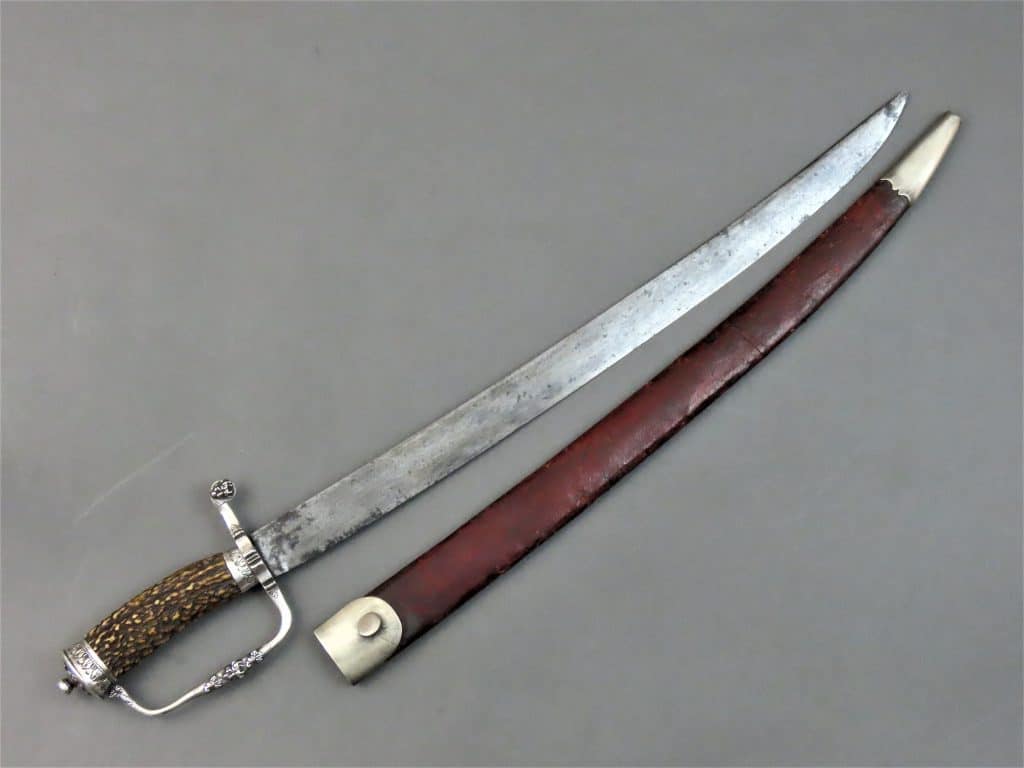
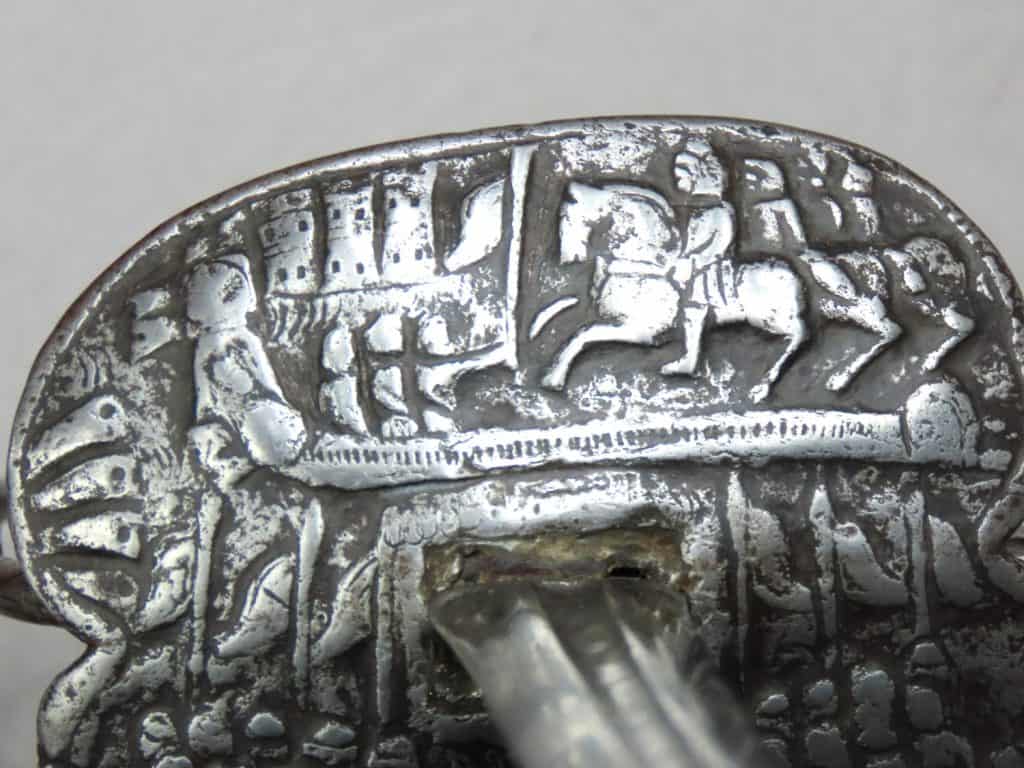
English Silver Mounted Hanger circa 1695. A late 17th century English silver mounted Hunting Hanger made by the silver hilted sword maker and cutler Francis Springall of London. In the 17th and 18th centuries when swords were a popular weapon for gentlemen, hangers were a robust secondary side arm used for self-defence when hunting and travelling. They were also used in parts of the British Army and Navy. Hangers appear in some military portraits of the time. The fine quality hanger described here was a gentleman's weapon. The maker is almost certainly Francis Springall. The knuckle bow is stamped with his pre-Britannia Standard mark of “F S” in raised relief inside a lozenge. The mark is worn but discernible. His mark has been identified on another silver hilted hanger which is in the Royal Armouries collection (Ref: IX.1803) and dates to around the same time. Francis Springall was one of a number of London-based silver hilted sword and hanger makers that excelled in their craft in the late 17th century. He is recorded from 1686 to 1735. He started his apprenticeship in 1686 and was sworn free upon completion in 1694. As the Britannia Standard would require his name stamp to read “S P” from 1697, the hanger can be dated to the small window of  three years between 1694 and 1697. Springall lived for most of his life at “Three Legg’d Alley”, New Street Precinct in the  Parish of St Bride’s. He was buried at St Bride’s Church, Fleet Street, in 1735. Springall lived in exciting times as London was remodelled after the turbulence of the Civil War period, plague and the Great Fire of 1666. The city was more outward looking, international trade was growing through London port, military success was being achieved abroad and more interest and investment was being expressed in art and culture. The quality of Springall’s work, like that of his leading contemporaries, represents the evolving style and fashions of late 17th and early 18th century Baroque London. The hilt of this hanger is comprised of a bold faceted quillon block from which a  downward facing rear quillon and a knuckle bow emerge. The pommel is formed as a cap on top of the natural stag horn grip. The top of the knuckle bow is fashioned as a hook which secures the bow into the pommel. The flattened quillon terminal features in bold relief a mounted caped horse rider on each side, possibly a representation of a huntsman.  The feature is repeated in a diamond shaped panel in the middle of the knuckle bow on each side with floral sprays above and below. The maker’s stamp is struck just above one of these panels. The knuckle bow terminal is decorated with a floral design which is also applied to the quillon block. The shank of the pommel cap is decorated with a complex pattern of closely aligned crescents and arches between a rim above and below. The same pattern is present on the base ferrule of the grip. The pommel top has a pronounced ribbed button around which a circular panel has been formed containing in raised relief a crown above and below the button and the bust of a man on each side, the symbolism of which is unknown. The decoration in raised relief is highlighted by contrast with a stippled background. The curved single edged blade is 18.75 inches long (just under 48 cm). The worn remains of the blade maker’s mark is present on one side. The hanger retains its original wooden scabbard with its red leather covering. The mounts are replacements and not original to the scabbard. For further information on Francis Springall see Leslie Southwick, “London Silver-Hilted Swords, their makers, suppliers & allied traders, with directory”, 2001, Royal Armouries, page 228 for his biography.
  • Nation : Spanish
  • Local Price : £2150
Transitional Spanish Rapier / Small Sword circa 1650 to 1680. A very interesting Spanish sword dating to the second half of the 17th century. The hilt is chiselled with scenes similar in style to those which appear on some earlier 17th century Spanish rapiers. The proportions show that it has evolved from larger typical rapier dimensions but is not slender enough to be classified as a “Small Sword” which ultimately replaced the rapier as a weapon in the second half of the 17th century. A a result it is an example “in transition” between the two edged weapon styles. The hilt is extensively chiselled with figures in raised relief and is mounted with a fine quality rapier blade. The salient feature of the hilt is the double shell guard. The exteriors of the convex oval guards are chiselled with two scenes.  The first shows two armies facing each other mounted on horses with their leaders at the front. The riders carry spear tipped lances fixed with pennants. The second scene shows a medieval castle inside a city wall with the occupants behind the wall (depicted as three in number) surrendering the city by waving a flag to men on horseback. The scenes seem to represent a battle and successful siege of a Muslim city by Christian forces during the earlier Christian Reconquest of Spain. The solid rectangular section quillon block and swollen quillon are chiselled on one side with reclining bowmen amongst scrolls.  The reverse shows a mounted figure chiselled into the block and another reclining bowman on the quillon. The knuckle bow is chiselled on both sides with chevrons and has a swollen middle thickened with a knop on the outer side. The terminal is flat with a small hook which fixes the bow into the pommel front. The solid pommel is of slightly flattened ovoid form with an integral waisted pommel button and a flared ribbed neck beneath. A figure of a horseman is present on one side and another bowman on the other. The original baluster shaped grip is of rounded rectangular cross section bound with copper strip separated with contra twisted ropes of copper wire. Woven copper “Turks’ Head” terminals are present top and bottom of the grip. The stiff diamond section tapering rapier blade is of fine quality. It has a short ricasso. A deep tapering single fuller extends along the middle on each side from the ricasso for 7.5 inches (19 cm). On each side inside the fuller  separated letters flanked by quatrefoil shapes of small crosses form the name of the blade maker S A H A G OM. The inscription “SAHAGOM” has various spellings and historically refers to Alonzo de Sahagun (the older or younger), who were renowned masters in Toledo, Spain, and known for the exceptional quality of their blades. In the 17th and 18th centuries the mark persisted on blades, often applied by other smiths using the mark as a spurious badge of quality for their own output. The sword is in original condition and in good tight order. The blade is 32 inches long and overall the sword is 38.25 inches.
  • Nation : Spanish
  • Local Price : £2150
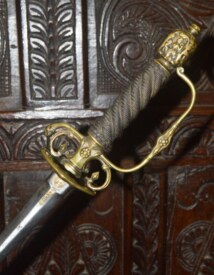
Click and use the code >22330 to search for this item on the dealer website Simply Fabulous Original Antique Napoleonic Wars Sword Of The King of Spain´s Elite, Heavy Cavalry Regiment. Used In The Spanish Peninsular Campaign, During Napoleon´s Peninsular War in 1808 Until 1814. In Superb Condition.
  • Nation : French
  • Local Price : £2,150.00
French AN XI Heavy Cavalry Cuirassiers Troopers Sword. French Napoleonic AN XI Heavy Cavalry Cuirassiers Troopers Sword. 44&157; overall, 37 ½&157; straight multi fullered blade with spear point. Blade with inspector&#acute;s mark, back edge engraved M-Fture Imp du Klingenthal juin 1811 Four bar brass hilt with brass pommel, original leather with 16 turns of brass wire, numbered 255. In its original heavy steel scabbard numbered 255, with large lyre shaped drag stamped G 998, with riveted throat piece, with two suspension rings. The Blade with poincon for F.L Lobstein. Reviseur June 1804 to July 1821 at Klingenthal and J.G.Bick controleur February 1809- July 1819
  • Nation : British
  • Local Price : £2150
Fine English Silver Hilted Small Sword by John Bennett Hallmarked for 1762 / 1763 mounted with a Boat Shell Hilt and Colichemarde Blade. A fine silver hilted smallsword by John Bennett date-stamped for 1762 / 1763. The bold hilt is of boat shell type which was one of the most robust hilt designs adopted by the London silver hilted small sword makers working in the 18th century. The sword is mounted with a broad robust colichemarde blade. John Bennett was one of the most renowned 18th century London silversmith / cutlers but surviving swords made by him are generally encountered less frequently than those of his competitors. The dish guard, pommel and ricasso are shaped en suite with well executed gadrooned lines and borders. The baluster shaped wooden grip is diagonally bound with silver strip interspaced with a double length of roped silver wire. The broad colichemarde blade is of stiff triangular section and retains is clearly engraved panels of strapwork near the hilt. The four hallmarks are stamped onto the knucklebow near the hilt. These  consist of the maker's mark “I . B” with a pellet between in raised relief inside a depressed rectangular panel, the lion passant mark, the crowned leopard's head assay mark and the date stamp. The hilt is as much an example of the high standards of design and execution required of the 18th century London silversmith and cutler as it is of an effective weapon. Silver hilted small swords were fashionable attire for 18th century gentlemen. Mostly worn for effect, someone wearing such a sword was also announcing to the world that he could use it. Despite the stylish and delicate appearance of these swords they were formidable dueling weapons. . There are some minor light blackened patches of old pitting near the middle of the blade but otherwise the sword is in fine condition overall. There are no losses or repairs to the hilt which has maintained its original pleasing outline. The blade is 30.5 inches (80 cm) long and overall the sword is 37.25 inches (94.5 cm) long. John Bennett was one of the most influential and foremost makers of silver hilted swords working in London in the middle of the 18th century and made swords for the London social and military elites. He and his son (John Bennett II) were also gunsmiths, jewellers and goldsmiths. They were based at Threadneedle Street in the City of London. Both were prominent members of the Cutlers’ Company and served in all the major posts including Master. John Bennett (I) lived from 1708/9 to 1774. In 1723 he started his apprenticeship with John Carmen, another important London silver hilted sword maker.  He was sworn free of the Cutlers’ Company in 1731 and entered his first mark of “I B” inside a rectangle in the Smallworkers’ Book at Goldsmiths’ Hall in 1732. John Bennett’s second known mark was entered in 1761, same as the first, with a pellet between the letters, which is the mark on this sword. The mark of John Bennett (II) may have been similar. However, the date stamp of 1762/1763 on this sword predates his freedom to practice in his own right from when he was sworn free of the Cutlers’ Company in 1765. As a result the mark on this sword is most certainly by John Bennett (I). For other silver hilted small swords by John Bennett see Leslie Southwick, “London Silver-hilted Swords”, Royal Armouries, 2001, and for further information on his working life of see page 45.
  • Nation : British
  • Local Price : £2150
Fine and Intriguing French Style Silver Hilted Small Sword by William Reason of London with London hallmarks for 1767 / 1768. A very nice aristocratic French style silver hilted small sword dating to the years preceding the French Revolution. It is a nicely balanced example mounted with a double shell guard hilt and a fine and robust hollow ground triangular section Colichemarde blade. The sword is intriguing because most usually silver hilted swords of French type are stamped with French marks, often for Paris, but this example is fully London hallmarked for 1767 / 1768 on the pas d’ane rings with the assay mark of the leopard’s head, lion passant royal standard mark, date stamp and maker’s stamp for the London maker William Reason. The pommel collar is also stamped with a second lion. The sword may have been made in London in the French style by William Reason for a London based French nobleman or other Frenchman of high social standing. The sword is a fine example of the high standards of design and execution required of the 18th century cosmopolitan silversmith as well as an example of one of the most effective duelling weapons of the late 17th and 18th centuries. The shell guard, ricasso, knuckle bow and pommel are skillfully chiselled with an intricate lattice of conjoined flowerheads which attest to the homogeneity of the hilt parts. The shells have a thickened defensive reeded rim with a design of knotted cloth chiselled on each side at the ricasso. The grip consists of a wooden rounded rectangular section baluster-shaped core spirally wrapped with bands of flat silver riband separated by contra twisted ropes of silver wire flanked by narrower lengths. The stiff markedly “Colichemarde” hollow ground triangular section blade tapers acutely to its point. Condition: the sword is in fine condition overall. The hilt and grip show little wear and no noticeable damage. The hilt retains its original pleasing shape.  There are no repairs the chiselling is crisp. There is slight blackened age staining to a few small parts of the blade, which is straight and undamaged. The sword is well balanced in hand. The blade is just over 32.25 inches (82 cm) long and overall the sword is 38.75  inches (98.5 cm) long.
  • Nation : British
  • Local Price : 2995.00 USD
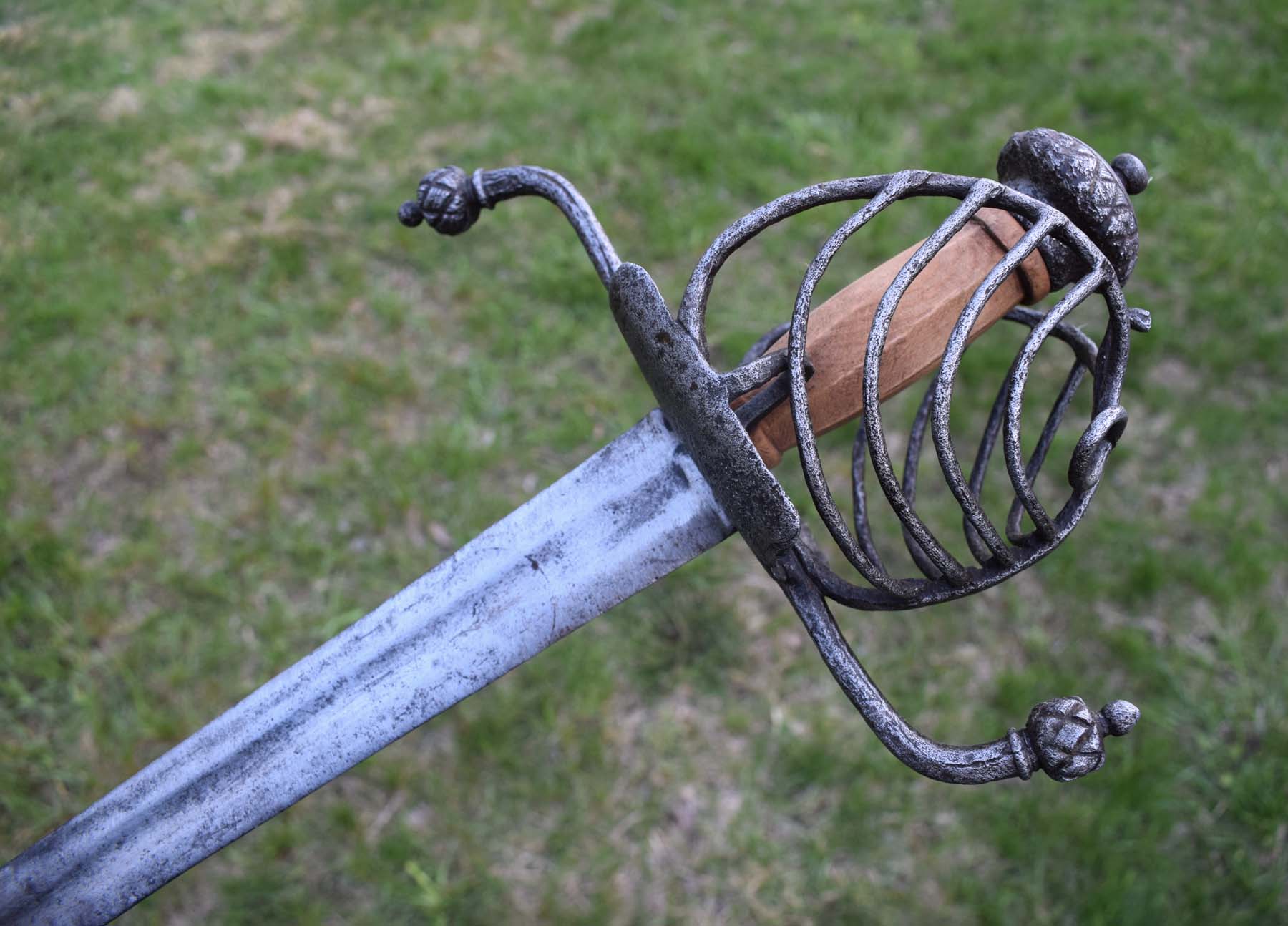
Late 16th Century Norwegian Tessak (sinclair) Basket Hilt Saber (sword)!. Here is a very nice circa 1580 – 1600 Norwegian Tessak saber, also called a Sinclair saber. A wonderful designed early sword in as found condition. Nice patina with very fine speckled pitting overall and good use wear.. Wonderful forged iron full basket hilt hilt with optic properties! No breaks or repairs! The beautifully carved wood grip is excellent. (note: these grips were always covered with a thin leather or fish skin covering. Not the twisted wire and Turks head ferrules you will see on the re-wraps). Its wide, single fuller blade is 31.5” long and retains traces of a crescent moon and written script engravings. NOTE: This is a full, symmetrical basket, not a half basket or 3/4 basket. It is a very scarce and desirable example! A very nice specimen for the advanced collector at a very reasonable price! Price is firm. Thanks for looking! Make sure to see our other listings for more great early blades and early antiques!
  • Nation : British
  • Local Price : £2100
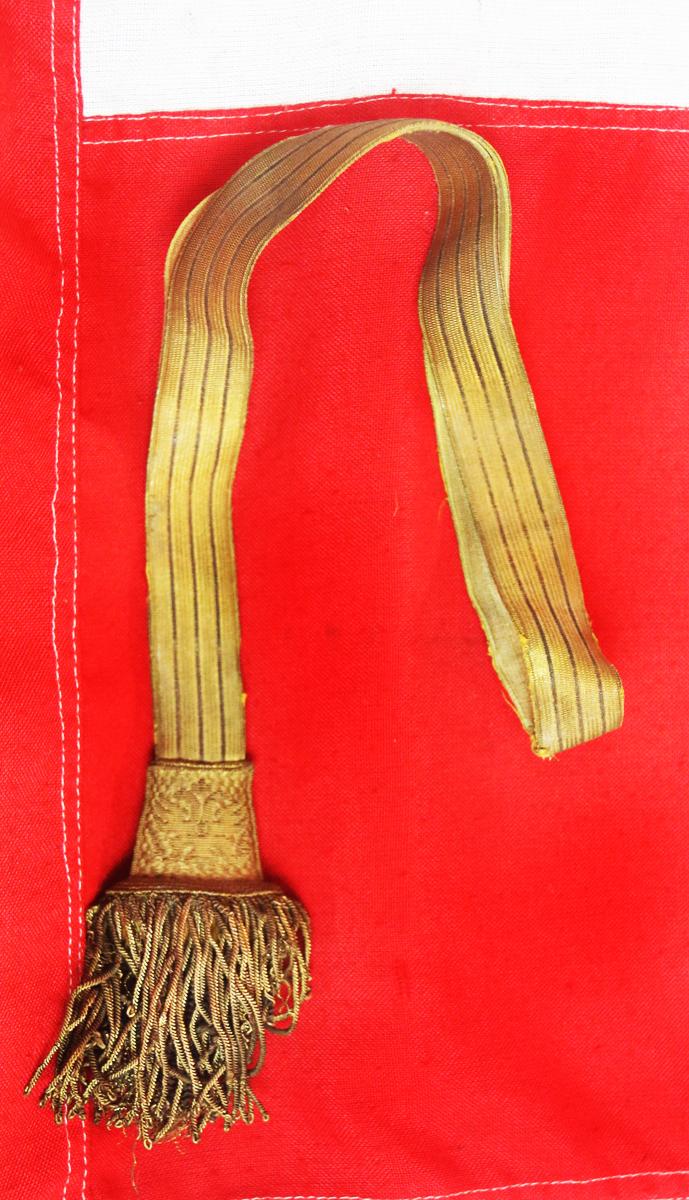
Click and use the code >25335 to search for this item on the dealer website Incredibly Rare Crimean War Romanov Senior Officer´s Sword Knot, Such As Worn By A Romanov Grand Duke of Russia, Or General. The Bullion Gold And Crimson Silk Knot Bears The Romanov Crest on One Side and a Cyrillic Royal Monogram on The Other
  • Nation : Japanese
  • Local Price : £2,075.00
**EXTREMELY RARE, ONE OF ONLY APPROX 6000**Original, Pre WW2 Japanese NCO’s 1st Pattern, Type 95 Katana With Solid Copper Hilt, Suya (Harp) & Tokyo Kokura Arsenal Marks & Scabbard. Sn 20649 -. On September 16th 1935 a new sword was authorised for Japanese army NCO’s. 1st type sword hilts were made from solid unpainted copper, later variants had cast alloy painted hilts (see page 183 of Swords Of Imperial Japan 1868-1945 by Dawson). Only approx 6,000 1st type copper hilt NCO swords were made before introduction of alloy hilt variants. This is an original extremely rare 1st type pre WW2 Japanese NCO’s Katana with copper hilt and scabbard. The sword has the correct solid copper unpainted cast handle with lanyard ring hole fitted with steel cord sarute loop, quality heavy brass tsuba and scabbard retaining clip which functions as it should. It has an undamaged, fullered, 27 ½” blade which has just light staining consistent with age. The blade is numbered ‘6321’ on one side above the fuller. The copper hilt is stamped with 1929-45 Kokura Arsenal mark, Suya sword shop (Harp) mark (see page 185 of Dawson’s book) and inspection mark. It is complete with its scabbard which has a single hanging ring. The scabbard has no damage. The throat of the scabbard is numbered ‘7199’. The price for this nicely marked rare piece includes UK delivery. Sn 20649
Page 8 of 40

The following items match your search but are currently listed on Ebay. We take no responsibility for any aspect of the listings or their accuracy.


Sorry, there is not any matching items.